

You’re getting ready to sell, maybe because a new job is pulling you out of state, and you want to know which problems will cost you. Knowing what devalues a house tells you where buyers will push back on price, what is worth fixing, and what to leave alone. Our guide to selling your house fast for cash in Arizona covers the full sale process. This article stays focused on value.
The things that devalue a house most are foundation or structural problems, water damage and mold, an aging roof or HVAC system, unpermitted additions, and a poor location, which you cannot change. Dated finishes lower offers. In Arizona, buyers also discount heavily for failing air conditioning, termite damage, and neglected pools.
A few points most value lists leave out:
- Buyers discount for uncertainty, not just cost. A problem nobody has priced often costs you more than the repair itself.
- Some defects shrink your buyer pool. If a lender won’t fund a loan until a repair is done, many financed buyers walk away.
- In the Phoenix metro, air conditioning is not a feature. Buyers treat a tired unit as a bill due this summer.
- Fixing the wrong things can lose money. System and safety repairs usually matter more than a new backsplash.
- Disclosure doesn’t go away. You still report known material defects on the Seller’s Property Disclosure Statement (SPDS), fixed or not.
What Devalues a House the Most?
Problems that are expensive, hard to see, and able to block a buyer’s loan devalue a house the most. Those three filters explain almost every price cut you will run into.
Cost is the obvious one. A roof costs more than paint. But cost alone doesn’t explain why a foundation crack can scare buyers more than a full kitchen remodel would. That is where uncertainty comes in.
A dated kitchen is visible and easy to price. A cracked slab is not. The buyer doesn’t know if it needs a patch or a structural engineer and piers. So they price in the worst case and add a margin on top. You end up paying for the fear, not just the fix.
Financing is the third filter. Most buyers use a mortgage. Their contract usually includes a financing contingency and an appraisal contingency. If the appraiser flags a safety issue or a roof near the end of its life, the lender may require repairs before closing. Some buyers can’t wait for that. Others use it to renegotiate. Either way, the problem now has a deadline attached to it.
Keep those three filters in mind as you read the list below. The items near the top hit all three. The items near the bottom mostly hit one.
10 Things That Lower Your Home’s Value in Arizona
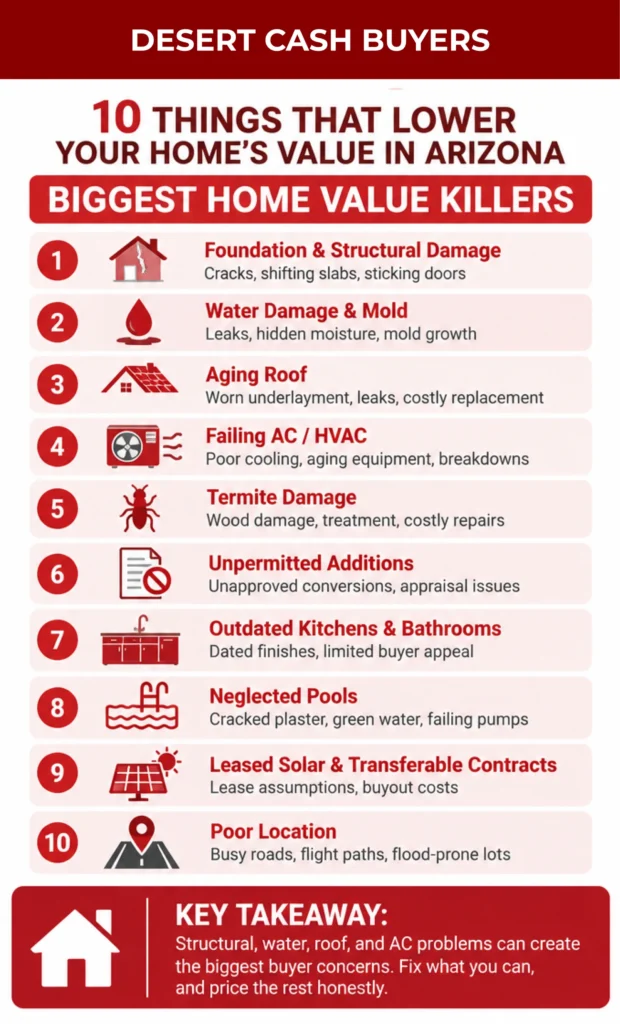
These ten issues lower Arizona home values the most, listed roughly from the biggest typical discount to the smallest. Your house may rank them differently, since condition, age, and neighborhood all shift the order.
What devalues a house most: structure, water, roof, AC, and termites
- Foundation and structural problems. Some soils in the Valley expand and shrink with moisture, and slabs can move. Warning signs include stair-step cracks in block walls, doors that stick, and gaps where walls meet ceilings. Buyers often ask for a structural engineer’s report. Until they have one, they assume the worst.
- Water damage and mold. Arizona is dry, but houses still leak. Monsoon storms find weak roofs. AC condensate lines clog. Water heaters fail in garages. Hidden moisture can turn into mold, and buyers discount hard for anything that looks like a health issue. If the water came from putting out a fire, selling a fire-damaged house for cash follows a different path.
- An aging roof. Tile is common here, and the tiles themselves can last a long time. The underlayment beneath them usually wears out first, and that is where leaks start. Older flat and foam roofs need regular recoating. Many buyers deduct at least a full replacement, and some lenders want repairs done before closing.
- Failing AC or HVAC (an Arizona deal-breaker). Phoenix summers routinely top 110°F. A unit that runs hard for months wears faster than one in a mild climate. Buyers price an older or struggling system as a near-term replacement. An AC that fails during escrow can stall a deal fast.
- Termite damage. Subterranean termites are common across the Phoenix metro. Many buyers and some loan programs ask for a Wood Destroying Insect Inspection Report on the Arizona Department of Agriculture form. Active termites plus visible damage mean treatment, repair, and often a second inspection.
Permit, finish, pool, and contract problems
- Unpermitted additions and conversions. Garage conversions, enclosed Arizona rooms, and added casitas are everywhere in older Valley homes. Appraisers may not count unpermitted square footage. Lenders may balk. Known unpermitted work also belongs on the SPDS.
- Outdated kitchens and bathrooms. Yes, they lower value, but usually less than sellers expect. Buyers see dated finishes as a preference they can change on their schedule. They see a bad foundation as a risk they can’t control. That difference is why a remodel rarely pays back in full.
- A neglected or outdated pool. A clean, working pool appeals to many Arizona buyers. A green pool, cracked plaster, or failing pump does the opposite. Buyers price in resurfacing and equipment. Pool barrier rules also vary by city, so fencing gaps can become a repair request.
- Leased solar and other contracts that transfer. A leased solar system is a contract, not just equipment. The buyer usually has to qualify for a solar lease assumption, or the seller buys it out. That paperwork is one of the most common delays in the Valley. Our post on selling a house with leased solar panels walks through the options. An HOA disclosure packet adds its own timing too.
Location factors you can’t change
- Location. A busy arterial road, a flight path, a commercial neighbor, or a flood-prone lot all lower value. No repair fixes them. You can only price them honestly and find the right buyer. Our page on selling a house in a bad location covers how that works.
Which Problems Hurt Value Most? Cost-to-Fix vs. Value-Lost Table
Structural, water, and system problems hurt value most because buyers usually discount them by more than the repair costs, while dated finishes often cost you less than a remodel would. The table below compares the ten value killers side by side.
| Value killer | Relative cost to fix | Typical time to fix | Effect on offers | Realistic before a move? |
| Foundation or structure | High | Weeks, plus engineering | Large; buyers add a risk margin | Rarely |
| Water damage and mold | Moderate to high | Days to weeks | Large if hidden or widespread | Sometimes |
| Aging roof | High | Days to weeks | Often a full replacement deduction | Sometimes |
| Failing AC or HVAC | Moderate to high | Days | Large in summer; can stall escrow | Usually |
| Termite damage | Low to moderate | Days to weeks | Moderate; may need reinspection | Usually |
| Unpermitted additions | Moderate to high | Weeks to months | Square footage may not count | Rarely |
| Dated kitchen or bath | High | Weeks to months | Smaller than the remodel cost | Rarely worth it |
| Neglected pool | Moderate | Days to weeks | Moderate; resurfacing priced in | Sometimes |
| Leased solar | Varies by contract | Weeks | Adds delay more than discount | Start early |
| Location | Cannot be fixed | Not applicable | Permanent; priced at sale | Not applicable |
Treat these as relative tiers, not price quotes. Costs move with materials, labor, and the size of the home, so get two or three local bids before deciding. If you want to see how buyers turn a repair list into a number, read how repairs factor into a cash offer.
Not planning to fix any of this before you move? That is a common answer, and a fair one. You can see how our process works before you decide anything.
What Should You Not Fix When Selling a House?
Don’t fix cosmetic items buyers plan to change anyway, and don’t start big projects you can’t finish, permit, and document before you list. Those two rules save most sellers the most money.
Skip these in most cases:
- Full kitchen or bath remodels. Buyers have their own taste, and the return is usually partial.
- New flooring throughout the house. A deep clean and a few repaired spots often do the job.
- Landscape overhauls. Clear the yard, trim it back, and stop there.
- Half-finished projects. An open wall or a half-tiled shower raises more questions than the original problem.
Do fix the inexpensive items that clear a buyer’s lender or calm an inspector. Think leaking faucets, missing smoke detectors, a tripped GFCI outlet, or an AC service visit with a receipt. Small fixes with paperwork reduce uncertainty, and uncertainty is what costs you.
If the list is long, selling a house as-is in Arizona may be simpler than chasing repairs. As-is doesn’t mean undisclosed, though. Arizona sellers still report known material facts. The Arizona REALTORS® guidance on why every buyer is entitled to an SPDS, hosted by the Arizona Department of Real Estate, explains why that form matters even in an as-is sale.
Is It Worth Renovating Before You Sell and Move?
Usually no for major renovations, and usually yes for small, documented repairs, especially if you are leaving Arizona and can’t manage contractors from a distance.
Renovations take longer than planned. They also add holding costs every month the house sits: mortgage, property taxes, insurance, utilities, and HOA dues. If you’ve already moved, you’re paying those costs on a house you don’t live in, plus your new housing.
Distance makes it harder. You can’t check a roofer’s work from another state. You can’t let in the AC tech on short notice. Every small delay pushes your listing date back, and summer listings in the Phoenix metro already face heat that thins out showings.
A simple test helps. Will the repair raise the price by more than it costs, including the months it adds? Will it remove a problem that would block a buyer’s loan? If both answers are no, skip it. Our article on whether to repair or sell lays out the same decision for a damaged home.
When Fixing First Beats Selling As-Is
If your house needs only small, known repairs, you have time, and you can be there to manage the work, fix it, and list it. A cash sale is the right tool for speed and certainty, not for topping the market.
We say that plainly because it’s true. A well-kept home with a working AC, a sound roof, and no open permits can attract strong financed buyers. Those buyers can pay retail. After commissions and closing costs, a seller in that position may net more than any cash offer.
Listing also makes sense when you have no deadline. If you can wait out a slow month, handle showings, and absorb a repair request or two, the traditional route often rewards that patience.
A cash sale starts to win when the repair list gets long, when a problem could block financing, or when you need a fixed closing date that fits a move. That is a narrower lane than most cash buyers admit. It’s also the honest one.
How Buyers Price a House With Problems

A cash offer typically reaches 70 to 85 percent of after-repair value in strong markets, but the net gap versus listing is smaller than it looks once you subtract 5 to 6 percent in commissions, repair credits, and months of carrying costs. After-repair value (ARV) is what the house would likely sell for once fixed, based on comparable sales nearby.
The table below is an illustrative example with round numbers. It is not an offer, and it is not a prediction for your house. It assumes a home with an aging AC and a roof needing work.
| Line item (example scenario) | List after repairs | Sell as-is for cash |
| Sale price | $400,000 | $315,000 |
| Repairs before listing (AC and roof) | – $25,000 | $0 |
| Commissions (about 5.5%) | – $22,000 | $0 |
| Buyer repair credits after inspection | – $5,000 | $0 |
| Seller closing costs | – $4,000 | $0 |
| Holding costs (4 months vs. about 2 weeks) | – $10,000 | – $1,250 |
| Estimated net before mortgage payoff | $334,000 | $313,750 |
In this example, listing still nets more. The gap is about $20,000, not the $85,000 the sticker prices suggest. Whether that gap is worth months of repairs, showings, and a loan that could fall through is your call. Some sellers will gladly take the extra money. Others need the certain date.
Two more items can affect your net either way. Arizona has no state real estate transfer tax, so that line stays at zero in both columns. Capital gains tax may apply depending on your situation, and many primary residences qualify for the federal exclusion. A tax professional can confirm your case.
Selling As-Is When You’re Relocating
Yes, you can sell an Arizona house as-is before you relocate, and it often makes sense when the repair list is long and you’ll be living out of state. You skip the contractor schedule, the listing prep, and the months of paying for two homes.
Here is what changes with our as-is sale. No open houses, no strangers touring your home week after week, and no waiting for a buyer’s showing schedule. We evaluate your property by phone or with a single private visit, and you’re never asked to stage it or clear out for a stranger.
Selling to us runs in three steps: tell us about the property by phone or a short form, get a cash offer in about 15 minutes with the math explained, and pick a closing date that works for you. We show you the comparable sales and the repair estimate behind the number. Ask any buyer for the same thing. If they won’t share it, that tells you something.
- Most closings take 7 to 14 days from an accepted offer. Our fastest on record took 3 days.
- Every closing runs through a licensed, independent Arizona title company, with funds held in escrow until closing.
- You pay zero commissions, zero closing costs, and zero fees.
Our full guide to selling your house as-is before you relocate covers remote signing and timing. We’ve bought 1,000+ Arizona homes since 2015 and hold a 4.9/5 rating from 1,245 verified sellers, all checkable through Google reviews. You can read more seller stories before you call.

Frequently Asked Questions About What Lowers Home Value in Arizona
Do unpermitted additions devalue a house?
Often, yes. Appraisers and lenders may not count unpermitted square footage, and the work can surface during inspection, which leads to price cuts or a canceled deal. Arizona sellers should disclose known unpermitted work on the SPDS. The Arizona REALTORS® overview of the purchase contract’s disclosure section explains when the form is due.
Does a pool add or lower home value in Arizona?
A well-kept pool is a selling point for many Arizona buyers, but it rarely returns its full cost. A green, cracked, or outdated pool usually lowers offers because buyers price in resurfacing, new equipment, and any barrier fixes the city requires.
Does a messy house lower its appraised value?
Not directly. Appraisers value the structure and condition, not the clutter. But mess lowers what buyers will offer, and it can hide problems that buyers then assume are worse. Cleaning and decluttering are usually the cheapest improvements before listing.
How much does a bad roof lower home value?
It depends on the roof type and how much life is left. Buyers typically deduct at least the replacement cost, plus a margin for the risk and the scheduling. Lenders may also require roof repairs before closing on a financed sale.
Do leased solar panels hurt home value?
They rarely lower the price much, but they often slow the sale. The buyer usually has to qualify to take over the lease, or the seller pays it off at closing. Starting that paperwork early keeps it from delaying your closing date.
Will Desert Cash Buyers buy a house with these problems?
Yes. Desert Cash Buyers buys Phoenix-metro homes as-is, including houses with foundation issues, old roofs, failing AC, termites, or unpermitted work. Each offer shows the comparable sales and repair estimate behind it. You can find more answers in our FAQ.
What Devalues a House Most, and What to Do Next
What devalues a house most comes down to cost, uncertainty, and anything that blocks a buyer’s loan. Foundation problems, water damage, an aging roof, and a failing AC lead the list in Arizona. Dated finishes matter less than most sellers think. If your home needs only small fixes and you have time, listing may net you more, and we’ll tell you that.
If the repair list is long or you’re moving soon, an as-is sale gives you a fixed date and a number you can check. Get your free cash offer and receive a cash offer in about 15 minutes, with no obligation and no fees.