

Understanding how a cash offer is calculated helps Arizona homeowners evaluate whether an offer is fair before deciding to sell. If you’re comparing your options to sell your house fast for cash in Arizona, knowing the math behind the offer can help you make a more confident decision. We build every cash offer by starting with a home’s After Repair Value (ARV), then subtracting estimated repair costs, holding expenses, resale costs, and other factors that affect the property’s final value. Once you understand the math behind the offer, the number becomes easier to evaluate and compare against a traditional sale.
A cash offer on a house is calculated by starting with the home’s After Repair Value, then subtracting estimated repair costs, holding and selling expenses, and the buyer’s margin. In Arizona’s stronger markets, that math typically lands cash offers around 80 to 85 percent of ARV, and the exact number shifts based on your home’s condition, location, and how fast you need to close.
- The formula has four parts: ARV, repair costs, holding and selling costs, and the buyer’s margin.
- In strong Arizona markets, cash offers often land near 80 to 85 percent of ARV.
- The classic investor “70% rule” is a rough shortcut, not the precise math a transparent buyer uses.
- Condition, location, and your timeline all move the number up or down.
- A lower-looking cash offer can still net you more once commissions, repairs, and holding costs come out of a traditional sale.
How Is a Cash Offer Calculated? The Short Formula
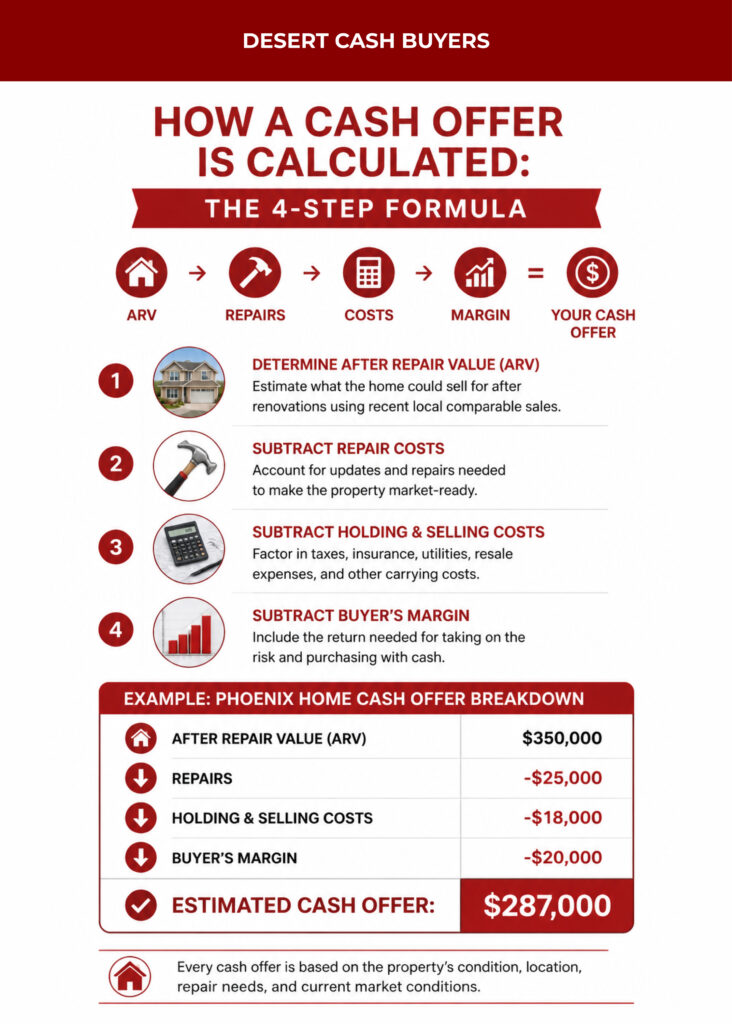
A cash offer is calculated with one core formula: After Repair Value, minus repair costs, minus holding and selling costs, minus the buyer’s margin, equals your offer. It’s the same math we use to evaluate every property, and we’ve now used it on more than 1,000 Arizona homes.
| ARV − Repair Costs − Holding/Selling Costs − Margin = Cash Offer |
Each piece stands for something real. ARV is what your house would sell for on the open market once it’s fully renovated and move-in ready, not what it’s worth today in its current condition. Repair costs cover what it actually takes to get the home there, from a new roof to updated flooring. Holding and selling costs are the carrying costs, insurance, property taxes, and resale expenses a buyer absorbs while they own the property before reselling it. Margin is the return a buyer needs for taking on that risk and paying in cash today instead of waiting months for a financed buyer to close.
We evaluate how we buy houses in Arizona the same way, whether the home sits in Phoenix, Scottsdale, or Mesa, so the formula stays consistent even when the property and the neighborhood around it don’t.
What Is After Repair Value (ARV)?
After Repair Value is the price your home would fetch on the open market once it’s fully repaired and staged to sell, not the price it would fetch today in its current condition. Appraisers and cash buyers pull recent comparable sales nearby, so your ARV depends heavily on what similar, updated homes in your specific neighborhood have actually closed for in the last few months, not on a citywide average that glosses over block-by-block differences.
| Based on our experience evaluating Arizona properties, cash offers can often fall within the 80% to 85% of ARV range in stronger market conditions. The exact percentage depends on the home’s condition, location, repair needs, and current market factors. |
That range isn’t arbitrary. It reflects the repair costs, holding costs, and margin a buyer needs to subtract, and it tends to land higher when a home needs less work and lower when it needs more. A home in solid condition on a desirable Scottsdale street will usually land closer to 85 percent. A home with a failing roof, outdated systems, or serious code violations will land closer to 80 percent, or below, once real repair costs come out of the math.
Arizona home values have moved considerably over the past several years, and buyers rely on updated comparable sales rather than outdated averages. The FHFA House Price Index tracks these state-level trends over time, which is part of why your ARV today can look different than it would have two or three years ago, and why a comp from an older report can undersell or oversell your home.
Neighborhood-level comps matter more than city averages because Arizona markets move at different speeds block by block. A Phoenix zip code near new construction can appreciate faster than a Mesa neighborhood with older housing stock, and a Scottsdale street with recent renovations sets a different ceiling than one that hasn’t turned over in years. That’s why we pull comps from the streets immediately around your home instead of leaning on a metro-wide median.
The Cash Offer Formula, Step by Step
The cash offer formula works in four steps: pull the ARV from recent local sales, subtract projected repair costs, subtract holding and selling costs, then subtract the buyer’s margin to reach the final number. Here’s how each step actually plays out on a real property.
We walk through each step with you rather than handing over a single number, because a line-item approach holds up to scrutiny in a way a flat percentage never does. If a repair estimate seems high, you can ask what it covers. If the ARV seems low, you can ask which comps we used. That level of detail is the difference between a number you have to trust blindly and one you can actually check.
- Start with ARV. We pull recent, comparable sales from your specific neighborhood, not citywide averages, since a fully renovated home two streets over tells us more than a broad zip code trend.
- Subtract repair costs. We review the property, either in person or through photos and your description, to estimate what it actually costs to bring the home to market-ready condition.
- Subtract holding and selling costs. This covers property taxes, insurance, utilities, and standard resale expenses for the months we’ll likely carry the home before reselling it.
- Subtract margin. This is our return for taking on the risk and paying cash upfront instead of waiting on a financed buyer, an appraisal, and an inspection period.
A Sample ARV Offer Breakdown for a Phoenix Home
Here’s an illustrative example using a Phoenix home. These figures are for illustration only. Every offer depends on the specific property, and we don’t guarantee any offer amount before we’ve actually evaluated your house.
| Line Item | Illustrative Amount |
| After Repair Value (ARV) | $350,000 |
| Estimated repair costs | −$25,000 |
| Holding and selling costs | −$18,000 |
| Buyer’s margin | −$20,000 |
| Illustrative cash offer | $287,000 |
In this example, the offer works out to roughly 82 percent of ARV, right in the range we typically see across stronger Arizona markets. A home needing more extensive repairs would show a larger subtraction on the repair line, which naturally moves the final offer lower.
Repair and Holding Costs Cash Buyers Subtract
Repair costs typically include items like roofing, HVAC, flooring, paint, and any code violations that would stop a traditional buyer’s lender from approving a loan. Holding costs cover the months a buyer carries the property, including taxes, insurance, utilities, and standard resale costs like title fees. Because we cover our full home-buying process from offer to close, none of these costs land back on you as the seller.
The 70% Rule and How Investors Use It
The 70% rule is a rough shortcut some real estate investors use to set a maximum offer: take the ARV, multiply by 70 percent, then subtract estimated repair costs. It’s a fast, back-of-envelope way to avoid overpaying, and you’ll see it referenced often if you research Arizona cash home buying options before requesting an offer.
House flippers built the 70% rule decades ago as a simple guardrail, and it still gets used because it’s easy to calculate on the spot. The trouble is that it assumes a fixed, generic margin and holding period regardless of the property. A flat 30 percent haircut off ARV doesn’t account for a home that needs light cosmetic work versus one that needs a new roof and foundation repair.
In practice, a well-priced home in good condition with a short holding period doesn’t need that much cushion, which is part of why transparent, line-item offers in strong Arizona markets often land higher, closer to 80 to 85 percent of ARV, than the 70% rule alone would suggest. We’d rather show you the actual repair and holding numbers behind your offer than apply a blanket percentage and call it a day.
What Affects Your Offer the Most
Five factors move your cash offer the most: the home’s condition, its location, current market conditions, the repair costs a buyer projects, and how quickly you need to close.
- Condition. Fire damage, foundation cracks, roof damage, mold, termite damage, and outdated systems all lower ARV-based repair estimates, but we buy fire-damaged houses for cash and every other condition without asking you to fix anything first.
- Location. A home in a fast-moving Scottsdale or Chandler neighborhood typically supports a higher ARV than a comparable home in a slower submarket.
- Market conditions. Rising or falling comparable sales shift ARV up or down before any other line item is even calculated.
- Repair costs. The more work a home needs, the more that comes off the top, which is also part of why tenant-occupied, code-violation, and hoarder-condition homes often see a wider offer range depending on the specific property.
- Timeline. A seller who needs to sell a house fast in Mesa or anywhere else in the Valley on a tight timeline is still working from the same formula. Speed doesn’t change the math, but the certainty of a private-funds cash purchase carries real value when a deadline is looming.
None of these factors work in isolation. A home in a strong location with light repairs and a flexible timeline will land at the high end of the range. A home needing extensive work in a slower submarket, sold on a tight deadline, will land lower, and that’s the honest tradeoff behind every cash offer. If you’re wondering how to get the highest cash offer, focusing on factors such as property condition, accurate information about repairs, and understanding local market values can help you maximize your final number.
Liens, back taxes, and title issues are a sixth factor worth naming separately, because they don’t lower your offer so much as they change who handles the cleanup. We work directly with a licensed title company to resolve liens and title problems during closing, so a messy title doesn’t have to mean a lower number or a longer wait, just a bit more coordination behind the scenes on our end instead of yours.
Why a Lower-Looking Offer Can Still Net You the Same
A cash offer that looks lower than your home’s full market value can still net you close to the same amount, or more, once you subtract commissions, repairs, and holding costs from a traditional sale. The comparison only makes sense when you look at what actually lands in your pocket, not the headline sale price. If you’re weighing cash buyers vs iBuyers vs realtors, it’s important to compare not only the offer amount but also the fees, repair requirements, timeline, and certainty of closing that come with each option.
| Factor | Traditional Sale | Desert Cash Buyers |
| Time to close | Often 60 to 90+ days | 3 to 21 days (as fast as 3) |
| Repairs | Buyer or lender may require them | None, bought as-is in any condition |
| Agent commission | Typically 5 to 6% | $0 |
| Closing costs | Seller pays a share | Covered by Desert Cash Buyers |
| Certainty | Financing can fall through | Private funds, no financing contingency |
The Consumer Financial Protection Bureau confirms that sellers commonly cover a share of closing costs and commission-related fees in a traditional sale, on top of any lender-required repairs. Once those costs come out of a traditional sale price, and once you factor in two to three months of holding costs while a listed home sits on the market, the gap between a cash offer and a traditional net often shrinks or disappears.
If you’d rather sell your Phoenix home without a realtor and skip the commission entirely, this is the exact comparison worth running with your own numbers before you decide.

Frequently Asked Questions About How Cash Offers Are Calculated in Arizona
Do cash buyers pay market value?
No, cash buyers pay a percentage of your home’s After Repair Value, not full retail market value, because they’re taking on the cost and risk of repairs, holding, and resale themselves. In strong Arizona markets, that typically works out to around 80 to 85 percent of ARV. We’re upfront that the offer sits below full retail, and we frame the real comparison around what you net after commissions, repairs, and closing costs are removed from a traditional sale rather than around the sticker price alone.
How do buyers estimate repair costs?
Buyers estimate repair costs by reviewing the property’s condition, either in person or through photos and a detailed description, and pricing out items like roofing, HVAC, flooring, and code violations. We use current Arizona contractor pricing rather than a generic national estimate, since labor and material costs vary by market. You can also browse more Arizona home-selling guides on our blog for a deeper look at how condition affects value.
Can I see how my offer was calculated?
Yes, we’ll walk you through every line item in your offer, including the ARV comps we used, the repair estimate, and the holding costs we subtracted. Transparency about the ARV math is something we build into every offer conversation, not something we hold back until you ask. If a number doesn’t make sense to you, ask us to explain it before you sign anything.
Is the first offer the final offer?
Yes, the offer we make is the offer you get, since there’s no lender-ordered appraisal, no inspection contingency, and no financing approval that could change the number later. The only thing that could change an offer is if the property’s actual condition turns out to be materially different from what we evaluated going in.
Final Thoughts on How Your Arizona Cash Offer is Calculated
Now that you understand how a cash offer is calculated, the next step is seeing what your own Arizona home is worth. Every property is different, so we calculate each offer based on its condition, location, repair needs, and current market data. That’s also why no online formula can replace a personalized evaluation.
If you’re ready to learn if selling for cash is a good idea, get a free, no-obligation cash offer from Desert Cash Buyers. We’ll walk you through every part of the calculation, answer your questions, and give you a transparent offer you can compare with any agent, iBuyer, or investor before making a decision.