
If you’re trying to sell a house with leased solar panels in Arizona, the panels usually aren’t the problem. The lease attached to them is. Arizona has one of the highest residential solar rates in the country. A large share of those systems are leased, not owned. That fact changes how your sale plays out.
Yes, you can sell a house with leased solar panels in Arizona. A financed buyer’s lender will want the lease resolved first. Someone has to assume it, transfer it, or buy it out. Sell to a cash buyer instead, and that step disappears. There’s no lender underwriting the deal. See our guide to selling your house fast for cash in Arizona for the full picture of how a cash sale works.
A few things surprise most sellers here:
- Leased solar rarely kills a sale. It slows down a financed one.
- Appraisers treat a solar lease as a monthly bill, not an upgrade that adds value.
- Transferring a lease to a new owner usually triggers a credit check on your buyer.
- A buyout can cost more than letting the term ride, depending on years left.
- A cash sale removes the lender, so the lease stops being your deadline.
We walk through each option below. You’ll also get the real paperwork, honest timelines, and the one case where listing still beats a fast cash sale.
Owned vs. Leased Solar: Why the Difference Matters When You Sell
Owned solar adds value to your home at sale. Leased solar adds a contract your buyer has to take on.
When a system is owned outright, or financed through a paid-off loan, the panels are titled to the property. They act like any other fixture. A comps-savvy buyer may pay more for lower future utility bills. An appraiser can sometimes credit that value.
Leased and power purchase agreement (PPA) systems work differently. You never own the equipment. You’re transferring a service agreement, not a fixture. The lease holder, whether that’s Sunrun, Sunnova, Tesla Energy, or Vivint Solar, still owns the panels on your roof. They expect monthly payments to continue, from you or from whoever buys the house.
That’s the reason a leased system shows up as a liability on a financed deal. On a cash deal, it barely registers. A cash buyer isn’t asking a lender to approve someone else’s debt-to-income ratio. A cash buyer is simply deciding whether to take on the lease, the same way they’d weigh any other transferable obligation on the property. You can see how we buy houses in Phoenix to get a sense of how that evaluation works in practice.
How a Solar Lease Can Complicate a Traditional (Financed) Sale
A solar lease complicates a financed sale because the lender underwrites your buyer, not just the house. An unresolved lease payment changes that buyer’s numbers.
Every mortgage lender checks a buyer’s monthly debt against their income before approving a loan. A solar lease payment, often $100 to $250 a month, gets added to that math the moment a buyer agrees to assume it. For a buyer who’s already close to their limit, that payment can be the difference between an approved loan and a denied one.
Why Mortgage Lenders Flag Leased Solar Systems
Lenders flag a leased solar system because it acts like a second recurring debt. It raises the buyer’s debt-to-income ratio the same way a car payment would. The Consumer Financial Protection Bureau defines debt-to-income ratio as monthly debt payments divided by gross monthly income. It’s one way lenders measure a borrower’s ability to handle new payments. Add a solar lease to a buyer who’s already stretched, and a loan that looked fine on paper can stall in underwriting.
Some loan programs go further. They require the seller to fully resolve the lease, buyout included, before they’ll fund at all. That single requirement has pushed more than one Phoenix metro closing past its original date.
Appraisal and UCC Filing Complications
Solar lease providers commonly file a UCC-1 financing statement against the panels. This protects their ownership interest, much like a lien on financed equipment. The Uniform Commercial Code sets the standard for recording these liens. Arizona’s Secretary of State processes UCC filings to protect financial interests in equipment, including leased solar systems. An appraiser and a title company both need that filing addressed before closing. If nobody catches it early, it surfaces during the title search, right when a financed deal has the least room to move.
Your 3 Options for Handling Solar Panels at Closing
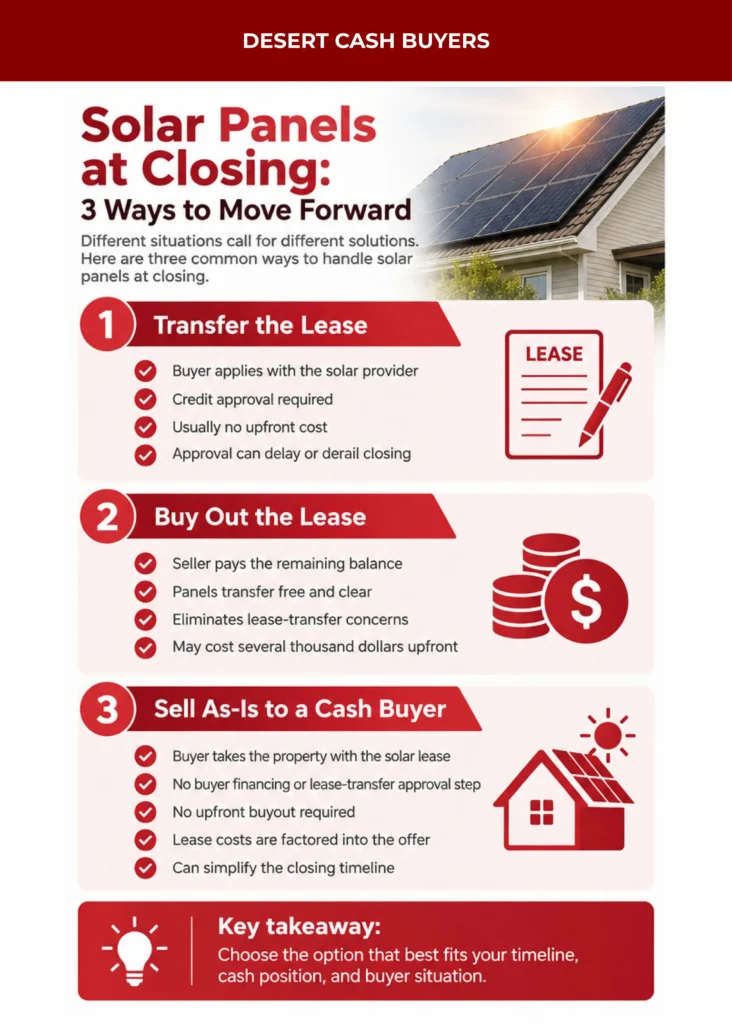
You have three ways to handle leased solar panels at closing: transfer the lease to your buyer, buy out the balance yourself, or sell as-is to a cash buyer who takes on the process.
Option 1: Transfer or Have the Buyer Assume the Lease
Most solar lease agreements are written to be transferable. Your buyer applies with the solar company. The provider runs a credit check and approves or denies the assumption, much like a loan application. If approved, the lease continues under the new owner’s name. Payments follow the house.
This option works well when your buyer is motivated and has solid credit. But it adds a dependency you don’t control. If the solar company denies the transfer, or drags out approval, your closing date moves with it.
Option 2: Buy Out the Remaining Lease Balance Before Closing
You can pay off what’s left and deliver the house with the panels owned free and clear. Buyout quotes come directly from the solar provider. They’re based on the remaining term and the system’s depreciated value under the lease agreement.
This removes the transfer risk entirely. There’s no longer a lease for a buyer’s lender to worry about. The tradeoff is the upfront cost. A buyout on a system with many years left can run several thousand dollars, money you’re spending to close a sale that hasn’t happened yet.
Option 3: Sell As-Is to a Cash Buyer and Skip the Process
A cash buyer purchases the house with the solar lease still attached. The ongoing payment gets factored into the offer instead of something you have to resolve first. Since there’s no lender underwriting a second borrower, the debt-to-income concern that stalls financed deals isn’t part of the transaction.
This is the option most sellers reach for when they’re short on time. It also suits sellers who don’t want to front a buyout payment, or who’d rather not gamble on a lease-transfer approval holding up their closing date. Read more about who we are and how we evaluate a property before making an offer.
| Option | Who Handles It | Typical Cost to You | Effect on Timeline |
| Transfer/Assume Lease | Buyer applies, solar company approves | Usually none, beyond application time | Adds a credit-approval step; can delay or derail closing |
| Buyout Before Closing | You pay the solar company directly | Often several thousand dollars, based on remaining term | Requires funds and processing time before you can close |
| Sell As-Is to a Cash Buyer | Cash buyer assumes or negotiates the lease | None; the lease is priced into the offer | No lender step; closing runs on your schedule, not the lease company’s |
What Paperwork You’ll Need to Sell a House with Leased Solar Panels
You’ll need your solar lease agreement, a current payoff or buyout letter, and confirmation that any UCC-1 filing will be released or properly assigned at closing. For the broader checklist, see what documents you’ll need to sell for cash.
Start by pulling the original lease agreement. It states the monthly payment, the remaining term, the transfer process, and any buyout formula. If you can’t find your copy, check your solar provider’s customer portal. It’s usually filed there.
Next, request a payoff letter, sometimes called a buyout quote. Do this even if you plan to transfer rather than buy out. It gives you and any buyer a real number to plan around, instead of a guess.
Finally, confirm the UCC-1 release process with your title company. This is the same paperwork friction our Arizona flagship guide flags as the most common paperwork staller in the Valley. It’s worth resolving before you’re mid-escrow. Arizona sellers also complete a Seller’s Property Disclosure Statement (SPDS) disclosing known material conditions, separate from the solar paperwork. Keep both moving at the same time. Don’t treat one as a substitute for the other. Our frequently asked questions page covers more of these paperwork basics if you want a broader checklist.
How Long a Solar Lease Transfer or Buyout Typically Takes
A solar lease transfer generally takes longer than a buyout. A transfer depends on a third party approving your buyer. A buyout only depends on you paying an agreed amount.
Exact timing varies by provider and by how fast documents move. Treat the ranges below as general planning windows, not a guarantee for your specific lease.
| Step | Transfer/Assumption | Buyout |
| Request payoff or transfer paperwork | A few days | A few days |
| Buyer credit approval (transfer only) | 1 to 3 weeks, depending on the provider | Not applicable |
| Funds paid, UCC-1 released | N/A until approved | Typically within days of payment |
| Overall added time to closing | Can add several weeks if approval stalls | Adds the time needed to secure buyout funds |
A cash sale to a local buyer avoids both columns. There’s no third-party approval to wait on. There’s no buyout to fund before you can close. Real Arizona sellers describe that difference in their own words on our reviews page.
When Listing With an Agent Might Still Make Sense
Listing with an agent can still net you more if your solar lease has a low remaining balance, your home shows well, and you’re not working against a deadline. You can also compare a cash sale to listing with an agent before deciding which route fits your timeline.
If your lease is close to paid off, or the buyout amount is small relative to your home’s value, a traditional listing opens the door to a wider buyer pool. Those buyers may pay closer to full market value. That gap can be worth more than the weeks a lease transfer might add to your closing timeline, especially in a seller-favoring market.
We show you the math either way. If a listing nets more after commissions, repair credits, and however long the transfer takes, that’s the honest answer. Even when it points away from a cash sale. The key number to compare is what you’ll actually net after fees and holding costs.
Why a Local Cash Sale Sidesteps the Solar Lease Problem Entirely
A cash sale sidesteps the solar lease problem because there’s no lender whose approval depends on your buyer’s debt-to-income ratio.
We’ve bought Arizona homes directly since 2015, including houses with leased solar systems still attached. We evaluate the property, factor the lease payment and remaining term into the offer, and show you the comps and repair math behind that number. It’s the same process we use for any other property condition. There’s no separate approval process for the panels, because there’s no second borrower to underwrite.
Most of our closings take 7 to 14 days from the accepted offer. Our fastest on record was 3 days. Cash offers typically come back within about 15 minutes of first contact. Zero commissions, zero closing costs, zero fees of any kind to you. None of that changes because your roof has leased panels on it. We handle the same kind of paperwork friction on sales in difficult Arizona locations and on fire-damaged homes, so a leased solar system is a familiar wrinkle, not an unusual one.
Selling a House with Leased Solar Panels in Arizona Comes Down to Timing
Selling a house with leased solar panels in Arizona comes down to two things: how much time you have, and how much lease balance is left. A short timeline or a sizable balance points toward a cash sale. A near-paid-off lease and no deadline points toward listing.
If you want a straight answer for your specific situation, tell us about the property and the lease. We’ll walk the math with you. Get your no-obligation cash offer in about 15 minutes, with zero fees either way.
Frequently Asked Questions About Selling a House with Leased Solar Panels in Arizona
Can I sell my house if I have leased solar panels in Arizona?
Yes. You can transfer the lease to your buyer, buy out the remaining balance before closing, or sell to a cash buyer who takes on the lease as part of the deal.
Does a solar lease transfer to the new buyer automatically?
No. Your buyer has to apply with the solar provider. The provider runs a credit check and approves or denies the assumption. It doesn’t happen automatically at closing.
What happens if I don’t resolve the solar lease before selling?
A financed sale generally can’t close with an unresolved lease. The lender needs it addressed before funding. A cash sale can proceed with the lease still attached, priced into the offer.
Is it better to buy out my solar lease before selling?
It depends on the remaining balance and your timeline. A small remaining balance often makes a buyout worthwhile. A large one may cost more upfront than it saves in speed, especially against a fast cash sale.
Do Desert Cash Buyers buy houses with leased solar panels?
Yes. We evaluate the property with the lease factored into the offer. You don’t need to transfer or buy it out first. We show the comps and repair math behind every offer, the same as we would for any other Arizona property we buy. Read more on our cash home buyers in Phoenix blog post, or contact us directly with questions about your specific lease.
Sell a House with Leased Solar Panels in Arizona: What to Do Next
Selling a house with leased solar panels doesn’t have to derail your plans. You generally have three paths: transfer the lease to the buyer, buy out the remaining balance, or sell the property as-is to a cash buyer who can account for the lease as part of the transaction.
The right path depends on your lease balance, your timeline, and whether you’re willing to wait for a buyer’s financing and solar-company approval. Before you make a decision, get your lease documents, request a current buyout or payoff quote, and understand what your title company needs for any UCC-1 filing.
If speed and simplicity matter most, a cash sale can remove the lender-related delays that often make leased solar more complicated in a traditional sale. Get your no-obligation cash offer and see what your Arizona house could sell for without paying for a lease buyout upfront.