
If you’re trying to sell a house as-is in Arizona, you already know the property needs work you don’t have the time, cash, or energy to finish. Maybe it’s a rental in Mesa with a cracked slab, a Scottsdale home with an outdated kitchen, or a Phoenix property you inherited with a leaking roof. You want a buyer who takes the house the way it sits today, not one who expects repairs, cleaning, or staging first. Selling as-is can be a practical option for Arizona homeowners dealing with properties that need significant work. Before you list or accept an offer, though, it helps to understand what as-is actually means and what Arizona sellers still need to disclose.
Selling a house as-is in Arizona means offering the property in its current condition without agreeing to make repairs or updates before the sale. However, as-is does not eliminate your responsibility to disclose known material defects. A cash buyer may be willing to purchase the property without requiring the repairs or lender-related conditions that can come with a traditional financed sale, and some cash transactions can close quickly depending on the property, title, and seller’s timeline.
A few specifics worth knowing before you move forward, whether you’re in Phoenix, Scottsdale, Mesa, or anywhere else in the metro:
- As-is does not remove an Arizona seller’s duty to disclose known material defects.
- The Seller’s Property Disclosure Statement (SPDS) is commonly used to document known property conditions in Arizona residential transactions.
- Cash offers can take into account the home’s condition, location, comparable sales, estimated repairs, and other factors. For properties that need significant work, the buyer may also consider their potential value after repairs.
- Selling to a direct cash buyer can reduce or eliminate financing-related delays and may involve fewer repair negotiations than a traditional financed sale.
What does selling a house as-is in Arizona mean?
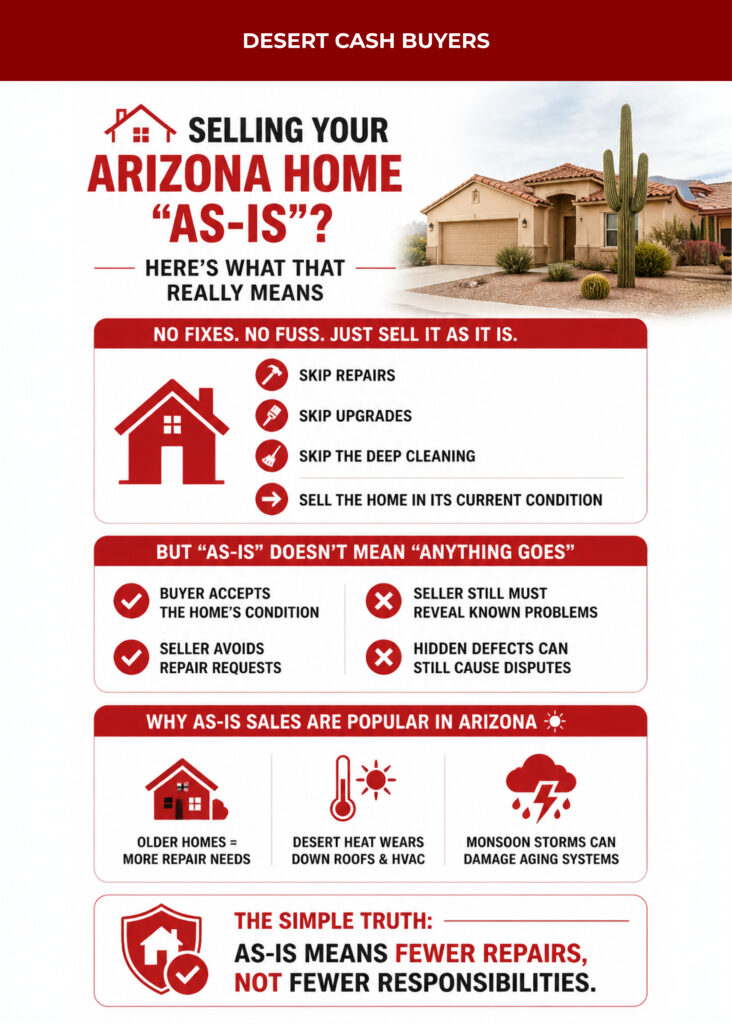
Selling a house as-is in Arizona means you’re listing or offering the property exactly as it stands today, with no repairs, no updates, and no cleaning completed before the sale. The buyer agrees to take the home in its current condition, defects and all, in exchange for a price that reflects that condition.
On the open market, “as-is” mainly means the seller is not agreeing to make repairs before the sale. A traditional buyer can still order an inspection, ask questions, request repairs or credits, or renegotiate based on the purchase agreement. With a direct cash buyer, the process may be simpler because there is no lender requiring financing conditions, and the buyer may agree to purchase the property in its current condition. The exact inspection and repair terms still depend on the buyer and the purchase agreement.
It’s worth clearing up a common myth here. Some sellers assume an as-is clause in a listing or contract means they’re legally exempt from telling a buyer anything about the property. That’s not accurate in Arizona. The clause addresses repairs and price negotiation, not honesty about known problems. Treating the two as the same thing is the mistake that leads to disputes after closing.
What as-is does not change is your legal duty to tell a buyer what you know about the property. That distinction trips up a lot of Arizona sellers, so it’s worth its own section.
As-is sales are especially common across the Phoenix metro for a reason tied to the local housing stock. Many neighborhoods in Phoenix, Scottsdale, and Mesa were built decades ago, and desert heat is hard on roofing, stucco, and HVAC systems that run nearly year-round. Add in summer monsoon storms that stress aging roofs and drainage, and it’s easy to end up with a home that needs more than a coat of paint before it would appeal to a traditional buyer. Selling as-is lets you skip that repair list entirely.
What You Still Have to Disclose (Even As-Is)
Even in an as-is sale, Arizona sellers still have a duty to disclose known material facts and known material defects. “As-is” describes the condition in which the buyer agrees to purchase the property; it does not give a seller permission to hide known problems. The Seller’s Property Disclosure Statement (SPDS) is commonly used to document property conditions and disclosures in Arizona residential transactions, as explained in the Arizona Department of Real Estate guidance on the SPDS.
What the Arizona SPDS covers
Most Arizona transactions use the Seller’s Property Disclosure Statement, or SPDS, to document known property conditions. If you’re preparing for a cash sale, it’s also helpful to review the documents needed to sell a house for cash so you know what information and paperwork may be required during the transaction. The SPDS typically covers:
- Structural components: foundation, roof, walls, and known settling or cracking
- Major systems: plumbing, electrical, HVAC, and water heater condition
- Environmental issues: past water damage, mold, pests, or underground tanks
- Neighborhood factors: Homeowners Association (HOA) obligations, easements, and known disputes
A few Arizona-specific items also show up on disclosure forms that surprise out-of-state sellers. You may need to state whether the property sits near a military airport, since state law requires that disclosure in certain areas. Sellers are also asked about flood zone status, which matters because a standard homeowner’s policy doesn’t cover flood losses. HOA obligations come up often too, since a large share of Phoenix-area subdivisions are governed by an association with its own rules, dues, and pending assessments a buyer will want to know about. None of these questions require repairs. They only require honesty about what you know.
A cash buyer who purchases homes as-is may not require you to complete those repairs before closing, but the exact requirements depend on the buyer and purchase agreement. You still need to answer disclosure questions honestly about conditions you know about.
| This is general information, not legal or financial advice. Every situation is different, so talk with an Arizona attorney or a tax professional about yours. |
As-Is on the Open Market vs. Selling to a Cash Buyer
Selling as-is on the open market and selling as-is to a cash buyer both avoid requiring the seller to complete repairs before closing, but the risks and process can differ. A listed as-is home can still face financing issues if a lender will not approve the property, or a buyer may request repairs or credits after an inspection. A direct cash sale can remove lender financing requirements and may reduce financing-related delays, while inspection and repair terms still depend on the buyer and purchase agreement.
| Factor | Traditional (as-is listing) | Desert Cash Buyers |
| Repairs | Buyer may request repairs or credits after inspection | Buyer may agree to purchase in the property’s current condition |
| Financing | Buyer may need lender approval | No mortgage lender is required from the buyer |
| Inspection | Buyer may conduct an inspection depending on the contract | Inspection and evaluation terms depend on the buyer and purchase agreement |
| Agent compensation | Varies by agreement | No traditional buyer-agent commission in a direct sale |
| Closing costs | Vary by transaction | May be covered by the buyer depending on the agreement |
| Timeline | Varies based on buyer, financing, and transaction | Can be faster when there is no lender financing |
| Certainty | Financing or inspection issues can affect the sale | Fewer financing-related conditions can simplify the process |
How is an as-is cash offer calculated?
A cash offer can take several factors into account, including the home’s current condition, location, recent comparable sales, estimated repair costs, and the buyer’s expected costs after purchase. For properties that need significant work, the buyer may also consider the home’s potential value after repairs. If you want to understand the factors that can affect the number, see our guide on how a cash offer is calculated in Arizona. Because every home’s situation is different, the best way to know what your property may qualify for is to request a free, no-obligation offer.
What “Any Condition” Really Covers
“Any condition” means significant, visible problems, not just cosmetic wear. It includes homes with:
- Fire damage, including homes that need work to sell a fire-damaged house for cash
- Foundation cracks or settling issues
- Roof damage or a roof past its useful life
- Mold or past water damage
- Termite or other pest damage
- Outdated systems, finishes, or code violations
- Tenant-occupied properties or hoarder homes
These conditions show up often in Arizona for practical reasons. Termite activity and roof wear are common in a climate with intense summer heat. Older homes in established Phoenix and Scottsdale neighborhoods can carry code violations from additions or repairs done without permits years ago. Rental properties across the metro sometimes come with tenants still in place, which can complicate a traditional sale but doesn’t stop an as-is cash sale. These conditions do not automatically prevent an as-is sale. Depending on the buyer and the purchase agreement, you may be able to sell the property without completing the repairs or bringing every condition up to current standards before closing.
Mold is worth calling out separately. If a home has visible mold or a history of water intrusion, moisture control and safe cleanup matter for health reasons as well as disclosure reasons. The EPA’s guide to mold, moisture, and your home explains that controlling moisture, not masking mold, is the only real fix, which is one more reason a buyer who accepts the home as-is can save you both time and risk.
Pros and Cons of Selling As-Is
Pros of selling a house as-is in Arizona
- No repair costs or contractor scheduling before you sell
- No staging, cleaning out, or showings to manage
- A faster, more certain closing timeline
- Fewer rounds of buyer requests after inspection
For sellers dealing with an inherited home, a rental with difficult tenants, or a property they simply can’t afford to fix, these advantages often matter more than squeezing out the highest possible price.
Cons of selling a house as-is
There are real trade-offs, too. An as-is sale, especially to a direct buyer, typically brings a lower price than a fully renovated home sold at full retail. Buyers who need financing may be harder to find for homes in rough shape, which narrows your pool on the open market. Your disclosure duties remain no matter who buys the house. Weighing these trade-offs is easier once you see other ways to sell your house for cash in Arizona and decide which fits your timeline.
The right choice usually comes down to timeline and tolerance for uncertainty. If you have months to wait, can absorb a financed buyer’s inspection demands, and want to test the top of the market, listing as-is with an agent may bring a higher headline price. If you need certainty, a firm closing date, and zero repair conversations, a direct cash sale trades some of that ceiling for speed and predictability. Sellers who’ve been through both often tell us the same thing afterward: they didn’t miss a single showing or repair estimate, and they appreciated knowing the exact date they’d have funds in hand.
How an As-Is Cash Sale Works, Step-by-Step
- Tell us about the house. Share the address and situation through our quick online form or by phone. That’s all it takes to start; no cleaning or repairs required first.
- Get a fair cash offer. We evaluate the property on location, condition, and current Arizona market data, then present a no-obligation cash offer, often within 15 minutes.
- Close and get paid. Accept, pick a date, and get funds at closing. A licensed title company handles the paperwork and any liens.
Because there’s no lender involved, there’s no appraisal contingency and no financing timeline to wait on. The title company still handles the same protections you’d expect from any sale, including a title search and payoff of any existing liens, so the process stays legitimate and documented even though it moves faster than a traditional listing.
If your home needs work you don’t want to tackle, we buy in any condition and factor it into a fair, no-obligation offer. You can see how our cash offer process works before you ever share your address.

Frequently Asked Questions About Selling a House As-Is in Arizona
Do I have to disclose problems if I sell as-is?
Yes. Arizona law requires you to disclose known material defects regardless of an as-is agreement. Desert Cash Buyers still expects full disclosure even though as-is changes who pays for repairs, not what you must tell a buyer about the property’s condition. This applies whether you use the standard SPDS form or skip it, since the underlying duty to disclose known problems doesn’t go away either way.
Can I sell a house that won’t pass inspection?
Yes. A house does not necessarily have to pass a traditional lender’s inspection to be sold. A cash buyer may be willing to purchase a property with significant condition issues because there is no mortgage lender requiring the buyer to meet traditional financing conditions. The buyer may still evaluate the property and negotiate the terms of the purchase agreement based on its condition.
Will I get less for an as-is sale?
Often, an as-is offer can be lower than the price a fully renovated home might command on the open market because the buyer is taking on the property’s repairs, risks, and other costs. However, price is only one part of the comparison. An as-is cash sale may also reduce or eliminate repair expenses, some selling costs, financing-related delays, and the time required to prepare the property for a traditional listing. The actual difference depends on the home’s condition, location, market value, and the terms of the offer.
Do I need to clean or empty the house?
You may not need to clean, declutter, or remove unwanted belongings before an as-is sale. With Desert Cash Buyers, the company states that it buys homes as-is, but sellers should confirm what personal property, furniture, or debris will remain in the home before closing.
How is the offer calculated on an as-is home?
A cash offer can consider the home’s current condition, location, recent comparable sales, estimated repair costs, and other costs the buyer expects to take on after purchase. For properties that need significant work, the buyer may also consider the property’s potential value after repairs. The exact calculation depends on the property and the terms of the offer.
Can I sell a tenant-occupied house as-is?
Yes. Tenant-occupied properties are one of the situations Desert Cash Buyers handles well, since there’s no need to have the property vacant, staged, or shown to prospective buyers before you accept an offer.
Sell a House As-Is in Arizona Without the Hassle
Selling a house as-is in Arizona gives you the option to move forward without spending time or money on repairs, upgrades, cleaning, or preparing the property for a traditional listing. However, as-is does not mean you can skip your responsibility to disclose known material defects. Arizona sellers still need to be transparent about issues they know about, while the buyer accepts the property’s condition according to the terms of the purchase agreement.
If your Arizona home needs repairs you don’t have the time, budget, or desire to handle, you don’t necessarily have to fix it before selling. A direct cash buyer may let you sell the property in its current condition while avoiding the repair work and preparation required for a traditional listing.
Ready to see what your property could be worth as-is? Request a free, no-obligation cash offer from Desert Cash Buyers. You can explain your situation, review the offer, and choose a closing timeline that works for you without committing to move forward.