
The documents you need to sell a house for cash in Arizona are usually simpler than sellers expect. In most cash sales, you will need a government-issued photo ID, proof of ownership or the deed, a mortgage payoff statement if you have a loan, current property tax information, and the Seller’s Property Disclosure Statement (SPDS). A title company handles the title search, lien payoffs, closing paperwork, and recording, so you do not need to have every document perfectly organized before you request an offer. If you inherited the property, are going through a divorce, have a lien or tax debt, or rent the home to tenants, you may need a few additional documents. The good news is that these situations do not automatically prevent a cash sale. The title company can identify what is missing and work with you to clear the file before closing.
If you are preparing to sell your Arizona home for cash, gathering your ID, ownership records, payoff information, tax records, and disclosure documents early can help avoid unnecessary delays.
Key takeaways:
- Arizona sellers generally have a duty to disclose known material facts about the property. The Seller’s Property Disclosure Statement (SPDS) is the standard form used in Arizona residential transactions to document those disclosures, including when a property is being sold as-is.
- Missing the deed isn’t a dealbreaker. County recorder and assessor records can help reconstruct proof of ownership.
- Special situations like an inherited home, a divorce, or a lien may require additional documents beyond the core list.
- Desert Cash Buyers has purchased 1,000+ Arizona homes and covers standard closing costs, so document delays rarely fall on the seller.
- A title company, not the buyer, handles lien payoffs and recording once your paperwork is in.
What Documents Do You Need to Sell a House for Cash in Arizona?
Selling a house for cash in Arizona typically requires five core categories of paperwork: a valid government-issued photo ID, proof of ownership or the deed, mortgage payoff information if you still owe money, current property tax records, and a completed Seller’s Property Disclosure Statement (SPDS). Depending on the property, you may also need HOA records, lien information, probate documents, or other paperwork tied to the ownership or occupancy of the home. A cash sale may involve fewer documents than a financed purchase, but the title company can still request additional records or coordinate an inspection when needed.
- Government-issued photo ID (driver’s license, state ID, or passport)
- Deed or other proof of ownership
- Mortgage payoff statement, if you still have a loan
- Most recent property tax bill or county assessor statement
- Completed Seller’s Property Disclosure Statement (SPDS)
- HOA documents, if the property belongs to a homeowners association
Compare that to a traditional listing, where an agent typically also asks for a home inspection report, repair receipts, a pre-listing appraisal, and sometimes a home warranty history before the house even goes on the market. A direct cash buyer may not require all of those pre-listing documents because the offer can account for the home’s condition. That’s the real reason the paperwork list is often shorter for a cash sale: fewer parties are reviewing the file, and no lender is underwriting a buyer’s loan against the property.
Core Documents Most Sellers Need
Most Arizona cash sellers will need the core ownership, identity, payoff, and tax records, with the SPDS and situation-specific paperwork added depending on the transaction. Here’s what each one covers and why the title company asks for it. If you want the bigger picture first, other ways Arizona sellers get cash for their house lays out the full range of options before you decide which paperwork path fits you best.
Proof of ownership and government-issued ID
Your deed is the document that proves you legally own the property, and Arizona law is specific about what makes one valid. Every deed must be in writing, signed by the grantor, and acknowledged before a notary before it can be recorded, under Arizona law (A.R.S. § 33-401). If you’re not listed as the owner of record, for example after inheriting the house, the title company can usually trace ownership through the county recorder or the probate file without holding up your sale. Bring a current, unexpired photo ID that matches the name on the deed, since the title company will need it to confirm your identity at signing.
Mortgage payoff statement and lien documents
If you still owe money on the house, request a payoff statement from your lender that shows the exact balance, per diem interest, and the date it’s good through. The title company uses this figure to pay off your loan directly at closing, so you receive the net proceeds rather than handling that wire yourself. If there’s a second mortgage, a HOA lien, a mechanic’s lien, or a tax lien on the property, gather those payoff amounts too. None of these are dealbreakers for a cash sale. They’re simply subtracted from your proceeds and paid off through the closing, the same way a traditional sale would handle them.
Property tax records and county assessor information
Your most recent property tax bill or a printout from your county assessor’s office confirms the parcel number, the assessed value, and whether taxes are current. If you’re behind on property taxes, that’s still workable. The title company simply pays the delinquent amount from your proceeds at closing and confirms the exact figure with the county treasurer before you sign anything.
Affidavit of Property Value at Closing
Most Arizona real property transfers require an Affidavit of Property Value, also known as a sales affidavit, unless the transaction qualifies for an exemption. The form reports information about the transfer, including the sale price and property details. The title or escrow company typically prepares and coordinates the required closing documents, so sellers generally do not need to figure out the filing requirements on their own.
The Seller’s Property Disclosure Statement (SPDS)
The SPDS is a form where you disclose known material defects about the property, and Arizona sellers complete it even when selling as-is for cash. The Arizona Department of Real Estate confirms that sellers are obligated under Arizona common law to disclose known material facts to a buyer, and the SPDS is the standard way to do that. This isn’t a repair list or an inspection report. It’s simply an honest account of what you know: roof leaks, foundation issues, plumbing problems, past insurance claims, or anything else that could affect the home’s value. A direct buyer who purchases in any condition, including a fire-damaged house for cash, may still require accurate disclosures about known material facts. Disclosing honestly protects you from a dispute after closing, and it doesn’t change the offer, since a cash buyer has already priced the home for its actual condition.
| Arizona sellers generally have a duty to disclose known material facts, including when a property is sold as-is for cash. |
The SPDS covers a handful of broad categories: structural and mechanical systems, environmental hazards like asbestos or underground storage tanks, property history including past insurance claims, utilities and water source, HOA membership, and any other material fact that could affect what a buyer is willing to pay. You’re only disclosing what you actually know. If you inherited the house and never lived in it, you disclose what’s been passed along to you, not what a prior owner may have known and never mentioned. When in doubt, disclose it and let the title company sort out whether it’s relevant.
Documents for Special Situations
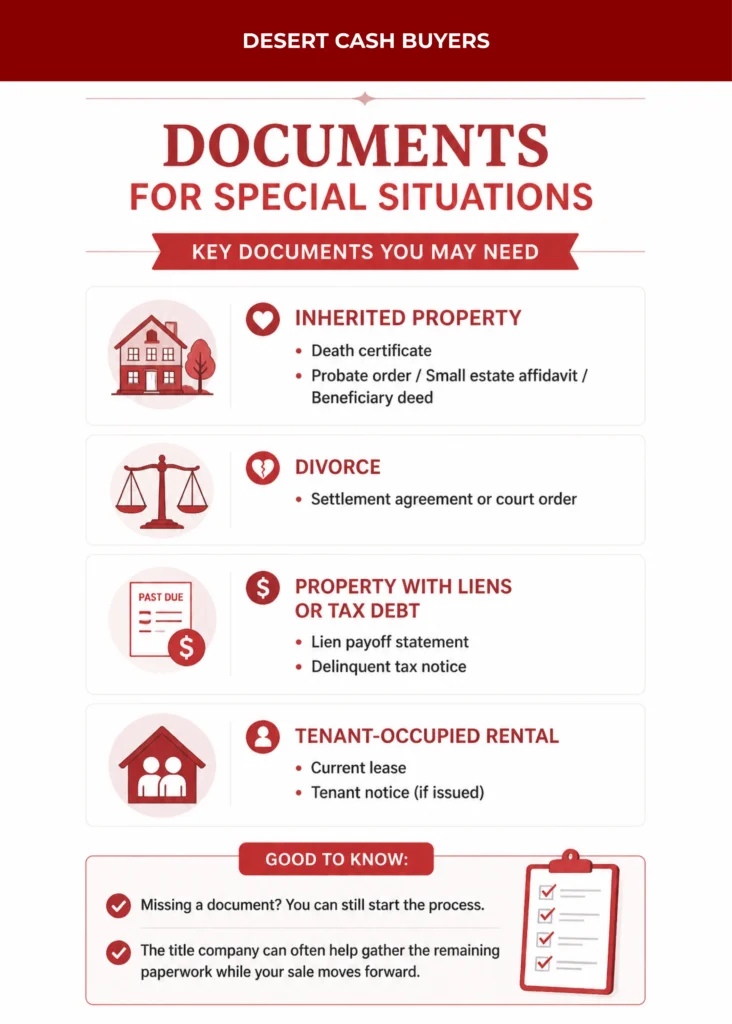
Beyond the core paperwork, a handful of situations may call for additional documents. If you want to see how your situation stacks up against other paths, our guide to Arizona cash home buying options walks through how each one is typically handled. The table below covers the most common cases.
| Situation | Extra document needed |
| Inherited property | Death certificate, will, probate documents, small-estate affidavit, beneficiary deed, or other records showing your authority to sell |
| Divorce | Signed settlement agreement or court order showing who is authorized to sell the property |
| Property with a lien or tax debt | Lien payoff statement, judgment information, or delinquent tax records |
| Tenant-occupied rental | Current lease, tenant information, and any notices already provided |
None of these extra documents have to be perfect before you reach out. If the probate case is still open, if you don’t have a copy of the lease, or if you’re waiting on a lien payoff figure, the title company can usually work in parallel while those pieces come together. It’s far more common for a seller to be missing one of these than to have every document ready on day one, and it rarely changes the offer itself.
This is general information, not legal or financial advice. Every situation is different, so talk with an Arizona attorney or a tax professional about yours.
What the Title Company Handles for You
A licensed title company verifies your ownership, clears any liens, prepares the closing documents, and records the new deed once the sale is final. You don’t have to track down every lienholder yourself or negotiate a payoff on your own. You can also learn who pays closing costs when selling to a cash buyer in Arizona so you know which expenses may be handled at closing. Here’s what typically falls on their side of the table:
- A title search confirming who legally owns the property and whether any liens are attached
- Payoff coordination with your lender and any other lienholders
- Preparation of the closing statement and deed for signature
- Recording the new deed with the county recorder after closing
- Issuing title insurance so the sale is protected against a prior claim
Because a direct cash sale skips a buyer’s lender, there’s no loan underwriter reviewing your file, no appraisal contingency, and no financing deadline that can fall through at the last minute. That’s part of why the document list stays short. The title company is still doing real, careful work behind the scenes; it’s just not waiting on a third party’s approval to finish it.
How Having Documents Ready Speeds Up Closing
Depending on the property and title situation, some cash sales can close in as few as 3 days, while many Phoenix cash sales close within 7 to 21 days. If you want to understand how long it takes to sell a house for cash in Arizona, having your paperwork ready can help avoid unnecessary delays.
Sellers who want to close fast run into the same delays anywhere in the Valley: a payoff statement that takes a week to arrive from the lender, or a deed that has to be pulled from the county recorder because the original was misplaced. None of that has to hold up your offer. You can request a free cash offer the same day you reach out, then gather documents in parallel while the title company starts its work. Most sellers find they already have the ID and tax records on hand, and the payoff statement is the only thing that takes more than a phone call.
A simple way to stay ahead of it: request your mortgage payoff statement and pull your property tax record the same week you reach out for an offer. Both usually take a few business days to arrive. Having them ready when the title company opens the file is one of the most helpful things you can do to keep the closing process moving toward the faster end of the 3 to 21 day window.

Frequently Asked Questions about the Paperwork for a Cash Home Sale in Arizona
A few quick answers to the paperwork questions we hear most, and you can browse more Arizona selling guides on our blog for related topics.
Do I need a disclosure statement for a cash sale?
Yes. Arizona sellers generally have a duty to disclose known material facts, including when a property is sold as-is for cash. The SPDS is the standard disclosure form used in Arizona residential transactions, and the information you provide should be accurate to the best of your knowledge.
What if I can’t find the deed?
A missing deed rarely stops a sale. The title company can typically reconstruct proof of ownership through the county recorder’s office or, for an inherited property, through the probate file. Most Arizona county recorder websites let you search recorded documents by name or parcel number for free, which is often faster than digging through old paperwork at home. Start your cash offer request with us and let the title team track it down while the rest of the process moves forward.
Do I need a real estate attorney in Arizona?
A real estate attorney is not necessarily required for every standard transaction, but an attorney may be useful for probate, contested divorce, title disputes, or other complex situations. If you’re comparing cash buyers, knowing how to spot a legitimate cash home buyer in Arizona can also help you evaluate who you’re dealing with before signing anything.
What ID do I need at closing?
Bring a current, unexpired, government-issued photo ID such as a driver’s license, state ID card, or passport. The name on your ID should match the name on the deed or, if it doesn’t (for example, after a marriage or a name change), bring the supporting document that explains the difference so the title company can confirm your identity.
Can I sell my house if my mortgage isn’t paid off?
Yes. Most Arizona homeowners still have a mortgage when they sell to Desert Cash Buyers. Your lender provides a payoff statement showing exactly how much is owed, and the title company pays that amount directly from your sale proceeds during closing. You receive the remaining balance after any loans, liens, taxes, and agreed closing costs have been paid.
Documents to Sell a House for Cash in Arizona
The documents to sell a house for cash in Arizona are usually straightforward: a government-issued ID, proof of ownership, mortgage payoff information if applicable, current property tax records, and the appropriate disclosure documents. Inherited properties, divorces, liens, and tenant-occupied homes may require additional paperwork, but a missing document does not necessarily stop the sale. A licensed title company can help verify ownership, coordinate payoffs, prepare closing documents, and handle recording.
You do not have to have every document in hand before you ask about selling. Desert Cash Buyers can review your property details, explain which paperwork applies to your situation, and coordinate with the title company as the transaction moves forward.
If you are ready to find out what your home could sell for, request a free, no-obligation cash offer. You can start the process before your paperwork is completely organized, and the title team can help identify what is still needed to keep your closing on track.