

Comparing cash buyers vs. iBuyers vs. realtors in Arizona is one of the best ways to decide how you should sell your home. Each option offers different advantages when it comes to speed, costs, repairs, and how much money you ultimately keep after closing. If you’re considering sell your house fast for cash in Arizona, comparing all three selling paths first can help you make a more confident decision.
Whether you’re relocating, inheriting a property, dealing with costly repairs, or simply looking for the easiest way to sell, every option comes with trade-offs. This guide compares local cash buyers, national iBuyers, and traditional real estate agents using real costs, timelines, and net proceeds so you can choose the solution that best fits your situation.
- Desert Cash Buyers has purchased 1,000+ Arizona homes and carries a 4.9 out of 5 rating, with $0 commission and closing costs covered.
- iBuyers historically charged about a 5% service fee, though Opendoor now shows it as a variable line item disclosed per offer.
- Traditional agent commission typically runs 5 to 6%, on top of a seller’s share of closing costs.
- A Desert Cash Buyers cash offer often arrives within 15 minutes, with closing available in as little as 3 days.
- Every path is legitimate. The right one depends on your home’s condition, your timeline, and how much certainty you need.
Cash Buyers vs. iBuyers vs. Realtors: Which Is Right for You?
Which is right for you depends on three things: how much repair the house needs, how fast you must close, and whether you can afford to wait for a full-price buyer to line up financing. A cash buyer removes the repair and financing variables entirely, since the offer accounts for the home’s condition up front and the funds come from private capital rather than a bank. An iBuyer removes some of the listing hassle but keeps a home inspection and a variable fee in the process. A realtor keeps the full market price on the table but asks you to carry the home, the showings, and the financing risk until closing day.
Arizona’s market moves fast in some zip codes and slowly in others, so the same three options can produce very different results in Scottsdale versus a rural county. A newer, updated home in a walkable Tempe neighborhood tends to attract multiple offers on the open market and may hold up fine through a 30-day inspection window. An older Phoenix property with deferred maintenance, or a Mesa rental with a tenant who won’t leave for showings, runs into friction with both agents and iBuyers before it ever reaches an accepted offer.
The comparison below uses verified figures so you can see where each path actually lands, but it’s worth naming the trade-off up front: speed and certainty cost money, and a full-price sale costs time. Neither is wrong. The question is which one your specific house and your specific deadline can actually support.
Current market data backs this up. As of May 2026, Redfin reports that Arizona homes were spending a median of 67 days on the market, up 4 days year over year, with a median sale price of $448,407. That timeline is the baseline a traditional listing has to clear before you even reach closing day, and it’s the gap a cash buyer or iBuyer is built to skip.
Side-by-Side Comparison
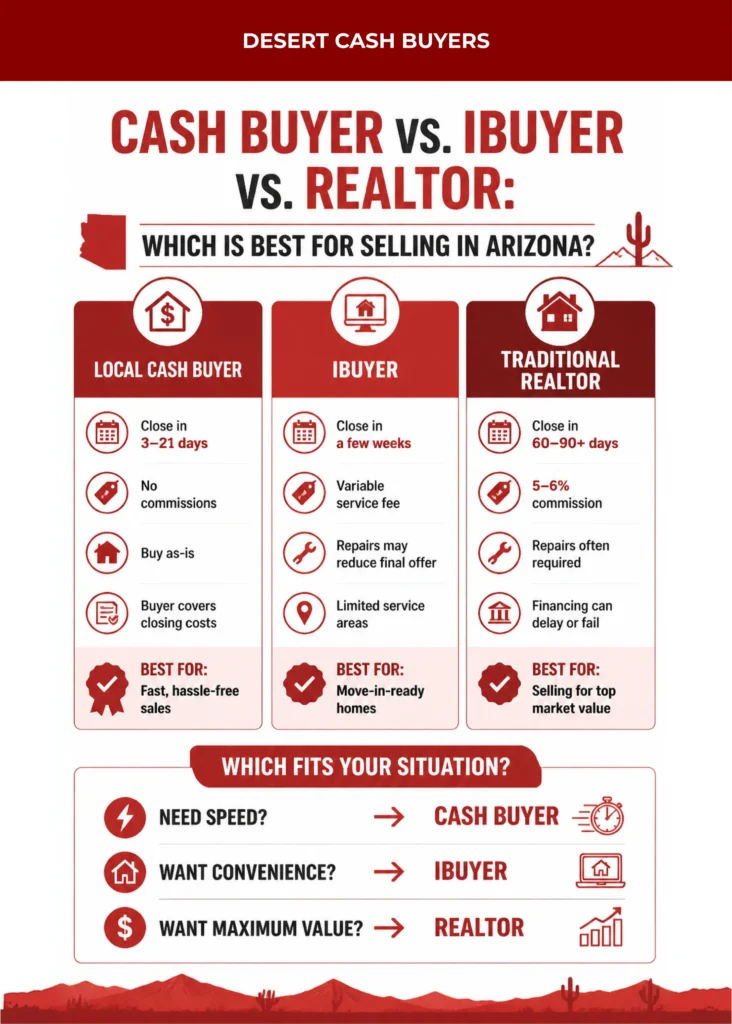
The clearest way to compare cash buyers, iBuyers, and realtors in Arizona is side by side on the factors that actually change your bottom line.
| Factor | Local cash buyer | iBuyer | Traditional realtor |
| Speed to close | 3 to 21 days, you pick the date | Typically a few weeks after inspection | Often 60 to 90+ days |
| Fees | $0 commission | Service fee historically ~5%, now variable per offer | Commission typically 5 to 6% |
| Repairs | None required, bought as-is | Repair deductions after inspection | Often required before or during escrow |
| Closing costs | Covered by the buyer | Seller pays standard costs, roughly 1 to 2% | Seller pays a share |
| Certainty | Private funds, no financing contingency | Offer can drop after inspection | Financing can fall through |
| Best fit | Repairs needed, tight timeline, tenant or inherited homes | Move-in ready homes in an active service area | Homes in strong condition with no time pressure |
The iBuyer figures above come from Opendoor’s own Help Center, which now discloses the service charge as a variable line item rather than a fixed rate. Closing-cost ranges are consistent with the Federal Trade Commission’s real estate glossary.
Local Cash Home Buyers
Local cash home buyers like Desert Cash Buyers purchase directly with private funds, so there’s no bank underwriting the sale and no financing contingency to fall through. We evaluate the property on location and condition, base the offer on the home’s After Repair Value, and cover standard closing costs. You can see how we buy houses in Phoenix and across the Valley for the full picture of what we purchase, including fire damage, foundation cracks, mold, termite damage, code violations, and tenant-occupied rentals. If your property has fire damage specifically, our guide to selling a fire-damaged house for cash walks through that situation in more depth. A licensed title company handles the paperwork and resolves any liens during closing, so you aren’t left fixing title problems on your own.
Not every company advertising a cash offer is equally reputable, so it’s worth knowing what a legitimate local buyer looks like before you sign anything. A direct buyer should be able to show proof of funds on request, meet you at the property instead of pricing it sight unseen, and put the offer in writing without an assignment clause that lets them resell your contract to a third party for a markup. If a buyer pressures you to sign immediately, can’t explain how the number was calculated, or won’t use a licensed title company, treat that as a warning sign rather than a formality.
Real seller experiences back this up. In one published review, an Arizona seller who first checked an iBuyer offer decided against it because the number came in low, then chose to work with Desert Cash Buyers instead. Another seller who went through a sale without a realtor or attorney representing them described the process as transparent and free of last-minute surprises, which is the standard a direct buyer should be held to.
iBuyers: Opendoor and Offerpad
iBuyers are large, technology-driven companies that make an algorithm-based offer, then resell the home after light repairs. Opendoor’s own Help Center confirms its service charge is no longer a flat 5 percent; it’s now shown as a variable line item on each seller’s individual offer breakdown, alongside standard closing costs. Industry-wide, iBuyer service fees have run anywhere from about 5% up to 13% depending on the platform, market, and the home’s condition. After the initial offer, iBuyers schedule a home inspection and can deduct estimated repair costs from the final number, which is where sellers most often see their offer shrink between the first look and the closing table. iBuyers also don’t cover every Arizona zip code; coverage is generally limited to active metro markets and homes in fairly standard, move-in-ready condition.
The appeal of an iBuyer is convenience: you get a preliminary offer online without listing photos, open houses, or a string of showings. The trade-off is that the preliminary number isn’t the final number. Once the inspection is complete, the company applies repair credits and finalizes the service charge, and both of those figures are set by the buyer, not negotiated the way a repair request would be with a traditional buyer. For a home in excellent condition inside an active Arizona service area, that gap can be small. For an older home, or one with deferred maintenance, the gap between the first offer and the closing number tends to widen.
Traditional Realtors
Traditional realtors list your home on the open market and negotiate a sale price that reflects full market value, in exchange for a commission. That commission is typically 5 to 6% of the sale price in most Arizona markets, paid to the brokerage at closing. You’ll also usually cover part of the closing costs, may need to complete repairs the buyer’s lender requires, and carry the home through showings, inspection, and a financing contingency that can still fall through near the finish line. If you’d rather avoid the agent relationship altogether, our guide on how to skip a realtor and sell your Phoenix home directly lays out that path in detail.
Listing with an agent is often the right move for a home in solid, market-ready condition with an owner who isn’t racing a deadline. You get access to the full pool of buyers, including those using traditional financing, and a good agent will negotiate on your behalf through inspection and appraisal. The trade is time and exposure. A traditional Arizona sale commonly takes 60 to 90 or more days from list to close, and during that stretch you’re covering the mortgage, utilities, insurance, and upkeep on a home you’re trying to leave. If a buyer’s financing falls through late in escrow, the clock resets and those carrying costs keep adding up.
Net Proceeds: A Worked Arizona Example
A worked example on a typical Arizona home shows how the same house can produce three very different net amounts. This is an illustrative scenario only, built from verified fee percentages, not a quote for any specific property.
| Path | Illustrative price basis | Fees / commission | Seller-paid closing costs | Repairs before closing |
| Local cash buyer | ARV-based offer, shown up front | $0 | $0, covered by buyer | $0, bought as-is |
| iBuyer | Near-market offer, adjusted after inspection | ~5% service fee (historically; now variable) | Roughly 1 to 2% | Deducted after inspection |
| Realtor / open market | $370,000 asking price example | 5 to 6% commission | Typically 1 to 3% | Often required before closing |
Take a $370,000 example home. On the open market, a 5 to 6% commission alone runs about $18,500 to $22,200, and a seller’s share of closing costs at 1 to 3% adds roughly $3,700 to $11,100 more, before repairs or the carrying costs of a 60 to 90+ day listing period. With an iBuyer, a service fee historically near 5% runs about $18,500, plus closing costs near 1 to 2%, plus whatever the post-inspection repair deduction turns out to be, and that number isn’t known until after the home is inspected. With Desert Cash Buyers, there’s no commission and no closing-cost bill, and the offer math is based on the home’s After Repair Value rather than a moving target. You can see exactly how your cash offer is calculated before you ever commit to anything.
This is general information, not legal or financial advice. Every situation is different, and this worked example is illustrative only; actual results vary by property, market, and terms. Talk with an Arizona attorney or a tax professional about your specific numbers.
Which Option Fits Your Situation
Which option fits your situation comes down to your home’s condition, your timeline, and how much certainty you need at closing. The scenarios below cover the situations we see most often across the Phoenix metro, and each one points toward a different path for a different reason, not because one option is universally better.
- Facing a tight deadline in Mesa or Phoenix: sell your house fast in Mesa through a direct cash buyer, since there’s no financing wait.
- Inherited a house from out of state: a cash buyer avoids coordinating repairs and showings remotely, and closes on your schedule.
- Tenant-occupied rental with an uncooperative renter: cash buyers purchase with the tenant in place, no eviction or vacancy required first.
- House needs major repairs you can’t afford: a cash offer accounts for repairs up front instead of asking you to pay for them before closing.
- Going through a divorce or dividing an estate: a fast, private-funds close removes the financing uncertainty that can drag out an already stressful timeline for everyone involved.
- Move-in ready home with no rush: an agent or, in some zip codes, an iBuyer may net more since you can wait for full market value. See our broader compare Arizona cash home buying options for how the buyer types stack up.

Frequently Asked Questions about Comparing Home-Sale Options in Arizona
Do iBuyers charge more than agents?
Not necessarily on paper. An iBuyer’s service fee has historically run near 5%, similar to a chunk of a typical agent commission, but iBuyers also apply repair deductions after inspection that agents don’t. A realtor’s 5 to 6% commission is fixed once agreed, while an iBuyer’s total cost isn’t finalized until after the home is inspected, so the two aren’t quite comparable line for line.
Are iBuyers available across Arizona?
Not everywhere. iBuyers operate in specific active metro markets and generally prefer newer, move-in-ready homes. A seller outside those zip codes, or with an older or damaged property, may not get an iBuyer offer at all, while a local cash buyer like Desert Cash Buyers serves Phoenix, Scottsdale, Mesa, and the surrounding Valley communities regardless of the home’s condition. This matters most for sellers outside the core Phoenix metro corridor, since an iBuyer offer simply may not be on the table no matter how the home is priced.
Which option is fastest?
A local cash buyer is typically fastest, with closings possible in 3 to 21 days and the seller choosing the date. An iBuyer usually needs a few weeks after inspection, and a traditional listing often takes 60 to 90 or more days from list to close.
Which nets the most money?
It depends on the home. A move-in-ready house in a hot Scottsdale or Phoenix zip code may net more listed with an agent at full price, even after commission. A home that needs repairs, faces a tight deadline, or comes with complications like a tenant or an inherited title often nets more with a direct cash buyer once repair costs, carrying costs, and the risk of a financing fall-through are factored in. The only way to know for sure is to run your specific numbers, not a general rule of thumb, since a single repair estimate or an extra month of carrying costs can flip the comparison either way. Our post on more ways to sell your house for cash in Arizona covers a few less obvious paths worth knowing about.
Is a cash offer lower than full market value?
Yes, and we’re upfront about that. A cash offer is built from the home’s After Repair Value, so it comes in below full retail. The trade is no commission, no repair costs, no closing-cost bill, and no risk of the deal falling through, which is why the offer we make is the offer you get at closing.
Cash Buyers vs. iBuyers vs. Realtors in Arizona
Choosing between cash buyers vs. iBuyers vs. realtors in Arizona depends on your home’s condition, your timeline, and the amount of certainty you want throughout the sale. A local cash buyer is often the best fit if your property needs repairs or you need to close quickly. An iBuyer can work well for newer, move-in-ready homes within its service area, while a traditional realtor usually offers the best opportunity to maximize sale price if you have time to wait.
Instead of focusing only on the highest offer, compare your expected net proceeds after commissions, repairs, closing costs, and carrying expenses. Looking at the complete financial picture will help you determine which selling option actually leaves you with the best overall result.
If you’re still comparing your options, request a no-obligation cash offer from Desert Cash Buyers. We’ll explain exactly how our offer is calculated, answer your questions honestly, and give you real numbers you can compare against an iBuyer or traditional listing before making your decision.