
You’re getting an Arizona house ready to sell. Maybe you’re already packing for a new job in another state. The things to avoid when selling your house are rarely dramatic. They show up quietly, in a lender’s appraisal, a late HOA packet, or the third month of paying two housing bills. If you want the bigger picture on how a cash sale compares to listing, our guide to selling your house fast for cash in Arizona walks through the full offer math.
Here’s the short answer. The biggest things to avoid when selling your house are overpricing, skipping repairs that block financing, hiding known defects, poor photos and clutter, buying your next home before selling, ignoring holding costs, accepting an unverified buyer, leaving paperwork late, over-renovating, and letting emotions drive the negotiation. Most of them cost you time first. The money follows.
A few things most seller checklists leave out:
- In the Phoenix metro, the paperwork item that stalls the most closings is often a leased solar system, not the house itself. The lease has to be transferred, assumed, or bought out before closing.
- A higher list price is not the same as a higher net. Commissions, repair credits, and months of holding costs close much of that gap.
- Every mistake on this list gets more expensive once you’ve moved. You end up fixing it by phone from another state.
- Any buyer worth trusting, cash or financed, can show you how they got to their number. Ask for the comparable sales and repair estimate behind every offer.
What Are the 10 Biggest Things to Avoid When Selling Your House?
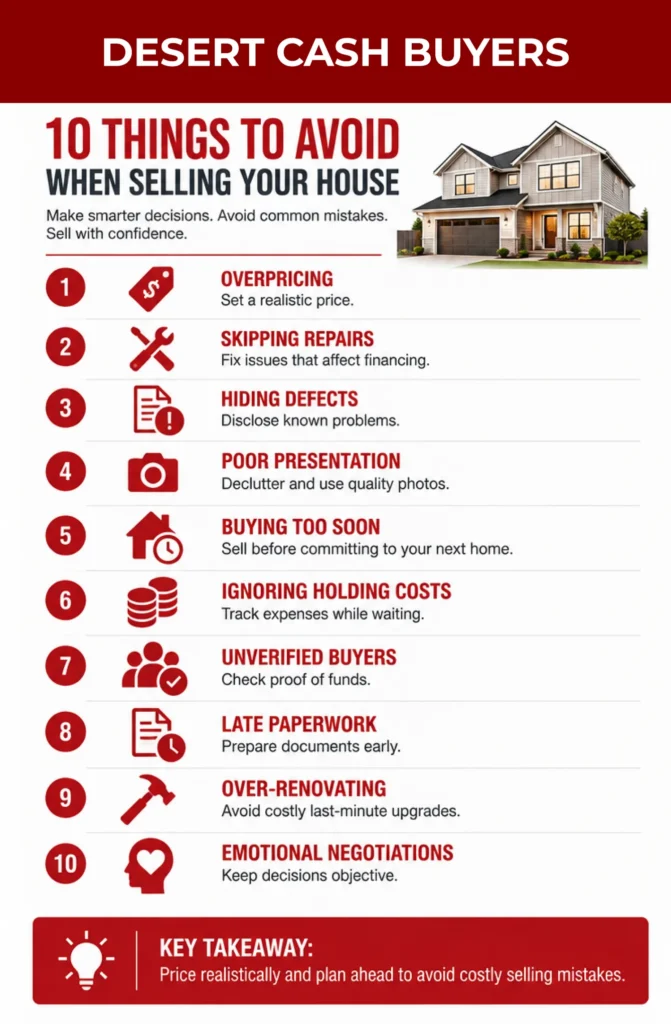
The 10 biggest things to avoid are listed below, and nearly all of them trace back to two root causes: pricing on hope and starting too late. Each one gets its own section after this list, with an Arizona angle where it matters.
1. Overpricing Your Home
Overpricing is the most common mistake, because a house priced above its comparable sales sits, and a house that sits gets discounted. Buyers shop by price range. If yours is high, you’re competing against better homes at the same price.
Financed sales add a second check. The buyer’s lender orders an appraisal, and the appraiser looks at recent comparable sales nearby. If your contract price beats the appraisal, the appraisal contingency usually lets the buyer renegotiate or walk away. Then you’re back on the market with weeks of days-on-market showing.
Price off real comps instead. Look at homes of similar size, age, and condition that closed recently, close to your street. Also decide how you’re selling before you set a number. Cash buyers vs. iBuyers vs. realtors each price a house differently, and an iBuyer’s algorithm won’t see your house the way a local buyer walking through it will.
2. Skipping Repairs That Block a Buyer’s Financing
You can skip cosmetic upgrades, but don’t skip the repairs a lender will flag, because they can stop a financed sale. FHA and VA loans come with minimum property requirements. Appraisers on those loans look for safety and habitability issues like roof leaks, exposed wiring, broken heating or cooling, and missing pool barriers.
In Arizona, a dead AC unit in July isn’t cosmetic. It can kill a deal or force a big repair credit. Get the system serviced before you list, and keep the receipt.
If you can’t or don’t want to make a repair, that’s fine. Disclose it, price it in, and expect more interest from conventional or cash buyers.
Relocation trap: Lender-required repairs often surface after the appraisal, weeks into escrow. If you’ve already moved, you’re hiring and supervising a contractor from another state.
3. Hiding Known Defects (and Skipping the SPDS)
Never hide a known defect. In Arizona, the Seller’s Property Disclosure Statement (SPDS) is the standard way sellers tell buyers what they know about the house, and leaving things off it is risky. The form asks about the roof, plumbing, pests, mold, HOA, solar, and work done without permits.
The duty to disclose known material facts doesn’t go away just because a form wasn’t used. The Arizona Department of Real Estate explains why every buyer is entitled to an SPDS, outlining the importance of seller disclosures.
Hidden problems tend to come out anyway, during the buyer’s inspection or after closing. The first leads to renegotiation or a canceled deal. The second can lead to a legal claim. If you’re unsure whether something counts, ask a real estate attorney before you sign the form.
4. Listing With Clutter and Poor Photos
Clutter and dark photos cost you showings, because most buyers decide from the listing photos whether to visit at all. A crowded room looks smaller. A half-packed room looks like a problem.
Arizona light is harsh at midday, so photos often look better in the morning or near sunset. The backyard matters here. Buyers want to see the patio, shade, and pool in good shape. Clean, declutter, and fix small things like burned-out bulbs and dripping faucets. They’re cheap, and they show.
If you’re relocating and short on time, light staging beats an empty house. A cluttered house shows worse than either.
5. Buying Your Next Home Before Selling This One
Buying before you sell is a mistake for most people, unless you can comfortably carry two housing payments for several months. Contingent offers, where your purchase depends on selling first, are weaker in a competitive market. Bridge loans help, but they cost money and add a deadline.
So should you buy a new house before selling your old one? Usually no. The safer order is to sell first, rent short-term if you need to, and buy once your money is in hand. If you must buy first, know your exact sale timeline before you commit.
Relocation trap: Buying in the new city first is the most common relocation mistake. If the Arizona house lingers, you’re paying for both homes while managing one from far away. The relocation section below covers how to line up a fixed closing date.
6. Ignoring Holding Costs While You Wait
Every month the house stays unsold costs real money, and sellers who ignore holding costs often lose more by waiting than they gain on price. Holding costs include the mortgage, property taxes, insurance, HOA dues, utilities, pool service, and yard care. In a Phoenix summer, the electric bill alone can surprise you.
It helps to know how long it takes to sell for cash compared with a financed listing before you pick a path. Listing timelines change month to month, so check current Arizona Regional MLS data or a named market report rather than an old rule of thumb.
Example: What Four Extra Months Can Cost
This is an illustrative example with round numbers. It is not a quote, and your costs will differ.
| Holding cost | Per month | Four months |
| Mortgage payment | $1,800 | $7,200 |
| Property taxes | $200 | $800 |
| Homeowners insurance | $150 | $600 |
| HOA dues | $100 | $400 |
| Utilities (summer AC) | $350 | $1,400 |
| Pool and yard care | $150 | $600 |
| Total | $2,750 | $11,000 |
Add commissions and repair credits to that, and the gap between a list price and a cash offer often narrows. Run the closing costs when you sell both ways before you decide.
If you’d rather know your number before choosing anything, see how our process works. We give you an offer with the comps and repair estimate behind it. You decide whether it beats listing.
7. Accepting an Offer From an Unverified Buyer
Don’t accept any offer, cash or financed, until you’ve confirmed the buyer can actually close. A financed buyer should have a full pre-approval, not just a pre-qualification. Read the financing contingency so you know when they can still walk.
Cash offers need checking too. Some buyers sign a contract they plan to sell to someone else before closing. That’s called an assignable contract. If the buyer can’t find someone to take it, your deal can fall apart late.
How to Vet a Cash Buyer in Arizona
- Ask for proof of funds before you sign.
- Confirm the closing runs through a licensed, independent Arizona title company, with money held in escrow.
- Ask to see the offer math: after-repair value (ARV), comparable sales, and the repair estimate.
- Ask directly whether they buy with their own funds or plan to assign the contract.
- Check reviews on a platform the buyer doesn’t control, and walk away from anyone charging you upfront fees.
Our guide on how to spot a legitimate cash buyer goes deeper. Hold us to the same list. Every closing we do runs through a licensed, independent Arizona title company, and our 4.9/5 rating from 1,245 verified sellers is on Google, where you can check it yourself. You can also read stories from sellers we’ve worked with.
8. Leaving Paperwork Until the Last Minute
Start gathering paperwork before you list, because missing documents are one of the most common reasons Arizona closings slip. Some items take days to arrive. Others take weeks.
- Your mortgage payoff statement and any lien information.
- The completed SPDS.
- The HOA disclosure packet, if you’re in an HOA. Timing varies by association, so request it early.
- Your solar lease or loan contract, plus the transfer or buyout terms. A leased system has to be assumed or bought out at closing, and it’s a frequent delay in the Valley.
- Permits for additions, warranties, and recent repair receipts.
Here’s a full list of the documents you need to sell. Don’t forget the tax side. Many primary residences qualify for the federal home sale exclusion of $250,000 for single filers or $500,000 for married couples filing jointly, as explained in IRS Publication 523, Selling Your Home. Our post on taxes when selling your house covers the Arizona angle. Confirm your own case with a tax professional.
9. Over-Renovating Right Before You Sell
Big renovations right before a sale rarely pay back their full cost, so fix what blocks a sale and skip the rest. A new kitchen reflects your taste, not the next owner’s. Buyers often plan to redo it anyway.
Projects also run long. Contractors in the Phoenix metro book up, and summer heat slows outdoor work. Every week of delay adds to your holding costs.
Better spending usually looks boring. Fresh neutral paint, an AC service, a roof repair, deep cleaning, and fixes from a pre-listing inspection. If you’re relocating, managing a remodel from another state is a hard way to save money.
10. Letting Emotions Drive the Negotiation
Letting emotions run the negotiation costs sellers good offers, because buyers price houses on comps and condition, not memories. A low offer isn’t an insult. It’s an opening number. An inspection repair list isn’t a judgment on how you kept the house.
Set your walk-away net before offers arrive. That’s the amount you need after payoff, closing costs, and moving. Then compare every offer by what you’d actually keep, not the headline price.
Keep your deadline to yourself, too. If a buyer knows you start a new job in three weeks, they know you’re motivated.
Extra Mistakes to Avoid When You’re Relocating
When you’re relocating, the extra mistakes all come from distance: leaving before the house is protected, buying first in the new city, and trusting a buyer whose financing could fall apart after you’re gone. Here’s when each one usually happens.
| When | Common mistake | Better move |
| 8 to 12 weeks before the move | Picking a price and method without comps | Pull recent comparable sales and decide listing vs. cash first |
| 6 to 8 weeks before | Buying in the new city before the sale is set | Lock in a closing date or a short-term rental first |
| 4 weeks before | Waiting on HOA, solar, and payoff paperwork | Request the HOA packet, solar transfer terms, and payoff now |
| Move week | Leaving the house vacant with the AC off | Keep the AC running and tell your insurer about the vacancy |
| After you leave | A financed buyer’s loan fails | Verify financing early, or choose a buyer with proof of funds |
Vacant homes carry their own risks in Arizona. Many standard insurance policies limit coverage once a home sits empty for a set period, so call your insurer before you go. Summer heat and monsoon storms can cause damage that nobody notices for weeks.
Questions to Ask Before You Leave Town
Who has a key? Who checks the house each week? What happens if the buyer’s appraisal comes in low while you’re 1,000 miles away? If you don’t like the answers, our page on selling your house fast when relocating in Arizona covers how to sell remotely and set a closing date around your move.
When a Cash Sale Is Not the Fix
If your house is in good condition, you have no deadline, and getting top dollar matters most, list it. A cash sale is the right tool for speed and certainty, not for topping the market.
Cash offers typically reach 70 to 85 percent of after-repair value in strong markets. That’s a general range, not a promise for any single house. Where a cash sale earns its place is a deadline, repairs you can’t manage from away, or paperwork that would scare off a financed buyer.
| Factor | Traditional listing | Cash sale to Desert Cash Buyers |
| Sale price | Often higher for retail-ready homes | Typically 70–85% of ARV in strong markets |
| Commissions and fees | Commissions plus seller closing costs | No commissions, no closing costs, no fees |
| Repairs | Lender and inspection repairs are common | Sold as-is; repairs are priced into the offer |
| Property access | Repeated showings to strangers over weeks | Phone review or a private walkthrough, scheduled around you |
| Timeline | Varies; check current ARMLS data | Most close in 7–14 days; fastest on record 3 days |
| Certainty | Financing and appraisal contingencies | No financing contingency |
What Is the Biggest Mistake Home Sellers Make?
The biggest mistake home sellers make is focusing on the sale price instead of the net proceeds they’ll actually walk away with. Price is the headline. Net is what lands in your account.
Net proceeds are the sale price minus your mortgage payoff, commissions, seller concessions, repair credits, closing costs, and the holding costs you paid while waiting. Two offers with a big price difference can end up close once you subtract those lines. Build a simple net sheet for every option you’re considering, then compare the bottom lines side by side.

Frequently Asked Questions About Things to Avoid When Selling Your House
What should you not say when selling your house?
Don’t share your deadline, your lowest acceptable price, or that you’ve already bought elsewhere. All three weaken your position. Answer condition questions honestly and let your written disclosures, like the SPDS, do the talking.
Should I get a pre-listing inspection?
It can help if your home is older or you suspect problems. You get to fix or disclose issues before a buyer’s inspector finds them, which limits renegotiation. Some sellers skip it when they plan to sell as-is to a cash buyer.
Is it a mistake to sell a house in the Arizona summer?
Not necessarily. Fewer homes are listed in summer, so serious buyers have fewer choices. Showings are harder in extreme heat, though, and the AC has to be working well. Sellers with a deadline shouldn’t wait for spring just because of the calendar.
Is it a mistake to sell to a cash buyer?
It can be if you don’t vet the buyer. Ask for proof of funds, insist on a licensed Arizona title company, and compare your net, not just the price. We show the comps and repair estimate behind every offer so sellers can check the math.
Do I have to move out before Desert Cash Buyers can buy my house?
No. We evaluate the property by phone or with a private walkthrough scheduled around you, and you pick the closing date. Many sellers stay until closing, then leave unwanted belongings behind as agreed in writing. More answers are on our FAQ page.
Avoiding Home Selling Mistakes in Arizona, Whatever Your Timeline
Most things to avoid when selling your house come down to pricing honestly, starting early, and checking every buyer’s math. If listing fits your situation, use this list and list with confidence. If you’re short on time or about to move, a cash sale may net more than it first appears once holding costs are counted.
There are no open houses and no strangers touring your home week after week. We look at the property by phone or with a private walkthrough, then show you the comps and repair estimate behind our number. Get your free cash offer, and you’ll have a cash offer in about 15 minutes, with no obligation and no fees.