

If you want the highest cash offer on your house in Arizona, the fastest way to get there runs through Phoenix, Scottsdale, and Mesa sellers who did one thing differently: they compared before they signed. Maybe you’re weighing a fast sale against a move, an inherited property, or a home that needs more work than your budget allows. The number one buyer quotes you on day one is rarely the best number you could get, and most sellers never find that out because they stop shopping after the first call.
Whether you’re exploring selling your house fast for cash in Arizona for the first time or you already have an offer in hand, a few concrete steps can put more money in your pocket without adding a single day to your timeline.
Key takeaways:
- Request offers from at least two or three buyers, so you have a real number to compare, not just one to accept.
- Know your home’s ARV first. Strong Arizona cash offers typically land around 80 to 85% of that figure.
- Clean-out access, documentation, and a flexible closing date can move a buyer’s number without costing you a repair dollar.
- Vague math, pressure to sign the same day, and no proof of funds are the clearest signs of a lowball offer.
How to Get the Highest Cash Offer on Your House in Arizona
Getting the highest cash offer on your house in Arizona means comparing multiple buyers, understanding your home’s ARV, and removing the guesswork that makes a buyer price conservatively. We’ve bought more than 1,000 Arizona homes and carry a 4.9 out of 5 rating from sellers who compared us against other offers before deciding, and that comparison step is exactly what tends to raise the final number. Sellers who read our Arizona cash home buying options before choosing a buyer consistently report a clearer sense of what a fair offer actually looks like, and clarity is leverage. The quick version: shop it, know your ARV, prep light documentation, and negotiate from information instead of urgency.
None of this requires repairs, staging, or weeks of extra time. It requires treating the offer like the negotiable number it is, because we buy houses across Arizona every week from sellers who did exactly that and closed on their terms, often within 15 minutes of a fair offer and as few as three days later.
This matters more in Arizona than sellers often expect, because Phoenix, Scottsdale, and Mesa each move at slightly different paces depending on the season, and a buyer’s confidence in resale timing directly shapes how aggressive their offer can be. A home in a fast-moving Scottsdale neighborhood may draw a tighter offer range than a similar home in a slower-moving pocket of the metro, simply because the buyer has more certainty about how quickly it will resell after repairs. None of that changes the steps you take, but it explains why two houses that look similar on paper can land in different places within the 80 to 85% ARV range.
Get and Compare Multiple Cash Offers
Comparing offers is the single highest-leverage step in this whole process, and it costs you nothing but a few phone calls. Local buyers, national iBuyers, and even investors who advertise online all price a home differently, and the gaps between them can run into the thousands. A local Arizona buyer usually prices from neighborhood-level comps and a direct walk-through, while an iBuyer leans on an automated valuation model and then adjusts after an inspection, sometimes lowering the number after you’ve already mentally accepted it. Neither approach is wrong, but they produce different numbers for the same house, which is exactly why one offer alone tells you very little.
- Request a cash offer from at least two or three buyers, including a local Arizona buyer and, if you’re curious, a national cash buyer vs. iBuyer vs. realtor comparison so you understand how each model prices a home.
- Ask each buyer the same three questions: how they calculated the number, what fees or service charges apply, and what happens if the walk-through reveals something they didn’t expect.
- Compare net proceeds, not the headline number. A slightly lower offer with zero fees can beat a higher one that gets renegotiated after inspection.
- Tell each buyer you’re comparing offers. Buyers who know they’re being compared tend to sharpen their number instead of anchoring low.
Give yourself at least a few days between the first call and a decision, even if one buyer pushes for a same-day answer. Offers on Arizona homes don’t typically expire in hours, and a buyer who insists otherwise is usually more worried about losing your comparison than about the market moving.
Know Your Home’s ARV Before You Negotiate
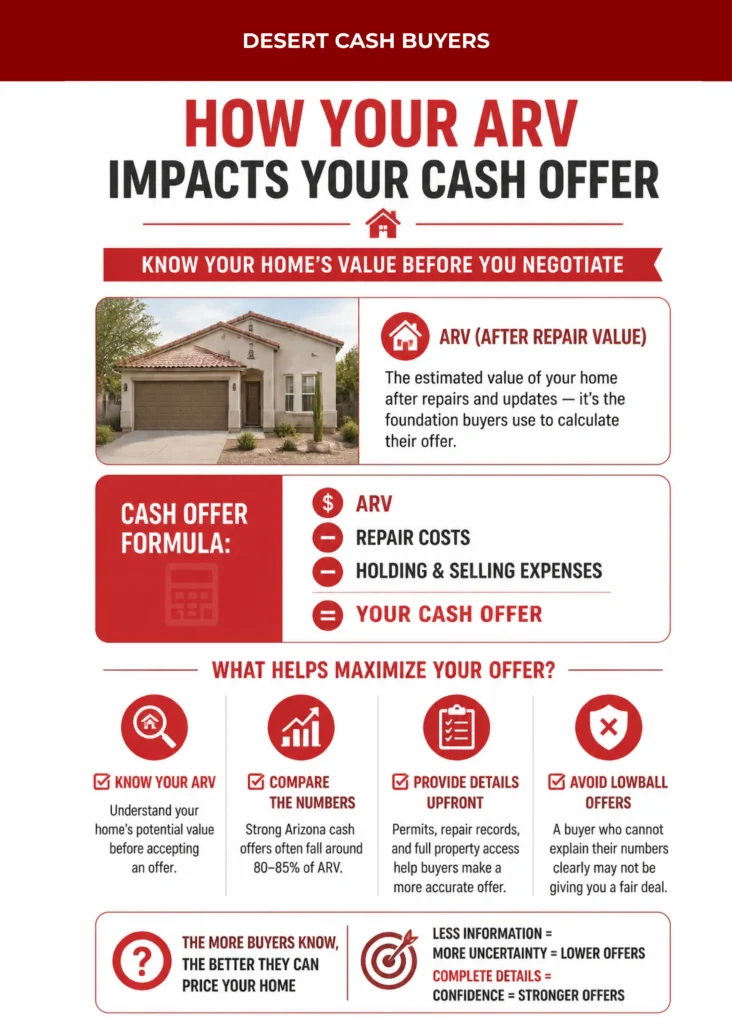
Your home’s After Repair Value is the number every serious cash offer is built from, so knowing it before you negotiate is your single biggest source of leverage. We walk through exactly how a cash offer is calculated in Arizona, but the short version is that a buyer estimates what your home would sell for fully repaired, then subtracts renovation and holding costs to land on a number. You can get a rough sense of current Arizona home values from the Federal Housing Finance Agency’s House Price Index, which tracks price trends by state and metro area and gives you a neutral benchmark that isn’t coming from a buyer with a stake in the number.
Strong Arizona cash offers typically land around 80 to 85% of ARV. If a buyer’s offer falls well below that range without a clear reason, that’s your opening to ask why, not to assume the number is fixed.
The gap between ARV and your offer isn’t profit sitting in a buyer’s pocket. It covers repair costs (paint, flooring, roof, systems), holding costs while the home sits on the market after renovation (loan interest, insurance, taxes, utilities), and resale costs like agent commission and closing fees on the eventual sale. A buyer who explains that breakdown line by line is easier to trust than one who just quotes a final figure, because you can see exactly where the number came from and push back on any piece that seems inflated.
A quick example of how the math plays out
Here’s an illustrative example only, not a quote for any specific house, showing how documentation and access can change the range a buyer lands on for the same home.
| Scenario | What the buyer sees | Typical effect on the offer |
| No access, no documentation | Buyer assumes worst-case repairs to protect their number | Offer lands at the low end of the ARV range |
| Full walk-through, no records | Buyer can see the condition but still estimates system age and history | Offer moves toward the middle of the range |
| Full access plus permits, repair records, and inspection history | Buyer can price actual condition instead of a worst-case guess | Offer moves toward the high end of the range |
Small Things That Can Raise Your Offer
None of these cost real money, and all of them reduce the uncertainty a buyer prices into a conservative offer.
- Clean-out access. Letting a buyer walk every room, including a garage or shed full of belongings, removes a guess they’d otherwise price down.
- Documentation on hand. Recent repairs, permits, a roof age, or a title report speeds up underwriting and removes a line item buyers hold back for the unknown.
- Flexible closing. A buyer holding a property for less time has lower holding costs to price in, so telling them you’re open on the date can help the number.
- Accurate condition upfront. Whether it’s fire damage, foundation cracks, or years of deferred maintenance, disclosing it early keeps the number from dropping after a walk-through. We buy homes in any condition, including through our fire-damaged house program, so there’s rarely a reason to hide a problem.
Timing matters too. Arizona’s summer heat can slow contractor availability and push repair-cost estimates higher, so a buyer pricing a home in July may build in a bigger cushion than one pricing the same home in a milder month. That’s not something you can control, but knowing it exists helps explain why the same house can draw slightly different offers a few weeks apart, and why comparing offers close together in time gives you a cleaner read.
Red Flags That Signal a Lowball Offer
A few patterns show up again and again when a buyer is pricing you low instead of pricing you fairly, and Arizona sellers in Mesa and across the metro report the same warning signs.
- The buyer won’t explain how they got to the number, or the math changes when you ask a second time.
- Heavy pressure to sign the same day, before you’ve had a chance to compare anything.
- No proof of funds and no licensed title company handling the closing.
- An offer well under the typical 80 to 85% ARV range with no condition-based reason given.
Before you accept anything, it’s worth running the buyer through a Better Business Bureau search and reading our guide on how to spot a legitimate cash home buyer in Arizona. A buyer with nothing to hide won’t mind the extra five minutes.
Watch for buyers who present themselves as the direct purchaser but are actually planning to assign your contract to someone else for a fee, a common practice sometimes called wholesaling. There’s nothing automatically wrong with it, but if the person you’re negotiating with isn’t the one closing on your house, that gap is often where a real offer gets quietly reduced before closing. Asking directly, “Are you the buyer who will close on this house, or will you assign the contract?” is a fair question, and a direct buyer using private funds, like our team, should answer it without hesitation.
Once you know your ARV and have an offer or two to compare, getting one more number costs you nothing. Request a free, no-obligation cash offer and use it as a benchmark, even if you end up going with someone else.
How to Negotiate With a Cash Buyer
Negotiating a cash offer looks different from negotiating a listed sale, because there’s no back-and-forth through agents, just you and the buyer talking directly.
- Lead with your comparison. Tell the buyer what you’ve been offered elsewhere and ask them to explain the gap.
- Ask about their offer path to closing costs. A buyer who covers closing costs on a cash sale is often worth more net than a slightly higher offer that leaves you paying fees.
- Offer flexibility in exchange for a number. If you can move on the closing date or grant early access, ask directly whether that changes the offer.
- Get the final number in writing before you agree to anything verbally.
Negotiating doesn’t mean adversarial. Most legitimate Arizona cash buyers expect sellers to ask questions and compare, and a straightforward conversation about the numbers usually goes further than a hard bargaining stance. If a buyer bristles at basic questions about how they arrived at a figure, that reaction alone is worth noting as you weigh which offer to take.
What actually moves the number
Some levers matter more than others when you’re trying to get the highest cash offer on your house in Arizona. Here’s how each one tends to affect a buyer’s math.
| Lever | Effect on your offer |
| Multiple offers in hand | Buyers sharpen their number to stay competitive |
| Documentation ready (title, permits, repair history) | Removes priced-in unknowns, often raises the number |
| Flexible or buyer’s-choice closing date | Lowers estimated holding costs, can improve the offer |
| Full condition disclosure upfront | Prevents a lower revised offer after the walk-through |
| Asking how the offer was calculated | Keeps the number honest and comparable across buyers |

Frequently Asked Questions About Getting the Best Cash Offer in Arizona
Can I negotiate a cash offer?
Yes. Cash offers are not fixed. Buyers price in unknowns like condition, timeline, and holding costs, and providing more information, comparing offers, or offering flexibility on the closing date can all move the number in your favor.
Do multiple offers really raise the price?
Often, yes. A buyer who knows you’re comparing offers has a reason to sharpen their number instead of anchoring low, and even if the first offer doesn’t move, you gain a real benchmark to judge every other offer against.
Should I make any repairs first?
Usually no. Cash buyers, including our team, purchase homes as-is in any condition, so spending money on repairs before an offer rarely pays back what it costs. Disclosing the condition accurately, rather than fixing it, is what actually helps the number.
How do I know an offer is fair?
Compare it against your home’s ARV, ask the buyer to walk you through how they calculated it, and check them against a BBB business search and our blog’s guide to Arizona home-selling options. A fair offer typically lands in the 80 to 85% ARV range and comes with a clear, specific explanation rather than a flat refusal to discuss the math.
Getting the Highest Cash Offer on Your Arizona House
The highest cash offer on your house in Arizona rarely comes from the first call. It comes from comparing a couple of buyers, knowing your ARV, and removing the guesswork that makes any buyer price conservatively. Real Arizona sellers who did exactly that, some featured in our success stories, ended up with a number they trusted because they understood how it was built. If you’re ready to see where you stand, get a no-obligation cash offer from our team, often within 15 minutes, with a close in as few as 7 days, no fees, and you pick the date.
This is general information, not legal or financial advice. Offer figures are illustrative and vary by property and market, with no guaranteed offer amount. Talk with an Arizona attorney or tax professional about your specific situation.