

If you’re getting ready to sell your house fast for cash in Arizona, especially in Phoenix or Mesa, taxes are probably right behind “how fast can this close” on your list of questions. A cash sale doesn’t create its own special tax category. What you owe comes down to your profit and how you used the home, not how you found your buyer. Homeowners facing foreclosure, a divorce, or an inherited property they never planned to keep often assume a fast sale triggers extra taxes. It doesn’t work that way. As a direct cash buyer working across Arizona, we’ve helped over 1,000 Arizona sellers close quickly, and this guide breaks down exactly when a sale creates a tax bill, when it doesn’t, and how the numbers actually get calculated.
A few specifics worth knowing before you go further:
- Selling for cash doesn’t change your tax treatment; only your profit and residency history matter.
- Most primary-residence sellers exclude up to $250,000 (single) or $500,000 (married) in gain under IRC Section 121.
- Arizona taxes any leftover gain as ordinary income at its flat 2.5% rate, with a 25% subtraction that lowers the effective rate on long-term gains.
- Inherited homes usually get a stepped-up basis, which erases most or all of the taxable gain for the heir who sells.
- You may still need to report the sale on your federal return even when the gain is fully excluded.
This is general information, not legal or financial advice. Every situation is different, so talk with an Arizona attorney or a tax professional about yours.
Do You Pay Taxes When You Sell Your House for Cash in Arizona? (QUICK ANSWER)
Usually, no—if you sell a qualifying primary residence and your gain falls within the IRS home-sale exclusion. Selling for cash does not create a special tax. What matters is your gain, your adjusted basis, how long you owned and lived in the home, and whether you qualify for the Section 121 exclusion. Selling costs can also affect your taxable gain. If you’re unsure which closing expenses may come out of your proceeds, see our guide to closing costs when selling to a cash buyer in Arizona. You may generally exclude up to $250,000 of gain if single or $500,000 if married filing jointly, provided you meet the applicable requirements.
A cash sale and a financed sale are generally taxed the same way. The important numbers are your gain and the amount of gain you can exclude.
Capital Gains Tax on a Home Sale, Explained
Capital gains tax on a home sale applies to your profit, not to the total sale price. The IRS calls that profit your “gain,” and it’s the number left after you subtract what you originally paid, plus qualifying improvements, from what you sold the home for and after you account for selling costs.
| Gain = Sale Price − Selling Costs − Adjusted BasisAdjusted basis is generally your purchase price plus the cost of capital improvements (a new roof, an addition, a rebuilt kitchen), minus any depreciation you’ve claimed if the home was ever a rental. |
Routine repairs, like patching drywall or repainting, don’t raise your basis. Capital improvements that add value or extend the home’s life do. Keeping receipts for major work pays off here, since a higher basis means a smaller taxable gain.
For the full worksheet on figuring your basis and gain, see IRS Publication 523, Selling Your Home, which covers adjusted basis, selling expenses, and how to report the sale. Your home’s sale price and a cash buyer’s offer are calculated differently. If you’re also wondering how a buyer arrives at an offer, see how cash offers are calculated.
Here’s how the math works in practice. Say a Mesa homeowner selling a house fast bought a house for $280,000, put $30,000 into a kitchen remodel and a new roof, and sold it years later for $520,000 after paying $15,000 in selling costs. Their adjusted basis is $310,000 (purchase price plus improvements), so the gain is $195,000 ($520,000 minus $15,000 in selling costs minus $310,000 in basis). If that was their primary home and they meet the ownership and use tests, the entire $195,000 falls under the $250,000 single-filer exclusion, and the federal tax owed is zero.
The math changes for a rental. If the same house had been a rental for several years, any depreciation claimed on Schedule E reduces the adjusted basis further, which increases the taxable gain, and that portion is subject to depreciation recapture, taxed at a different rate than the rest of the gain. This is one of the more common surprises for Phoenix-area landlords who convert a rental back into a primary residence and then sell.
The $250,000 / $500,000 Primary-Residence Exclusion
The $250,000/$500,000 exclusion lets most Arizona homeowners sell their primary residence and owe no federal tax on the profit, as long as they meet the IRS ownership and use tests.
| The 2-of-5-year testYou must have owned and lived in the home as your main residence for at least 24 months (they don’t need to be consecutive) within the five years before the sale. Married couples filing jointly can claim the full $500,000 exclusion as long as either spouse meets the ownership test and both meet the use test individually. |
These rules come straight from IRS Topic No. 701, Sale of Your Home, which also covers the military service member’s exception that can pause the five-year clock for up to ten years of qualified extended duty.
If your profit is below the exclusion amount and you meet both tests, you typically owe nothing on the sale, whether you sell to a cash buyer, list with an agent, or sell FSBO. If your gain runs higher than the exclusion, only the amount above the threshold is taxable.
Sellers who don’t fully meet the two-year test aren’t automatically out of luck. The IRS allows a partial exclusion, prorated to how much of the two years you actually met, for sales driven by a job change, a health issue, or another unforeseen circumstance the IRS recognizes, like a divorce or a multiple-birth event. A partial exclusion is still meaningfully better than none, so it’s worth reviewing with a tax professional before assuming you owe on the full gain.
When a Home Sale is Taxable in Arizona
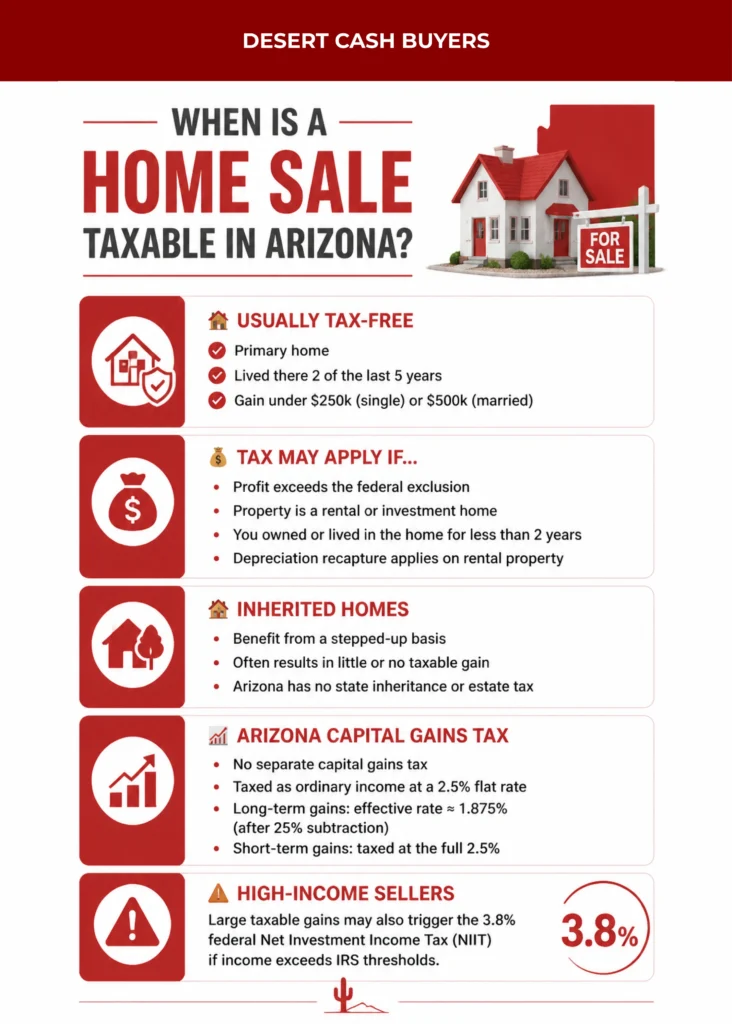
A home sale becomes taxable in Arizona when your profit exceeds the federal exclusion or the property wasn’t your primary residence, which is common with rental homes, fire-damaged or neglected properties bought as investments, and homes sold within a year or two of purchase.
| Scenario | Likely tax treatment |
| Primary home, lived in 2 of last 5 years, gain under $250K/$500K | Federal gain typically excluded; Arizona follows the same exclusion |
| Primary home, gain above the exclusion | Excess gain is taxable (federal capital gains rate, plus Arizona’s flat 2.5%) |
| Rental or investment property | Full gain is generally taxable; depreciation recapture may also apply |
| Inherited property sold by the heir | Usually a small or no taxable gain, due to the stepped-up basis |
| Owned or lived in less than 2 years | Gain is generally taxable, though partial exceptions exist for job moves, health, or other unforeseen circumstances |
High earners should also know that a large gain, whether from a primary home above the exclusion or an investment property, can trigger the additional 3.8% federal Net Investment Income Tax once modified adjusted gross income passes $200,000 for single filers or $250,000 for married couples filing jointly. That surtax stacks on top of ordinary federal capital gains rates and Arizona’s flat 2.5%, so a high-income seller with a large, non-excludable gain should run the full picture with a CPA rather than estimate it.
Selling an inherited home and stepped-up basis
Selling an inherited home rarely creates a large tax bill, because the property’s basis “steps up” to its fair market value on the date the original owner died, instead of what they originally paid decades earlier. If you inherit a home worth $350,000 at the time of death and sell it soon after for close to that amount, your taxable gain is small or zero, even though the original owner may have paid a fraction of that price years ago.
Arizona has no state estate or inheritance tax, so heirs generally face only the federal rules described above. This is one reason selling an inherited property, even one that needs repairs or has sat vacant, often carries a lighter tax burden than sellers expect. If you’re weighing your options as an heir, our guide to selling an inherited house covers the process and options in more detail.
The tricky part is documenting that stepped-up value. Heirs in Maricopa County often start with the county assessor’s records for the year of death, then get a formal appraisal if the home needs repairs, is vacant, or the family is settling a probate estate where the court wants a defensible number. Whichever route you take, keep the paperwork; it becomes your basis if you sell later, and it’s the number a tax preparer will ask for first.
Does Arizona have a separate state capital gains tax?
Arizona does not have a separate state capital gains tax. The state taxes capital gains as ordinary income at its flat 2.5% rate, the same rate that applies to wages, confirmed on the Arizona Department of Revenue’s individual income tax pages. Arizona also allows a 25% subtraction on net long-term capital gains, which lowers the effective state rate on those gains to roughly 1.875%. Short-term gains don’t get that subtraction and are taxed at the full 2.5%.
How to Reduce or Avoid Tax on Your Sale
- Confirm the home was your primary residence for at least 24 months within the last five years, so you qualify for the $250,000/$500,000 exclusion.
- Track capital improvements, like a new roof, a room addition, or a full kitchen remodel, since they raise your adjusted basis and shrink your taxable gain.
- For an inherited home, document the fair market value as of the date of death, often through a professional appraisal or the county assessor’s records, to lock in the stepped-up basis. Keep your sale records organized, too. If you’re preparing to sell for cash, our documents needed to sell a house for cash in Arizona checklist covers the paperwork you may need before closing.
- If you’re close to the two-year ownership or use mark and have flexibility on timing, waiting until you cross it can be the difference between owing tax and owing nothing.
- Talk with a CPA before closing, especially for rental property or an inherited home with depreciation history, since those situations have more moving parts than a straightforward primary-residence sale.
- If you’re selling a rental or a second home, ask your CPA about a 1031 exchange, which can defer tax on investment property by rolling the proceeds into another qualifying property instead of cashing out.
None of these steps require slowing down your sale. Most of this is paperwork you gather before closing, like receipts for a remodel or an appraisal for an inherited home, not a reason to delay while a buyer sits on financing. For more on how the process works for different situations, our Arizona seller resources blog covers foreclosure, probate, and tenant-occupied sales in more depth than we can fit here.
We can’t give tax advice, but we can move on your timeline while you sort out the numbers with your CPA. See how our process works and request a free, no-obligation cash offer whenever you’re ready.
None of this changes what a cash sale is worth to you. Our offers are based on the home’s After Repair Value, minus repair and holding costs, and the offer we make is the offer you get. There’s no financing contingency, no repair renegotiation, and we cover standard closing costs, so the number you see is the number that closes.
Sellers in different situations often find it helpful to compare their options first. Our overview of Arizona cash home buying options walks through how a direct cash buyer, an iBuyer, and a traditional listing stack up on speed, certainty, and net proceeds.
It’s also worth being honest about what any of these paths mean for your tax picture. Whether you sell to a direct buyer, an iBuyer, or through a traditional listing with an agent, the sale price is the sale price for tax purposes; the IRS doesn’t care which route you took to get there. What changes your net proceeds is commission, repair costs, and closing costs, not your basis or your exclusion. A traditional sale in Phoenix or Scottsdale typically carries a 5 to 6% agent commission plus a seller’s share of closing costs, and a lender may require repairs before closing, which is one reason some Valley sellers look at selling a Phoenix home without a realtor. Selling to a direct buyer skips the commission and covers standard closing costs, but the offer itself reflects the home’s after-repair value minus what it would cost to fix it up. Neither path changes what you report to the IRS.

Frequently Asked Questions About Taxes on Selling a House for Cash in Arizona
Does selling for cash change my taxes?
No. The IRS and the state of Arizona tax your gain the same way regardless of whether you sell to a cash buyer, list with an agent, or sell FSBO. What matters is your profit, how long you owned and lived in the home, and whether it was your primary residence. A faster closing timeline doesn’t create a faster or different tax bill; it just gets you to your net proceeds sooner.
Do I pay tax if I lived there 2 years?
If you owned and used the home as your primary residence for at least 24 months within the five years before the sale, you can typically exclude up to $250,000 of gain as a single filer or $500,000 if married filing jointly. Any profit above that threshold is taxable.
Are there taxes on an inherited home sale?
Sometimes, but usually less than sellers expect. The stepped-up basis resets the home’s value to what it was worth on the date of death, so most of the appreciation that happened before you inherited it isn’t taxed. Arizona also has no separate inheritance or estate tax, and if the home was vacant or needed repairs before you sold it, that doesn’t change the basis calculation.
Do I report the sale even if it’s tax-free?
Sometimes. If you receive a Form 1099-S or your entire gain isn’t excludable, you need to report the sale, even when the taxable amount is zero. Publication 523 covers exactly when reporting is required.
What if I’ve owned the house for less than a year?
If you sell before hitting the one-year mark, any taxable gain is treated as short-term and taxed at your ordinary federal income tax rate rather than the lower long-term capital gains rates, and it won’t qualify for Arizona’s 25% long-term subtraction either. Owning past the one-year mark, and meeting the two-year primary-residence test where it applies, generally produces a smaller tax bill.
Taxes on Selling a House for Cash in Arizona
Taxes when you sell your house for cash in Arizona come down to your profit, your residency history, and whether the home was your primary residence, not the speed of the sale or the type of buyer. Most Phoenix and Mesa homeowners selling a primary residence owe nothing federally, and Arizona taxes any leftover gain at a flat, modest rate. Sellers dealing with an inherited home, a rental, or a property they’ve owned less than two years should talk with a CPA before closing, since those situations carry more moving parts. Whatever your situation, we can walk you through the process and get a no-obligation cash offer started, often within 15 minutes, with a close in as few as 7 days, no fees, and no pressure. You pick the closing date, and there’s no obligation to accept.