

How to Sell an Inherited House in Phoenix After a Loved One Dies
Selling an inherited house in Phoenix is rarely straightforward, especially when you’re navigating grief, probate paperwork, family decisions, and the pressure to sell an inherited house Phoenix families may not have planned to manage.
By the time the funeral is behind you and the estate paperwork begins, you’re often fielding questions from siblings, calls from a probate attorney you’ve never met, and decisions about a property you may never have intended to own, all while grieving.
If you’re dealing with an inherited home in Phoenix or the surrounding Valley, you’re not alone. Arizona sees thousands of estate home sales every year, and the process involves legal steps, tax implications, and family dynamics that most people have never navigated before.
This guide gives you the full picture: how Arizona probate works, who has the legal authority to sell, what the tax rules mean for you, how to handle disagreements between heirs, and what your selling options actually are, including why many Arizona families choose to sell for cash and move on with their lives.
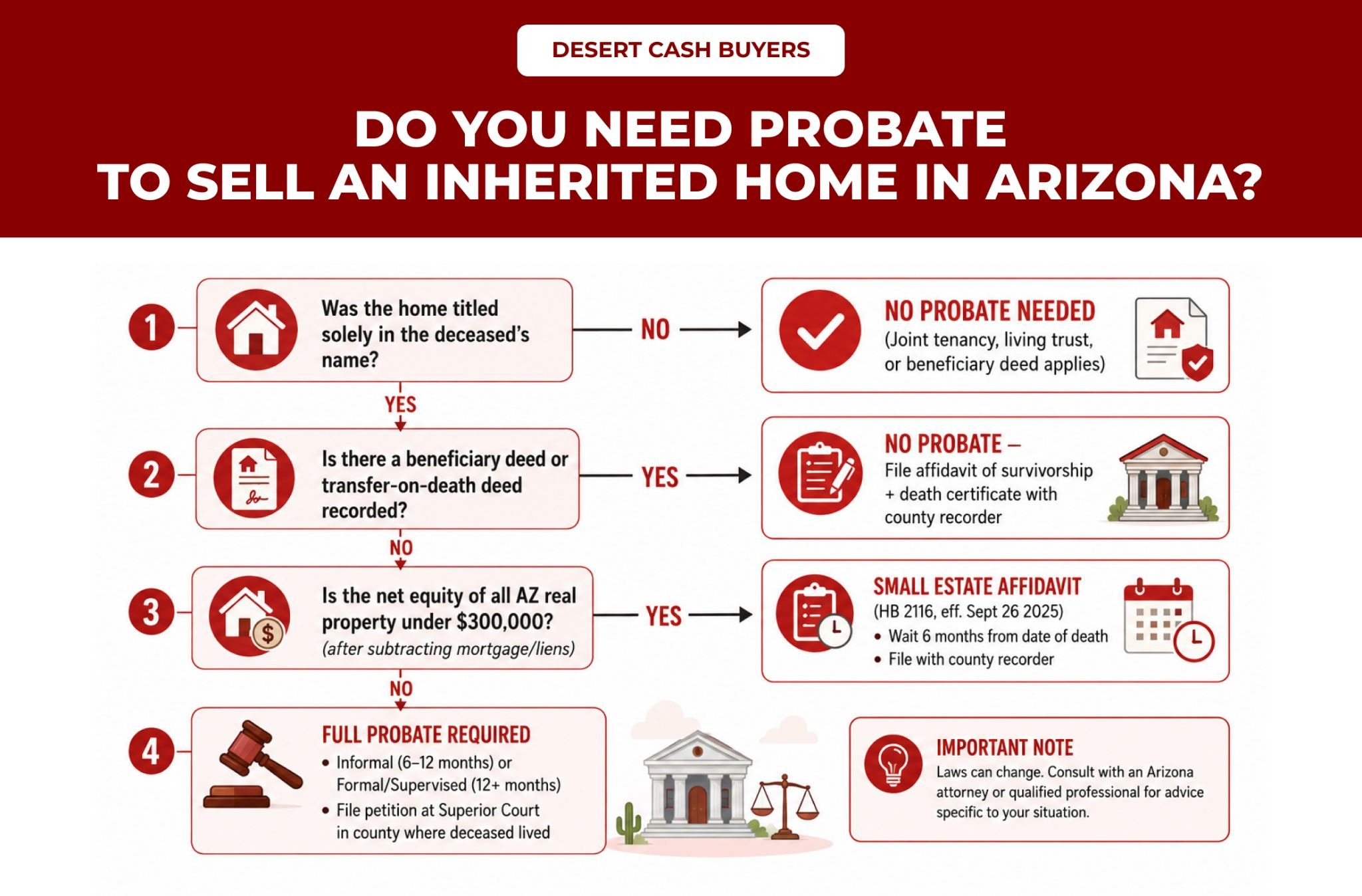
Section 1: Do You Actually Need to Go Through Probate?
You may not need to go through probate to sell an inherited house in Phoenix if the property was held in a trust, had a survivorship designation, or the estate qualifies for Arizona’s simplified probate process.
When Probate Is Required
Probate is required when the deceased person owned real property solely in their own name, and it wasn’t set up to transfer automatically at death. If the Phoenix home was titled only in your parents’ name, no beneficiary deed, no joint tenancy, no living trust, it must pass through probate before it can be legally sold.
When You Can Skip Probate
Arizona law provides several ways to transfer property without full probate:
Beneficiary Deed (Transfer on Death Deed): If the deceased recorded a beneficiary deed with the county, the property transfers directly to the named beneficiary upon death. The beneficiary records an affidavit of survivorship and a certified death certificate with the county recorder, without a court order.
Joint Tenancy with Right of Survivorship: If the home was held in joint tenancy, the surviving owner automatically inherits the deceased’s share. A certified death certificate recorded with the county recorder is typically sufficient.
Living Trust: If the home was held in a revocable living trust, it passes to the successor trustee and then to beneficiaries according to the trust terms, completely outside probate.
Small Estate Affidavit – Updated 2025 Limits: Under Arizona’s updated small estate affidavit law (HB 2116, effective September 26, 2025), heirs can use a simplified affidavit process, rather than formal probate, if the net value of all Arizona real property in the estate does not exceed $300,000 after subtracting any liens or mortgages. The personal property cap was also raised to $200,000. These are significant increases from the previous caps of $100,000 (real property) and $75,000 (personal property).
Important: These thresholds apply based on the affidavit filing date, not the date of death. Even if your loved one passed away before September 26, 2025, you may qualify for the higher limits by filing after that date. Consult an Arizona probate attorney to confirm eligibility before filing.
When Full Probate Is Unavoidable
If the home’s net equity exceeds the small estate threshold, or if there are disputes among heirs, creditor claims, or questions about the validity of the will, you’ll need to open formal or informal probate in the Superior Court of the county where the deceased lived.
Arizona Probate Timeline at a Glance
| Stage | Informal Probate | Formal / Supervised Probate |
| File petition | Week 1–2 | Week 1–2 |
| Personal rep appointed | Within a few weeks (no hearing) | Longer court hearing required |
| Inventory & appraisal | Month 2–4 (within 90 days) | Month 2–4 |
| Creditor notice period | 4 months from first publication | 4 months from first publication |
| Pay debts & taxes | Month 5–8 | Month 5–8+ |
| Distribute assets & close | Month 8–12 (6–12 months total) | 12+ months, sometimes years |
Section 2: Legal Authority. Who Can Actually Sign to Sell?
Even if everyone agrees the house should be sold, only certain people have the legal authority to sign a purchase contract and close the transaction.
If there is a will: The executor, called the ‘personal representative’ in Arizona, named in the will has legal authority to sell estate property, but only after being formally appointed by the court. In informal probate, this can happen within a few weeks of filing.
If there is no will (intestate): Arizona courts appoint an administrator as personal representative. Surviving spouses have priority, followed by adult children, parents, and other relatives under Arizona’s intestacy statutes (A.R.S. § 14-3203).
If the home is in a trust: The successor trustee has full authority to sell as defined by the trust document, no court involvement required.
Key point: No one, not even an heir who lives in the home, can legally sell the property until proper legal authority is established and documented. Attempting to sell before the personal representative is appointed creates serious legal exposure for everyone involved.
Section 3: Documents You’ll Need Before Selling
Gathering the right paperwork early saves weeks of delays. Whether you’re working with a real estate agent or a cash buyer, have these ready:
□ Certified copy of the death certificate (obtain multiple certified copies; you will need them)
□ Original will and any codicils, if one exists
□ Letters Testamentary or Letters of Administration from the Superior Court, proves the personal representative’s authority to act
□ Property deed showing how the home was titled
□ Recent property tax statements, confirm taxes are current or identify any arrears
□ Mortgage statement, if the home has an outstanding loan
□ HOA documents, if the property is in a homeowners association
□ Any existing appraisals or recent Maricopa County Assessor records
□ Title insurance policy, if available
Cash buyers typically help you identify what’s missing and can guide the process, but having these ready from the start significantly speeds up the timeline.
Section 4: The Tax Advantage Most Heirs Don’t Know About
One of the most important, and most misunderstood, aspects of selling an inherited home is the federal stepped-up basis rule. Understanding it correctly can save you thousands of dollars or help you decide whether to sell quickly or wait.
How the Stepped-Up Basis Works
When you inherit property, the IRS adjusts your cost basis to the fair market value of the home on the date of the original owner’s death, not the price they originally paid for it.
Example: Your parent purchased a home in Scottsdale in 1992 for $85,000. At the time of their death, the home was worth $450,000. Your stepped-up basis is $450,000, not $85,000. If you sell for $460,000, your taxable gain is only $10,000, not the $375,000 gain your parent would have recognized if they had sold it before death.
This rule can dramatically reduce or eliminate your capital gains tax liability, especially if you sell the inherited property soon after inheriting it.
Arizona’s Tax Picture for Inherited Property
• No Arizona estate tax. Arizona eliminated its state estate tax in 2006. As of 2025–2026, there is no Arizona state inheritance tax either. Heirs owe no Arizona tax simply for receiving an inheritance.
• No federal estate tax for most families. The federal estate tax only applies to estates exceeding $13.99 million per individual in 2025. Most Arizona families owe nothing.
• Capital gains tax does apply when you sell. If the home has appreciated between the date of death and when you sell, the gain above your stepped-up basis is subject to capital gains tax. For inherited real estate held long-term, the maximum federal rate is 20%. Arizona taxes capital gains as ordinary income at a flat 2.5% state rate, with a 25% subtraction for long-term gains, bringing the effective Arizona rate to approximately 1.875%.
Practical takeaway: The longer you hold the inherited property before selling, the more potential gain accumulates above your stepped-up basis. Many heirs choose to sell quickly, often to a cash buyer, to capture the tax advantage before additional appreciation occurs. Always consult a tax professional for guidance specific to your situation.
Section 5: Aligning Multiple Heirs. The Most Common Roadblock
When a home is left to multiple children or heirs, disagreements are common. One heir wants to sell immediately. Another wants to keep it as a rental. A third hasn’t responded in weeks. This is the single most common reason inherited home sales in Phoenix take far longer than they need to, or fall apart entirely.
Understanding Your Legal Position
In most cases, all heirs with an ownership interest must agree before the personal representative can complete a sale. If even one heir objects or is unreachable, the sale can be delayed indefinitely or require court intervention through a partition action, where a judge orders the forced sale of the property. Partition actions resolve the deadlock, but they add legal costs, time, and stress to an already difficult situation.
Strategies for Getting Everyone on the Same Page
• Get everyone informed early. Many heir conflicts come from information gaps, one person knows more than others, and the rest feel excluded. A family meeting with a clear financial picture (current value, carrying costs, debt, tax implications) helps everyone make decisions from the same starting point.
• Put the carrying costs in writing. Property taxes, insurance, utilities, and maintenance on a vacant home accumulate every month. When heirs see the real monthly cost of delay, decisions often move faster.
• Present a concrete cash offer. A real number from a local buyer, with a clear closing date and no repair requirements, removes the uncertainty that often stalls decisions. It’s easier to compare options when there’s an actual offer on the table.
• Consider a buyout. If one heir wants to keep the property and others want to sell, the heir who wants to keep it can pay out the others’ share. This is often the cleanest resolution when heirs disagree on intent.
• Involve the probate attorney early. If communication has broken down, an attorney can help everyone understand their legal obligations before the situation escalates to litigation.
Section 6: Your Selling Options Compared
Once the personal representative has legal authority and the heirs are aligned, you have three main paths to sell an inherited home in Phoenix.
| Factor | Agent Listing | Cash Sale |
| Timeline to close | 60–90+ days | As little as 3 days |
| Repairs required | Often yes | None |
| Certainty of close | Moderate (financing can fall through) | High (no lender involved) |
| Commission / fees | 5–6% agent commission | None |
| Showings required | Yes—weekly open houses | No |
| Contents of home | Must be cleared before listing | Leave anything behind |
| Best for | Heirs with time, aligned heirs, move-in ready home | Speed, certainty, out-of-state heirs, properties needing work |
Agent listing: Achieves the highest gross sale price but requires repairs, staging, and a timeline that often runs 60–90+ days. Inherited homes that need updating may sit longer or require pre-sale investment. Best for heirs who have time, are aligned, and have a move-in-ready property.
Auction: Can move quickly and create competitive bidding, but the final price is unpredictable, and auction fees can be substantial. Best for unique or high-value properties.
Cash sale: Purchases the home as-is, no repairs, no listings, no showings. The personal representative signs once, and the sale can close in as little as 3 days, or on whatever timeline the estate needs. This option is often best for heirs who want a fast, predictable, and low-stress way to sell the home as-is.
Section 7: Why Cash Buyers Are Ideal for Inherited Homes
Cash buyers are ideal for inherited homes because they can purchase properties as-is, close quickly without financing delays, simplify the process for out-of-state heirs, and help estates avoid costly repairs and agent commissions.
• No repairs required. Inherited homes are often older properties with deferred maintenance, outdated systems, or belongings left behind. Cash buyers purchase in any condition — no cleaning, repairing, or staging needed.
• Speed. Informal probate alone takes 6–12 months. Once the personal representative has legal authority, a cash buyer can close in as little as 3 days. There’s no reason to add months of listing and negotiation on top of the probate process.
• Certainty. Traditional buyers using mortgage financing can have their loans fall through at the last minute. Cash offers have no financing contingencies; the deal closes.
• Simplicity for out-of-state heirs. Phoenix is a major retirement destination. When heirs live in different states, managing a traditional listing remotely is complicated. A cash sale requires minimal in-person involvement from the personal representative.
• No commissions. Cash buyers purchase directly, with no agents required on either side. On a $450,000 home, avoiding a 5–6% agent commission saves $22,500–$27,000 that stays in the estate and gets distributed to heirs.
Curious about how much cash buyers typically offer for a Phoenix home? We break down the full calculation.
Section 8: How Desert Cash Buyers Works With Inherited and Probate Homes
Desert Cash Buyers has served Arizona homeowners for over 10 years and has purchased more than 1,000 homes across Scottsdale, Phoenix, Chandler, Mesa, Tempe, Cave Creek, and Gilbert. The company is BBB-accredited with a 4.9/5 rating from 1,245 verified sellers and is run by Quinn Irvine.
Quinn and his team work with personal representatives, executors, trustees, and heirs throughout the Phoenix metro—including situations where probate is still in progress. Here is how the process works:
1. Schedule a visit in person or by phone. Tell us about the property and where things stand with the estate. We explore all options with you. No hassles, no commitments.
2. Get a fair cash offer in 15 minutes or less. We assess the property and present a no-obligation offer. No repairs required. No commissions. No hidden fees.
3. Accept and get paid on your timeline. We close on the estate’s schedule, as little as 3 days, or whenever probate authority is confirmed. We will not rush you to move out. A licensed and insured title company handles all paperwork.
You don’t have to empty the home. Leave what you don’t want; we’ll handle it.
If the inherited home has an outstanding mortgage, that’s not a barrier to selling. The mortgage is paid off at closing from the sale proceeds, and you receive whatever equity remains. For more on this, see our guide on selling a house that isn’t paid off.

Frequently Asked Questions About Selling an Inherited Home in Arizona
Can the executor sell the house without all heirs agreeing?
In most cases, the personal representative has the authority to sell estate property to pay debts and distribute assets, even if not all heirs agree, once properly appointed by the court. However, if the will requires heir consensus for a sale, or if the home is to be distributed in-kind, the situation is more complex. Your probate attorney can clarify the specific terms of the estate.
How long does it take to sell an inherited home in Arizona?
Informal probate in Arizona typically takes 6–12 months from filing to close, with a mandatory minimum of 4 months for the creditor notice period. Once the personal representative has selling authority, a cash buyer can close the actual home sale in as little as 3 days. A traditional listing adds 60–90+ days on top.
Do we have to pay off the mortgage before selling?
No. If the inherited home has an outstanding mortgage, it is paid off at closing from the sale proceeds, the same as any other home sale. The estate receives the remaining equity after the mortgage payoff and any closing costs.
What if the home has more debt than it’s worth?
Options include a short sale with lender approval or allowing the lender to foreclose. A cash buyer may still be interested in purchasing at the property’s as-is value, but the estate and lender would need to resolve the remaining balance. This is a situation worth discussing directly with both a probate attorney and Desert Cash Buyers.
Can we sell during probate, before it’s finished?
Yes. The personal representative can sell the home during probate once formally appointed and issued Letters Testamentary or Letters of Administration by the court. Proceeds are held in the estate account until probate closes and distributions are authorized.
What happens to the contents of the house?
Personal property is typically addressed separately from real property. Heirs can divide items of personal value, sell or donate the rest, or simply leave everything for the cash buyer to handle. Desert Cash Buyers purchases homes with contents left in place; you are not required to empty the home before closing.
Is there a deadline to sell the inherited home?
No law forces an immediate sale. However, the estate incurs carrying costs—property taxes, insurance, and maintenance—for as long as the property is held. These reduce the net proceeds eventually distributed to heirs. Acting promptly once legal authority is established is generally in everyone’s financial interest.
Do I need a real estate agent to sell an inherited home?
No. If selling to a cash buyer, no agent is required. The title company handles the legal transfer. If using a traditional listing, an agent experienced in probate sales is strongly recommended; the process has specific requirements that general-practice agents sometimes miss.
You Have More Control Than You Think When Selling An Inherited Home in Phoenix
Selling an inherited home in Phoenix involves more steps than a standard sale, but the path forward is clearer than it feels in those first overwhelming weeks. Once you understand where you stand legally and what your selling options actually are, most families find they can move faster and more decisively than they expected.
The key questions to answer first:
• Does this estate need full probate, or do you qualify for Arizona’s updated small estate affidavit process?
• Who is the personal representative, and do they have their Letters Testamentary?
• Are the heirs aligned, or do you need to get everyone on the same page first?
• What matters most to the family—maximum sale price, speed, or certainty?
If speed and certainty matter, and for many families managing an estate from a distance, they do, a cash sale is often the most practical path. No repairs, no showings, no waiting on a financed buyer’s lender, and no agent commission, reducing what the estate receives.
Desert Cash Buyers works with executors, trustees, and heirs throughout Phoenix, Scottsdale, Mesa, Chandler, Tempe, Cave Creek, and Gilbert. Quinn Irvine and his team understand probate timelines and can move as fast or as slow as the estate requires.