
Selling a rental property with tenants in Arizona is not the same as selling an empty house. You have a lease to think about, maybe a tenant behind on rent, and a mortgage payment due whether the unit is occupied or not.
Yes, you can sell a house with tenants in it in Arizona. State law lets the sale close with the tenant still inside. Selling occupied rental property in Arizona does not require an eviction, and it does not require the unit to sit empty first.
Here is what catches most landlords off guard going in:
- Fixed-term leases survive a sale. Whoever buys the house becomes the new landlord for whatever time is left.
- A local cash buyer can often close around a tenant, unlike most financed buyers who want the unit vacant.
- A problem tenant or back rent does not block a sale. It changes how a buyer prices the deal, not whether they will make one.
- The security deposit moves with the sale. It goes to the buyer or back to the tenant, never into your pocket at closing.
- We hear from tired landlords asking this exact question every week, and a tenant in place rarely changes the answer.
Can You Sell a House in Arizona While Tenants Still Live There?
Yes. Arizona law lets you sell an occupied rental, and neither the state nor your lender requires the unit to be vacant first.
A sale transfers the deed. It does not cancel a lease. The Arizona Residential Landlord and Tenant Act treats a change of ownership as a change of landlord, not a change of tenancy, so your tenant’s rights carry over to whoever buys the house next, whether that is a family moving in, an investor after the rent roll, or a local direct buyer like us.
What actually changes is your buyer pool. Financed buyers and traditional listings tend to want vacant possession. A cash buyer for a tenant-occupied house in Arizona, working through a licensed independent title company with funds held in escrow, often does not.
Arizona Landlord-Tenant Law Basics Every Selling Landlord Should Know
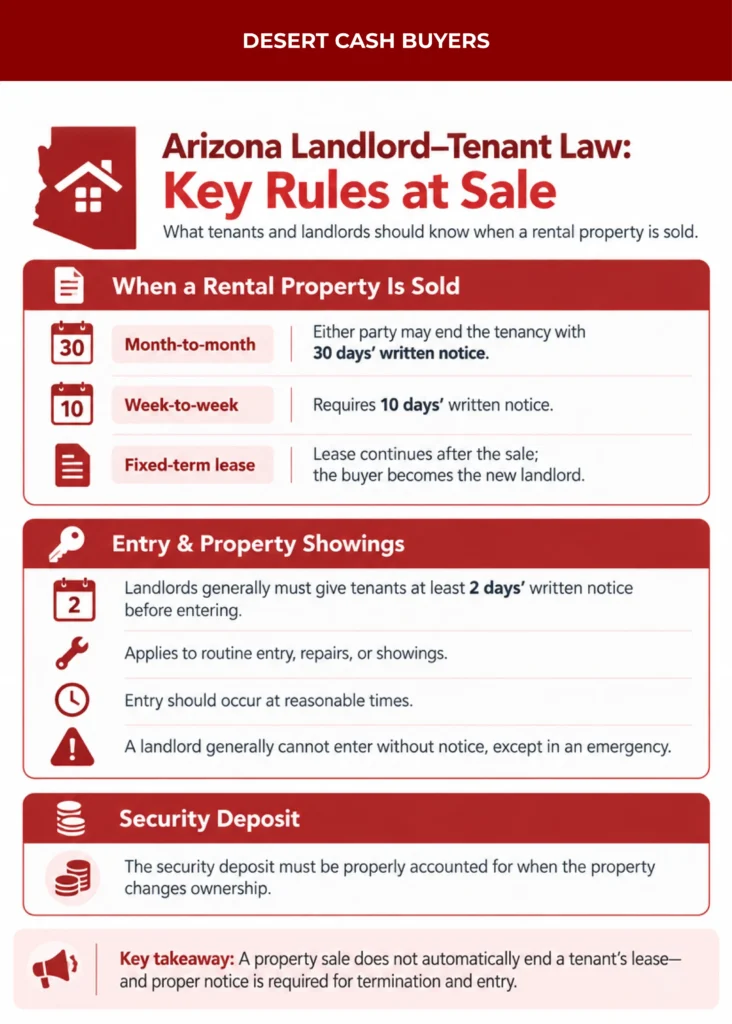
Three rules matter most when you sell an occupied Arizona rental: the lease survives the sale, you owe specific notice before anyone can enter or show the unit, and the security deposit has to be accounted for at closing.
Month-to-Month vs. Fixed-Term Leases at Sale
A month-to-month tenant can be asked to leave with 30 days’ written notice. A fixed-term tenant generally stays until the lease ends, sale or no sale. That single distinction shapes most of your timeline if you sell a house with tenants in it in Arizona.
| Lease Type | What Happens at Sale | Minimum Notice to End Tenancy | Governing Statute |
| Month-to-month | Buyer or seller may end it | At least 30 days’ written notice before the periodic rental date | A.R.S. § 33-1375(B) |
| Week-to-week | Same idea, shorter clock | At least 10 days’ written notice | A.R.S. § 33-1375(A) |
| Fixed-term lease | Lease continues; new owner becomes landlord | No standard early-termination notice; runs to the lease’s end date | Lease terms, under the Arizona Residential Landlord and Tenant Act |
Tenant Notice Requirements for Entry and Showings
Arizona law gives your tenant at least two days’ notice before you, a buyer, or an inspector can enter the unit, even just to look. A tenant cannot unreasonably withhold consent for a landlord to show the property to a prospective purchaser, but the landlord side of that bargain is just as real: notice of at least two days, entry only at reasonable times, and no letting yourself in outside a genuine emergency.
| Arizona notice-to-enter snapshot: at least two days’ written notice for a routine entry, repair, or showing, entry only at reasonable times, and no separate notice period for a purchaser walkthrough versus any other permitted entry. Confirm current statute language before relying on this for a specific situation.General information only, not legal advice. For lease-specific or eviction questions, talk with an Arizona attorney or your county justice court. |
Why Traditional Buyers and Agents Struggle with Occupied Rentals
Traditional buyers and agents struggle with occupied rentals because financing, appraisals, and showings are all built around an empty house.
Financing and Appraisal Hurdles with a Tenant in Place
A lender financing the purchase typically wants clear, vacant possession, or at minimum a lease the buyer’s loan program allows. An appraisal can also come in lower once a below-market lease is factored in, which can sink a financing or appraisal contingency before closing.
Showing Logistics and Buyer Hesitation
Every showing needs your tenant’s two-day notice honored, which means coordinating three schedules instead of one. Many buyers also hesitate to inherit someone else’s tenant, back rent, or lease terms they did not negotiate, so the buyer pool for an occupied rental is smaller than for a vacant one.
| Friction Point | Why It’s Harder With a Tenant in Place |
| Vacant possession | Most loan programs require it before funding |
| Appraisal | A below-market lease can pull the appraised value down |
| Showings | Every visit needs at least two days’ tenant notice |
| Repairs | Lenders often require repairs finished before closing, hard to do with someone living there |
Selling with a Problem Tenant or Back Rent Owed
You can sell a rental property with problem tenants in Arizona or back rent owed. It changes how a buyer prices the deal. It does not change whether a sale is possible.
You cannot remove a tenant yourself, even a holdover tenant, no matter how close you are to closing. Arizona bans self-help removal: no changing locks, no shutting off utilities, no setting belongings on the curb. Removing a genuine holdover runs through a court action for possession, and the timeline depends on the court’s schedule and the facts of the case, not a fixed number of days.
A local direct buyer can factor a slow-moving tenant situation, or a house with tenants behind on rent, into the offer instead of requiring it solved first. Landlords in this spot are often facing foreclosure as well, or the property also has liens or a payoff to resolve, and a single buyer who can work through all of it at once usually beats juggling three separate problems on three separate timelines.
What Happens to the Security Deposit and Lease at Closing
Your tenant’s security deposit and lease both move through closing on paper. They do not move through your pocket.
Arizona’s landlord-tenant act addresses deposit handling when the landlord’s interest in the property changes. In most closings, the deposit moves to the buyer along with written notice to the tenant naming the new party holding it. Every closing here runs through a licensed independent title company, with funds held in escrow until closing, so the deposit transfer and the sale proceeds are both documented, not handled on a handshake.
The lease itself needs no separate paperwork to survive the sale. A fixed-term lease simply continues under the new owner. A month-to-month tenancy continues too, until whoever now owns the house gives the required 30 days’ notice.
Why a Direct Cash Sale Is the Simplest Exit for Tired Landlords
A direct cash sale is the simplest exit for a tired landlord who wants to sell a house fast in Arizona, because one buyer absorbs the lease, the tenant, and the repairs instead of asking you to resolve them first.
We have bought Arizona homes directly since 2015, more than 10 years serving Arizona sellers, and back that with a 4.9-out-of-5 rating from 1,245 verified sellers you can check independently on Google. Zero commissions, zero closing costs, and zero fees of any kind come out of your side of the deal.
| Factor | Financed Buyer | Local Cash Buyer |
| Vacant possession required | Usually, for most loan types | Often not required |
| Financing or appraisal contingency | Yes | No |
| Property access | Multiple showings scheduled around the tenant | One phone call or a single private visit |
| Repairs before closing | Typically required | As-is |
| Typical timeline | 30 to 60-plus days, financed escrow | 7 to 14 days; fastest on record 3 days |
Ask any buyer, us included, to show the comps and repair estimate behind the number. Our offers typically land at 70 to 85 percent of after-repair value (ARV) in strong markets, a range that describes general outcomes, not a promise for your specific property. See how the cash offer is calculated for the full breakdown.
The example below is illustrative only, with round numbers, to show where the gap between listing and a cash sale actually comes from once a tenant is part of the picture.
| Line Item | Traditional Listing (Tenant Must Vacate First) | Cash Sale (Tenant Stays Through Closing) |
| Estimated market value | $300,000 | $300,000 |
| Commissions (approx. 5-6%) | -$16,500 | $0 |
| Repair credits and negotiated concessions | -$8,000 | $0 |
| Vacancy loss while waiting on move-out (approx. 60 days) | -$3,000 | $0 |
| Closing costs | -$3,000 | $0 |
| Illustrative net (example scenario only, not an offer) | roughly $269,500 | 70-85% of ARV, condition-dependent |
Real numbers depend on your tenant’s lease, your loan payoff, and the property’s actual condition. Treat this as a way to check any offer’s math, not as a quote.
One Exception: When Listing With a Good Tenant Might Net More
If your tenant pays reliably, the unit is in good condition, and you are not in a hurry, listing to another investor can net more than a fast cash sale. Investor buyers often pay closer to full market value for a performing rental, since it removes their own vacancy risk and turnover cost. If your situation is less about the tenant and more about a difficult block or a hard-to-sell location, that is a separate problem with its own fix, covered in our guide to selling a house fast in a bad location in Arizona. A cash sale is the right tool for speed and certainty. It is not built to beat a strong market price when time is on your side.

Frequently Asked Questions about Selling a Tenant-Occupied Rental Property in Arizona
Can I sell my house if I have a tenant in Arizona?
Yes. Arizona law allows a sale to close with a tenant in place. The lease and the security deposit transfer to the new owner instead of ending the tenancy.
Do I have to evict my tenant before selling?
No. Eviction is not a prerequisite to selling. A local direct buyer can purchase the property with the tenant still living there and take over as landlord.
Can I sell a house for cash if it has tenants in it?
Yes, and this is one of the most common questions we get. Our sub-pillar page answers this same question in its own FAQ, Can I sell a house for cash if it has tenants in it?, with the full breakdown of how an occupied purchase works.
What happens to the security deposit if I sell while a tenant is living there?
It transfers to the buyer or gets refunded to the tenant, documented in writing at closing. A licensed independent title company handles this the same way it handles the rest of the closing funds, through escrow.
Can I sell a rental property with a tenant who is behind on rent?
Yes, though it affects how a buyer prices the deal, since unpaid rent and a possible eviction are part of what they are taking on. Describe the situation honestly when you request an offer so the number reflects reality.
Do I have to end my tenant’s lease before selling to a cash buyer?
No. A local direct buyer can purchase the property with the lease in place and collect rent as the new landlord. How It Works walks through the steps of a tenant-occupied sale from first call to closing, and our FAQ page covers more landlord-specific questions like this one.
Selling Your Rental Property With Tenants in Arizona Starts With One Call
Selling a rental property with tenants in Arizona does not require an empty house, a finished eviction, or a listing agent’s showing schedule. It requires knowing which lease you are working with, what notice it needs, and who you are actually selling to. A tenant is just one of the situations we work through with sellers; see every situation we help with if something else about your property is complicating the sale too.
Tell us about your tenant, your lease, and your timeline, and we will walk the property by phone or a single private visit, then build a cash offer with the comps and repair math shown, typically within about 15 minutes, with no obligation and no fees. If you’d rather talk it through first, get your free cash offer and speak with us directly. You can also browse our blog for more information on specific landlord and seller situations. You can also browse our blog for more on specific landlord and seller situations.