
A Section 363 bankruptcy home sale is a court-supervised sale of property belonging to the bankruptcy estate. If you have already read our guide to selling your house fast during bankruptcy in Arizona and know a sale may be possible in your case, the next question is how the bankruptcy court’s approval process actually works.
In Arizona, a sale outside the ordinary course generally proceeds through a motion, notice to interested parties, an opportunity for objections, and a court process that results in an order authorizing the sale. The exact procedure can depend on the bankruptcy chapter, the property involved, and the applicable federal and Arizona local rules.
A few mechanics surprise most people the first time they see this process:
- A court hearing or approval process cannot simply be assumed away. The applicable rule and the judge’s procedures determine how the sale is handled.
- “Free and clear” does not necessarily erase liens. Section 363 can allow qualifying interests to be dealt with through the sale proceeds rather than remaining attached to the property.
- A financing contingency that fails after notice or court proceedings can create additional work and delay.
- Creditors and other parties in interest can object to the sale, including its price or terms.
- The court’s sale order is a critical part of completing and protecting the transaction.
This article explains how the process generally works in Arizona bankruptcy cases. It is general information, not legal advice, and it is not a substitute for guidance from your own bankruptcy attorney about your specific case.
What Is a Section 363 Sale in Bankruptcy?
A Section 363 sale is a court-approved sale of property that belongs to the bankruptcy estate, authorized under 11 U.S.C. § 363 of the federal Bankruptcy Code. Under Section 363 trustee or debtor in possession may sell property of the estate outside the ordinary course of business after notice and a hearing. For a home sale, this means the bankruptcy court’s approval is part of the process when the property is being sold outside the ordinary course.
Who actually files that motion depends on the chapter. In a Chapter 7 case, a trustee is appointed to control non-exempt assets, and only the trustee, not you, has authority to sell the house; if there is not enough real equity to reach, the trustee typically abandons the property back to you instead. In a Chapter 13 case, you generally keep that authority yourself, selling under 11 U.S.C. § 1303 with the trustee’s consent and the court’s order, rather than waiting on someone else to act. A Chapter 11 debtor-in-possession works similarly, selling business or personal real estate directly under the court’s supervision.
Section 363 also is not limited to a primary residence. A trustee or debtor can use the same process to sell a rental property, a duplex, or a second home in the estate, not just the home you live in, and Arizona’s homestead exemption only protects equity in the residence you actually occupy.
The Court Approval Process, Step by Step
A Section 363 home sale moves through four stages in most Arizona cases: the trustee files a motion, creditors get formal notice and a chance to object, a hearing happens only if someone actually objects, and the judge’s signed order clears the way to close.
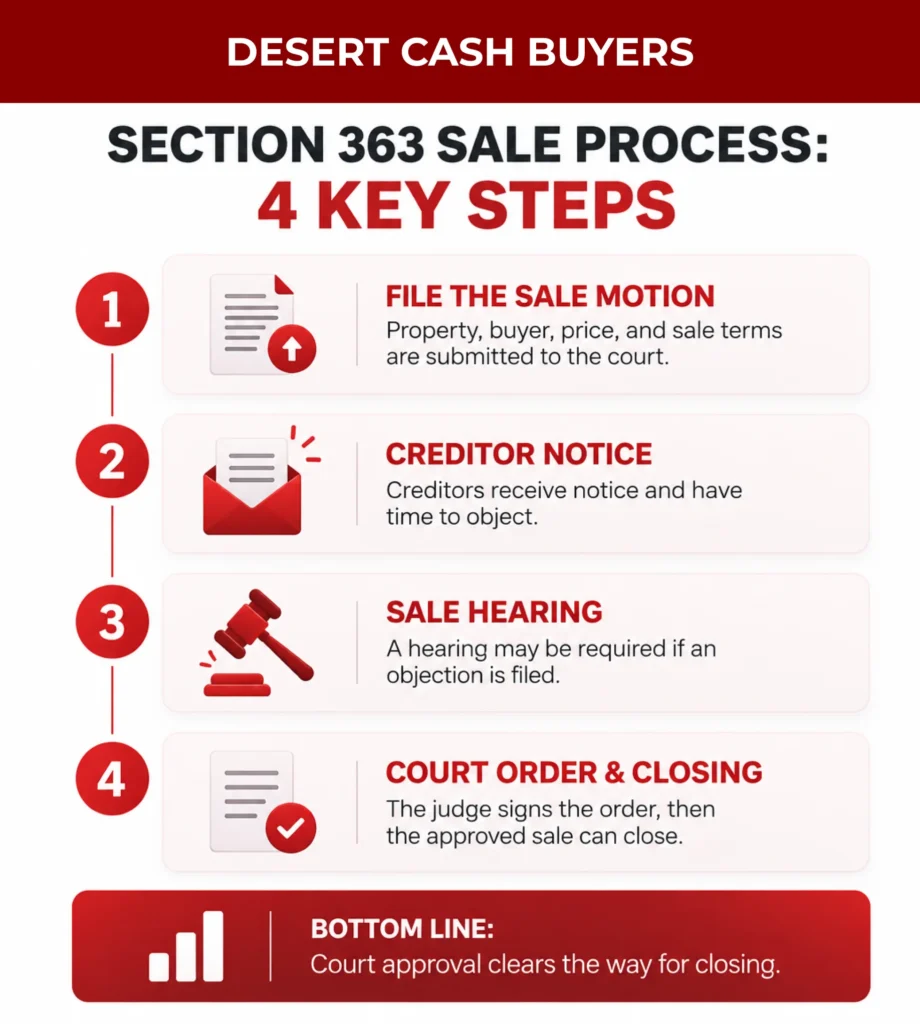
The trustee in a Chapter 7 case, or the debtor in a Chapter 13 case (with the trustee’s consent), or a Chapter 11 debtor-in-possession, files a written motion describing the property, the proposed buyer, the price, and the terms. This is the document that starts the clock. It has to include enough detail for creditors to evaluate whether the price and terms make sense, since the motion itself is what everyone else gets to react to.
Trustees who want room to accept a higher offer later often build bidding procedures into the same motion, sometimes called overbid procedures, so the court and any competing buyer already know the rules before the hearing. A motion built on comparable sales and a documented repair estimate, rather than a single unsupported number, gives creditors less to challenge and the judge more to rely on.
Step 2: The Creditor Objection Period
Once the motion is filed, the debtor, creditors, and other parties in interest receive formal notice with a deadline to object. Federal Rule of Bankruptcy Procedure 6004 sets the baseline notice requirements for a sale outside the ordinary course of business, and Arizona’s federal bankruptcy court has its own local rule that adds real-property-specific requirements on top of that baseline. If nobody files a timely objection, the sale can often move forward without a judge holding an in-person hearing; an objection sends it to a contested hearing instead. Given how much this can vary by case type, confirm the specific notice period and process that apply to your motion directly with your bankruptcy attorney.
Step 3: The Sale Hearing (When One Is Required)
The court process for a Section 363 sale depends on the applicable federal rules, the District of Arizona’s local rules, the bankruptcy chapter, and the judge’s procedures. Arizona Local Rule 6004-1 provides that sales of property outside the ordinary course of business are handled by motion, notice, and an opportunity for hearing, and it requires the sale notice to identify important details such as the proposed buyer, property, sale terms, known interests, objection deadline, and whether higher and better bids will be accepted. If an objection is filed, the matter can proceed to a contested hearing where the court considers the objection before deciding whether the sale should be approved.
When a hearing does happen, it is not always a simple yes-or-no on the original offer. If the motion included overbid or “higher and better offer” procedures, other interested buyers can show up and outbid the original offer right at the hearing, and the judge approves whichever bid the process produces. This is one more reason the trustee’s original price has to be defensible on its own: a number with no comps or repair math behind it invites both an objection and a lower ceiling for any competing bid.
Step 4: The Judge’s Order and Closing
The signed order is what actually authorizes the sale, and it is also what protects a good-faith buyer under 11 U.S.C. § 363(m) if anyone tries to challenge the sale later. Once the order is entered, the transaction closes like any other real estate sale, through a title company, with proceeds routed back through the bankruptcy estate. Our how it works page walks through what closing looks like on our end once a sale is cleared to move forward.
What “Free and Clear” Really Means for Liens and Judgments
A free and clear sale under Section 363 does not erase a mortgage, a judgment lien, or a tax lien. It moves that lien from the house to the sale proceeds, so the buyer takes clear title and the lienholder gets paid, or disputes its claim, out of the money instead of the property.
The court can approve a sale free and clear of an interest if at least one condition is met: applicable law allows it, the lienholder consents, the price is higher than the total of all liens against the property, the lien is genuinely disputed, or the lienholder could be forced to accept a cash payoff outside bankruptcy anyway. If your house also has a lien attached to it, our guide to selling your house fast with liens in Arizona breaks down how those payoffs actually get resolved at closing, inside or outside a bankruptcy case.
This is also where objections tend to cluster. A junior lienholder who thinks the sale price will not leave enough proceeds to reach their position has real standing to push back, which is one more reason the trustee wants a price backed by real comparable sales data going in.
Proceeds from a Section 363 sale get paid out in order, not all at once to everyone. Closing costs and any liens against the property are paid first, in priority order, out of the sale price. Your Arizona homestead exemption amount is protected next, since exempt equity is not part of what the estate can reach for creditors in the first place. What is left after that covers the trustee’s administrative costs and commission, and only then goes toward unsecured creditor claims. If anything remains after all of that, it comes back to you. The exact order and amount in your case depends on your liens, your exemption, and your filing date, so ask your bankruptcy attorney to walk through the actual math for your specific house.
How Long Does Section 363 Approval Take in Arizona?
A Section 363 home sale in Arizona can take several weeks from the filing of the sale motion through closing, but there is no single standard timeline. The timing depends on the notice requirements, whether an objection is filed, when the court can hear the matter, and how quickly the transaction can close after the sale order is entered.
| Stage | Typical Time Frame |
| Motion filed and served | Day 0 |
| Notice and objection period | Arizona’s general negative notice rule uses a 21-day window; real property sales follow their own separate local rule with its own notice and hearing requirements, so confirm which one applies to your case |
| If an objection is filed | Hearing must be scheduled; timing depends on the court’s calendar |
| Sale order entered | After the court approves the sale |
| Closing after the order | As fast as a few days with a cash buyer already under contract; 30 to 45 days is typical with a financed buyer |
Once the order is signed, the closing itself can move fast if the buyer is already ready to fund. That is the same logic behind our own most-closings-in-7-to-14-days standard, with our fastest close on record at three days, on a private sale outside bankruptcy. Our sell your house fast for cash in Arizona guide covers how that timeline works in a standard sale. Inside a Section 363 process, the court steps are what add weeks. The closing itself does not have to.
Why Financed Offers Struggle to Survive This Process
A financed offer adds two variables to a sale that is already running on a court clock: a financing contingency and an appraisal contingency. Either one can collapse the deal after the notice period has already run its course, and when that happens, the trustee is often back where they started.
If a financed buyer’s loan falls through after the court has already approved the sale, or during a re-notice, the trustee may have to file a new motion and restart the notice clock. Every restart adds weeks to a case, and weeks add legal fees that come out of the same estate the sale was supposed to benefit.
A cash offer also gives the trustee’s attorney something concrete to defend at the hearing. Proof of funds, a price built from comparable sales, and a documented after-repair value are the kind of details a judge expects to see before signing off, and they are much harder for a creditor to challenge than a number with no math behind it.
| Factor | Financed Buyer | Cash Buyer |
| Financing contingency | Present; the deal can fail in underwriting after notice has run | None |
| Appraisal contingency | Present; a low appraisal can force a price renegotiation or kill the deal | None; price is set from comps and repair math up front |
| Risk of a re-notice if the deal fails | Higher, since a late collapse can send the trustee back to square one | Lower, since funds are already verified and held in escrow |
| Typical time to close once the order is signed | 30 to 45 days, driven by loan underwriting | As fast as a few days to two weeks |
As a local direct buyer, we can fund a purchase without a lender, which is exactly the kind of certainty a trustee’s attorney wants to put in front of a judge. It is one less thing that can go wrong after the notice period has already run, and one less reason for anyone to end up back in front of the court a second time.
What Can Go Wrong, and How to Avoid It
Most Section 363 sales close without drama, but a few recurring problems are worth knowing about before your case runs into one.
- An unsupported price invites an objection. A number backed by comparable sales and a documented repair estimate is much harder to challenge than a round figure with no math behind it.
- A financing or appraisal contingency that fails late can force a re-notice and add weeks, as covered above.
- Incomplete or improper service of the notice can give an objecting party grounds to challenge the sale even after a hearing.
- Failing to claim, or misreporting, the Arizona homestead exemption on your bankruptcy schedules can affect how much of the proceeds actually come back to you, so this is worth confirming with your attorney early, not after an offer is already on the table.
- A junior lienholder disputing the free-and-clear treatment of their lien can slow or stall a sale if the trustee has not lined up the payoff math in advance.
- A trustee who accepts an offer without giving other buyers a chance to compete can face a challenge to the sale itself; building overbid procedures into the motion up front, so anyone can offer more at the hearing, heads this off before it becomes a problem.
Our frequently asked questions page covers more of the process-level questions sellers ask us directly, and our success stories page features accounts from Arizona sellers we have worked with.
We are a locally owned, independent buyer based in Scottsdale, serving Phoenix, Chandler, Mesa, Tempe, Cave Creek, and Gilbert, and we have been buying homes directly, including rentals and duplexes, since 2015. You can read more about our team on our About Us page.

Frequently Asked Questions about Section 363 Bankruptcy Home Sale
Can a sale be stopped after the motion is already filed?
Yes. A sustained objection can stop or modify a proposed sale, and the trustee can also withdraw a motion voluntarily if a better offer or a different resolution comes along before the hearing or the order is entered.
What happens if a creditor objects to the sale?
The trustee has to get a hearing date on the court’s calendar and serve notice of that hearing on the objecting party. The judge then hears both sides and decides whether the sale goes forward, gets modified, or gets denied.
Does every bankruptcy home sale require a court hearing?
Not every bankruptcy property sale follows the exact same hearing procedure. The applicable bankruptcy chapter, federal rules, Arizona local rules, and the judge’s procedures determine whether the sale requires a scheduled hearing or can proceed through another court-approved process. For example, Arizona Local Rule 6004-1 governs sales outside the ordinary course through motion, notice, and an opportunity for hearing, while other local procedures can apply to particular Chapter 13 sales. Check the specific procedure in your case with your bankruptcy attorney.
How much notice do creditors get before a Section 363 sale closes?
The notice period depends on which rule applies to the sale. Arizona’s general negative notice rule uses a 21-day window, but real property sales follow their own separate local rule with different requirements, so confirm the specific deadline that applies to your case with your bankruptcy attorney.
What is an overbid or a “higher and better offer” at a Section 363 hearing?
It is a chance for another buyer to top the pending offer right at the sale hearing, under bidding procedures the trustee usually spells out in the original motion. The court approves whichever bid comes out ahead once the process runs its course, which is part of why the initial offer needs to be a serious one and not just a placeholder.
Can I object to the sale of my own house as the debtor?
Yes. As the debtor, you are a party in interest and can raise an objection to price, terms, or process just like a creditor can. If you are unsure whether your situation calls for that, contact us, and we can at least help you understand where a cash offer might fit, alongside what your attorney tells you about your options.
Section 363 Bankruptcy Home Sales in Arizona: The Bottom Line
If you are considering selling a home during bankruptcy, the important questions are whether the property is part of the bankruptcy estate, which party has authority to propose the sale, what notice and court procedures apply, how liens will be handled, and what conditions must be satisfied before closing. Because the exact procedure depends on the bankruptcy chapter and the court handling the case, your bankruptcy attorney should confirm the requirements for your specific sale.
If you need an offer to evaluate alongside your attorney’s advice, you can get your free cash offer and see what the numbers look like for the property. If you are specifically dealing with liens, our guide to selling your house fast with liens in Arizona explains how lien issues can affect a sale.
This article is general information about bankruptcy and real estate sales, not legal advice. Bankruptcy cases are highly fact-specific. Confirm the applicable court procedures, notice requirements, sale terms, and lien treatment with your bankruptcy attorney before relying on any timeline or process described here.