
Your home may be one of the biggest assets your family owns, so if you are planning for long-term care, you may be asking: Does selling my house affect ALTCS eligibility? The short answer is that selling the house does not automatically disqualify someone from ALTCS, but the proceeds from the sale can become countable resources and affect eligibility.
If selling is part of a move to assisted living or long-term care, you can sell your house fast for a move to assisted living and still need to consider how the timing and proceeds of that sale fit into ALTCS rules. A qualifying home may be excluded while it meets ALTCS home-property requirements, but once sold, the proceeds generally become a different resource that AHCCCS must evaluate.
A few facts decide whether a sale creates a problem, more than the sale price ever will:
- The home may qualify for the home-property exclusion while it meets ALTCS requirements, but selling it can convert the equity into a countable resource.
- ALTCS uses a 60-month look-back period when reviewing transfers for less than fair value.
- The order of events, selling first or applying first, can affect how the proceeds are treated.
- A power of attorney, trustee, or conservator may be able to sell on a loved one’s behalf, but the person’s legal authority and the transaction documentation still need to be reviewed.
- Getting a cash offer number before talking to an attorney can give your planning conversation a concrete number to evaluate.
This article explains general Arizona ALTCS rules as of 2026. It is not legal, tax, financial, or medical advice. Every family’s situation is different. Talk to an elder law attorney or an AHCCCS caseworker about yours before you list, gift, or transfer a home.
Does Selling Your House Affect ALTCS Eligibility? The Short Answer
Selling your house does not disqualify you from ALTCS by itself. It converts an exempt asset, the home, into a countable one, cash, and that conversion is what can push a family over the limit. ALTCS runs two separate financial tests: income and assets. A single applicant’s countable assets cannot exceed $2,000. A married applicant whose spouse stays in the community can protect more through the Community Spouse Resource Allowance, which sits between $32,532 and $162,660 for 2026, but the applicant’s own share is still held near the $2,000 line.
While you own and live in the home, none of its equity counts against either limit. Sell it, and the proceeds move into the countable column the same month they land in a bank account. For the underlying federal rules on how a home is treated for Medicaid long-term care eligibility, the U.S. Department of Health and Human Services publishes a plain-English policy brief worth checking. For Arizona’s current dollar limits specifically, confirm the exact figures with an AHCCCS caseworker or elder law attorney before acting on any number in this article.
How ALTCS Treats Your Home vs. Cash From a Sale
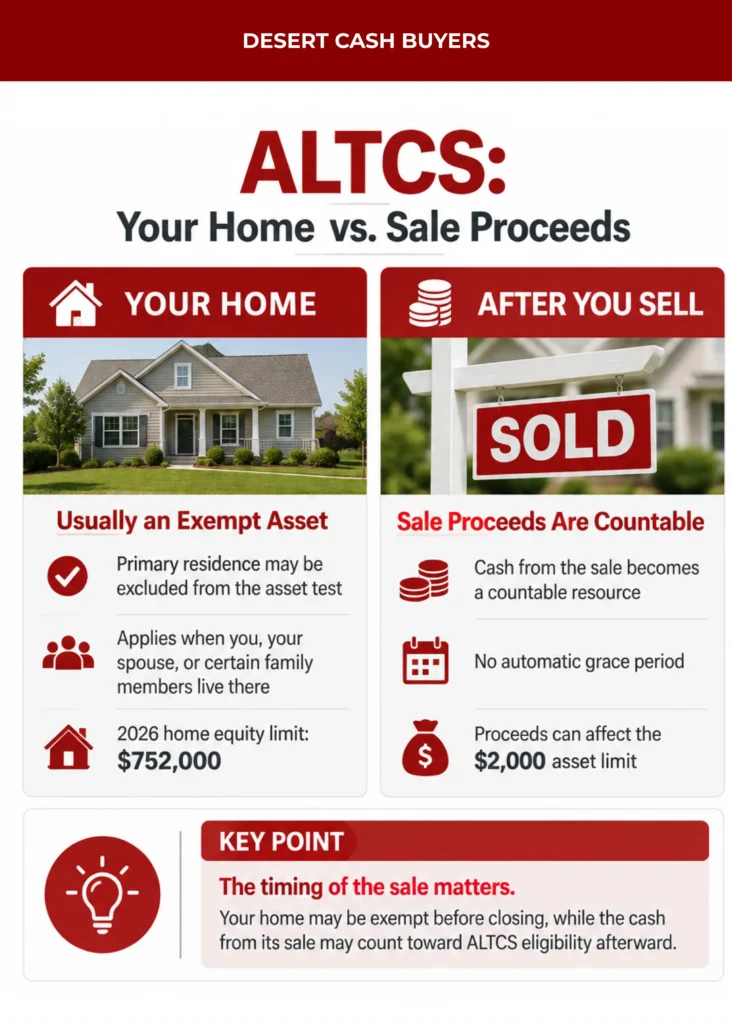
ALTCS treats your home and the cash from selling it as two different kinds of assets, exempt versus countable, and that difference is the entire reason timing matters.
Why the primary residence is normally an exempt asset
ALTCS has a specific home-property exclusion, subject to program requirements and a home-equity limit. For 2026, AHCCCS lists the ALTCS home-equity limit at $752,000. The rules also contain specific exceptions and conditions, including situations involving a spouse or certain family members living in the home. Because the home-property rules are more specific than simply asking whether someone lives there, families should confirm how the exclusion applies to their particular household before selling or transferring the property.
Why sale proceeds are counted differently
Once a sale closes, the home is no longer the resource being evaluated under the home-property exclusion. The sale proceeds generally become a countable resource that AHCCCS must evaluate under its resource rules. AHCCCS determines resource eligibility on a month-by-month basis, so the exact timing of the sale, receipt of proceeds, and ALTCS application can matter.
This is why families should not assume that selling the home and immediately applying for ALTCS will produce the same result as planning the sale around the application and the family’s allowable expenses. The proceeds may need to be addressed through legitimate spend-down or other planning that fits the person’s circumstances. Do not give away the proceeds or sell property for less than fair value simply to get under the resource limit, because those transactions can create a transfer penalty.
The $2,000 Asset Limit and What It Means for a Single Applicant
A single ALTCS applicant can hold no more than $2,000 in countable assets, so a six-figure home sale creates a problem in a single transaction if the timing is wrong.
Some assets never enter that count. Others do the moment they exist. The table below reflects how ALTCS generally sorts a household’s resources during eligibility review.
| Asset | Exempt or Countable |
| Primary home, up to $752,000 equity, while occupied | Exempt |
| Cash from selling that home | Countable |
| One vehicle | Exempt |
| Household goods and personal belongings | Exempt |
| Checking, savings, and investment accounts | Countable |
| Prepaid burial plan | Exempt |
| Second home or rental property | Countable |
A family with non-exempt assets above the limit usually has legal options, spending down on allowable costs, an income-only trust, or other planning tools, but each carries rules that change based on marital status and timing. This is general information, not a plan for your household. An elder law attorney can confirm what actually applies.
The 60-Month Look-Back Period, Explained.
ALTCS reviews every asset transfer made in the 60 months, five years, before you apply, and a sale priced below fair market value inside that window can trigger a penalty period of ineligibility.
What counts as a transfer or below-market sale
Gifting equity to a family member, selling to a relative for less than the appraised value, transferring title with no payment, or forgiving part of a purchase price all count as transfers during the look-back review. A documented, arm’s-length sale at a fair, supportable price to an unrelated buyer is a different story. Keep the comparable sales, the repair estimates behind the offer, and the closing statement. That paperwork is what proves the price was real.
How a penalty period is calculated

Arizona divides the uncompensated value of a transfer by a state-published penalty divisor, generally tied to the average monthly cost of private-pay nursing facility care, to calculate how many months of ineligibility result. That divisor changes periodically, so this article won’t guess at today’s number. Confirm the current figure directly with AHCCCS or an elder law attorney before assuming what a past transfer might cost a family.
The practical effect matters more than the formula. A larger uncompensated transfer generally produces a longer penalty period, and that period typically starts running from the point the applicant would otherwise be eligible, not from the date of the original transfer. A gift made years ago can still be sitting inside the 60-month window when an application is finally filed, which is why families who suspect a past transfer might raise questions should ask an attorney to review it before applying, rather than after a denial.
A Realistic Example: How Sale Timing Changes the Outcome
Numbers make this easier to picture. The example below uses round, illustrative figures for a hypothetical Scottsdale family, not a promise, an offer, or data from an actual seller.
| Scenario | What Happens to the $300,000 in Equity | ALTCS Result |
| Home sold, proceeds spent down on care costs and allowable expenses before applying | Cash is used on qualifying expenses, documented with receipts | Countable assets fall back under $2,000 by the time of application |
| Home sold, proceeds left sitting in a checking account, then applied for ALTCS the same month | Cash remains a countable asset in full | Application is likely denied until assets fall under $2,000 |
| Home sold to a relative for $150,000 below its appraised value inside the 60-month window | Half the value transferred for no payment | Uncompensated portion can trigger a penalty period once discovered |
| Home kept as the applicant’s primary residence, no sale | Equity stays in the house | Home remains exempt regardless of its value, up to the 2026 equity limit |
Three of these four outcomes come from the same $300,000 in equity. The difference is entirely about sequence and documentation, which is exactly why a planning conversation before listing matters more than the sale price does.
Getting the Sequence Right: Sell, Apply, or Both?
In most cases, the safer sequence is professional guidance before a listing agreement, not after, because the closing date can matter as much as the sale price. The State Bar of Arizona’s attorney directory can help a family find an Arizona attorney by practice area or location.
Questions to ask an elder law attorney or ALTCS planner before listing
- Should the house sell before or after the ALTCS application is filed?
- Do the proceeds need a spend-down plan, and on what kinds of expenses?
- Does a Miller Trust or other tool change the timing calculus here?
- What documentation proves fair market value if this sale is ever reviewed later?
Situations where selling first can still make sense
- The home needs repairs a facility placement can’t wait on.
- No family member is able to manage upkeep, insurance, or utilities during a long application review.
- A documented fair-market sale is already paired with a spend-down plan worked out with a planner in advance.
Who Can Legally Sell the Home on a Loved One’s Behalf
A named agent under a valid power of attorney, a successor trustee, or a court-appointed conservator can usually sell the home for someone who can no longer handle the transaction directly.
Power of attorney, trustees, and conservators
A power of attorney needs language that specifically grants authority to sell real estate. Title companies and lenders check for that wording before closing, and a general POA that never mentions real property can stall a sale at the worst possible time. If the home sits in a living trust, the successor trustee sells according to the trust’s terms, with funds still moving through a licensed, independent title company and held in escrow until closing, the same standard any sale should meet. A conservatorship adds court oversight and often requires the court to confirm the sale price before closing, which adds time to the process. Building that extra time into the plan avoids a last-minute scramble.
Whoever holds the authority to sell should also be the one gathering the documentation ALTCS may ask for later: the appraisal or comparable sales used to set the price, the settlement statement from closing, and a record of where the proceeds went. That paper trail is what turns a normal sale into a documented, defensible one if it’s ever reviewed inside the 60-month window.
What a Timeline Looks Like If Selling Turns Out to Be Right
If a sale is the right move for the family, a traditional listing typically runs several months from listing to closing once financing escrow is included, while a local cash sale can close in 7 to 14 days once you accept an offer, with the fastest on record at 3 days.
| Selling Path | Typical Timeline | Property Access |
| Traditional listing | Several months, listing to closing, financing escrow included | Repeated public showings to strangers over weeks |
| Local cash sale | 7 to 14 days from accepted offer; fastest on record: 3 days | Phone evaluation or a single private walkthrough |
We’ve bought over 1,000 Arizona homes since 2015 and hold a 4.9 out of 5 rating from 1,245 verified sellers. You can read seller experiences on our success stories page. A cash offer typically comes together in about 15 minutes, with zero commissions, zero closing costs, and zero fees of any kind. We evaluate a property by phone or with a single private visit, never a parade of open houses, and you’re never asked to stage it or clear out for a stranger. You can see the full process on our how it works page.
That said, a cash sale isn’t automatically the better math for every family. If the home is in good condition and there’s no deadline pressing on the situation, listing with an agent may net more over time once the property sells. A cash sale is the right tool for speed and certainty, not for topping the market, and we’ll say that plainly even when it points away from working with us. If you’re specifically located in the Phoenix core rather than the broader metro, our Phoenix cash home buying page covers that area in more detail, and our blog post on how cash home buyers work in Phoenix breaks down the buyer side of the process.

Frequently Asked Questions About Selling a House Before or During ALTCS in Arizona
These are the questions we hear most from families weighing a sale against ALTCS timing. Our full FAQ page covers general seller questions beyond ALTCS specifically.
Can I gift the house to a family member instead of selling it?
Gifting the house or gifting equity counts as an uncompensated transfer, and it falls under the same 60-month look-back scrutiny as a below-market sale. A gift doesn’t avoid the review; it just changes what the review is looking at. Talk to an elder law attorney before gifting any real property near an ALTCS application.
Does ALTCS put a lien on the house instead of counting it as an asset?
While the applicant is alive and the home remains exempt, ALTCS generally doesn’t need a lien to count it; the exemption simply keeps it out of the asset test. Separately, after a recipient’s death, Arizona’s Medicaid estate recovery program can seek repayment from the estate, including the home, depending on the circumstances. That’s a distinct process from eligibility, and it’s worth asking an attorney how it applies to your family’s situation specifically.
How do I find an ALTCS planner or elder law attorney in Arizona?
The State Bar of Arizona’s lawyer directory, linked above, lets you search specifically for elder law attorneys by location. Many offer an initial consultation focused on ALTCS and long-term care planning before you commit to a full engagement.
Does selling affect eligibility if my spouse still lives in the house?
Generally, no, not right away. The home typically stays exempt while a community spouse continues to live there, even after the applicant spouse moves into a facility. Selling while a spouse still resides there changes the picture and should go through the same planning conversation as any other sale timing question.
What if I already applied and then need to sell?
Report the sale and the resulting change in resources to AHCCCS promptly. The same countable-asset rules apply to proceeds received after approval as before it, and failing to report a change can affect ongoing eligibility. A caseworker or attorney can walk through exactly what needs to be reported and when.
Is there ever a good reason to sell before applying for ALTCS?
Yes. A home that needs expensive repairs, sits vacant with no one to maintain it, or carries costs a family can no longer cover are all real reasons to sell early. The key is pairing that decision with a spend-down or trust plan before the proceeds arrive, so the cash doesn’t sit as a countable asset with nowhere planned for it to go.
Does Selling Your House Affect ALTCS Eligibility? What to Do Before You List
Selling a house does not automatically end ALTCS eligibility, but the sale can change an exempt home into countable resources. The timing of the sale, the amount of proceeds, the person’s other resources, marital situation, and any transfers made during the 60-month look-back can all affect the analysis. AHCCCS also has specific rules for home property and conditional exclusions that can apply while a property is being sold.
Before you sign a listing agreement, gift equity, transfer title, or spend down sale proceeds, consider getting advice from an Arizona elder law attorney or an ALTCS professional who can review the family’s specific circumstances. If selling turns out to be the right move, you can get a free cash offer to give your attorney or planner a concrete number to work with. There is no obligation to sell.
This article is general information about Arizona ALTCS and long-term care eligibility, not legal, tax, financial, or medical advice. ALTCS rules and individual circumstances can affect the result. Confirm how the rules apply to your situation with AHCCCS or a qualified Arizona elder law attorney before selling, gifting, or transferring a home.