

Medical bills you cannot pay might already have you searching for whether medical debt can take your house in Arizona, especially once the calls start. You are not alone. Unexpected medical debt hits thousands of Arizona families every year, often after an emergency room visit or a hospital stay nobody planned for.
No. In most cases, a medical creditor cannot force the sale of your Arizona home. Arizona’s homestead exemption, combined with the 2022 reforms under Proposition 209, makes that outcome rare rather than routine. This article walks through exactly what the law protects, what it does not, and what your options look like from here.
Here is what actually changed for Arizona homeowners dealing with medical debt:
- Interest on medical debt is capped, so an old bill cannot snowball the way credit card debt sometimes does.
- Wage garnishment dropped sharply, leaving more of every paycheck untouched.
- Home equity protection grew large enough to cover most Arizona houses outright.
- A court judgment is not the same thing as a forced sale, and the two get confused constantly.
- These protections apply automatically. You do not file paperwork to activate them.
This is general information, not legal, tax, financial, or medical advice. Every situation is different, and confirming your specifics with a licensed Arizona attorney is worth the hour it takes. If you are further along and specifically considering selling your home because of medical-related financial hardship, you can learn more about selling your house fast for medical issues in Arizona.
What Proposition 209 Changed for Arizona Homeowners
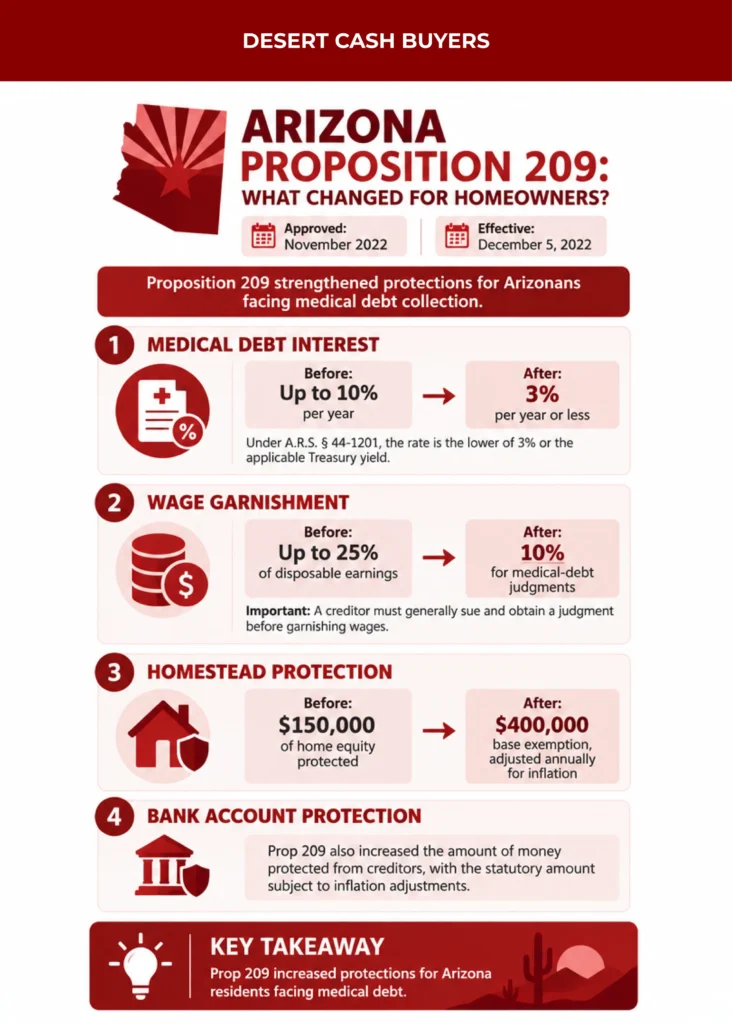
Proposition 209 rewrote three parts of Arizona debt collection law at once: it capped medical debt interest, cut wage garnishment limits, and raised the amount of money and home equity creditors cannot touch.
Arizona voters approved the measure in November 2022 by a wide margin, and it took effect December 5, 2022. Formally called the Predatory Debt Collection Act, it amended several sections of Arizona law, including A.R.S. §§ 33-1101, 33-1123, 33-1125, 33-1126, 33-1131, and 44-1201. The changes apply going forward, not retroactively to debts and judgments that existed before the effective date.
| Protection | Before Prop 209 | After Prop 209 |
| Medical debt interest cap | Up to 10% per year | 3% per year or less (A.R.S. § 44-1201) |
| Wage garnishment limit | 25% of disposable earnings | 10% of disposable earnings |
| Homestead exemption | $150,000 of home equity | $400,000 base, adjusted yearly for inflation |
| Protected bank balance | A few hundred dollars | A meaningfully larger, inflation-adjusted cushion |
We touch on Proposition 209 and this interest cap more briefly elsewhere. Get the full breakdown of your options if bills are the pressure in the “Before You Sell: Two Arizona Rules Worth Knowing First” section of our medical-issues guide, and review the Arizona Judicial Branch’s Proposition 209 garnishment information for court-related guidance.
The medical debt interest rate cap (3% under A.R.S. § 44-1201)
A.R.S. § 44-1201 now caps interest on medical debt at 3% a year or less, down from the old 10% ceiling that applied to almost every kind of Arizona debt. The statute actually sets the rate at whichever is lower: 3%, or the weekly average one-year constant maturity Treasury yield. That cap also applies to any court judgment entered on medical debt, so interest cannot balloon after a lawsuit either. You can read the current statutory language directly from the Arizona Legislature’s text of A.R.S. § 44-1201.
Reduced wage garnishment limits (25% to 10%)
Wage garnishment for a medical debt judgment in Arizona is now capped at 10% of your disposable earnings, down from the old 25% limit. A creditor still has to sue you and win a judgment before any garnishment can start. Nobody can garnish your paycheck for medical debt just because a bill went to collections.
Increased protected bank account balance
Proposition 209 also raised the amount of money a creditor cannot touch in your bank account, protecting a meaningfully larger cushion than Arizona law allowed before 2022. Because this figure is one of several dollar amounts in the statute that adjusts over time, confirm the exact current number with an attorney or the statute itself rather than relying on an older article, including this one.
The Arizona Homestead Exemption: How Much Home Equity Is Protected

Arizona’s homestead exemption currently protects $400,000 of equity in your primary home from most creditors, and that base amount rises every year for inflation under A.R.S. § 33-1101.
The exemption is automatic. You do not file a form to activate it, though recording a homestead declaration with the county can help in edge cases like a co-owned property. It covers a house, condo, cooperative, or manufactured home you actually live in. A married couple or a single person gets one homestead, not one per person.
The $400,000 exemption, indexed to inflation
The exemption’s statutory base is $400,000, set by Proposition 209 in 2022, up from $150,000 before the reform. Starting January 1, 2024, the figure adjusts every year by the prior year’s cost-of-living increase, rounded up to the nearest $100. Several current guides put the 2026 indexed figure meaningfully above the $400,000 base, but because it moves annually, confirm the exact current-year amount with an attorney or the Arizona Legislature’s text of A.R.S. § 33-1101 before relying on a specific dollar figure for your situation.
What the exemption does and doesn’t protect against
The homestead exemption blocks unsecured creditors, like an unpaid medical bill, from forcing a sale to reach your equity. It does not erase your mortgage, an HOA lien, a property tax lien, or any lien you voluntarily signed, such as a home equity loan. Those secured, voluntary obligations sit outside the exemption entirely.
Here is a simple, illustrative example using round numbers, not an estimate of your own equity or offer:
| Scenario | Home Value | Mortgage Owed | Equity | Protected by Homestead? |
| Example A | $350,000 | $180,000 | $170,000 | Fully protected (under $400,000 base) |
| Example B | $700,000 | $150,000 | $550,000 | First $400,000+ protected; remainder may be reachable |
Most Arizona homeowners, even with strong appreciation over the past few years, fall into a scenario closer to Example A. This is a simplified illustration, not a projection of your own numbers.
Can a Medical Creditor Force the Sale of Your House in Arizona?
Generally, no. A medical creditor can only reach your home after suing you and winning a judgment, and even then only for equity above your protected homestead amount, which covers most Arizona homes outright.
Judgment liens vs. forced sale: what’s actually possible
A judgment lien and a forced sale are two different things. Winning a lawsuit lets a creditor record a lien against property you own, but recording a lien does not put your house up for sale by itself. Forcing a sale to satisfy an unsecured judgment is a separate court process; it is uncommon for primary residences once the homestead exemption is applied, and it generally is not worth pursuing when a home’s equity sits entirely under the exemption amount. If a medical judgment does become a recorded lien on your house, sell your house fast with a lien in Arizona walks through how that lien actually gets resolved at closing.
When the exemption doesn’t apply (mortgages and voluntary liens)
The homestead exemption protects you from unsecured creditors, not from debts secured by the house itself. Your mortgage lender, an HOA with a valid lien, a contractor with a mechanic’s lien, or a county with an unpaid property tax lien can still enforce their claim, because you agreed to those terms or the lien attached by statute regardless of the homestead exemption.
| Type of Claim | Homestead Exemption Applies? | Example |
| Unsecured judgment (e.g., unpaid medical bill) | Yes, protects equity up to the exemption amount | Hospital collection lawsuit |
| Mortgage or home equity loan | No, it is a voluntary secured debt | Your primary mortgage |
| Property tax lien | No, statutory lien attaches regardless | County tax lien |
| HOA lien for unpaid dues | No, generally enforceable against the property | HOA assessment lien |
What This Means If You’re Getting Collection Calls Right Now
If a collector is calling about medical debt today, Arizona law already gives you real leverage, even before anything reaches a courtroom.
- Ask for a written validation notice. Collectors have to send one within five business days of first contact.
- Do not ignore a lawsuit summons. Missing a court date can lead to a default judgment, even on a debt the exemptions would otherwise limit.
- Check the interest being charged. Anything above 3% on a medical debt is worth questioning against A.R.S. § 44-1201.
- Keep records of every call, letter, and payment. Documentation is your strongest tool if a dispute ever goes to court.
The Consumer Financial Protection Bureau’s debt collection resources walk through your federal rights under the Fair Debt Collection Practices Act, which apply on top of Arizona’s own protections. If you want to talk through your specific situation, our team is reachable through our contact page and can point you toward the right resource, even if selling is not the right move for you.
When Selling Still Makes Sense, Even Without Legal Pressure
Selling your house is not required to deal with medical debt in Arizona, but for some homeowners it is still the right move once they understand their equity and their options.
A homeowner managing a serious illness may want to relocate closer to family or a treatment center. A larger, harder-to-maintain house can become a real burden during recovery. Some homeowners simply want to convert home equity into cash to pay down medical bills directly and stop interest and collection stress at the source, even though the law would have protected the house either way. Those are personal decisions, not legal necessities, and worth treating as separate from the question of whether a creditor can take your home.
If you do explore a sale, know that a legitimate cash buyer still needs to see the property, whether by phone, photos, or a single private visit, to finalize an offer. That is different from the repeated public showings and open houses a traditional listing usually involves, which matters if energy and time are already stretched thin.
Medical bills rarely arrive alone. If your debt situation is broader than a single hospital bill, our guide on selling your house fast during bankruptcy in Arizona covers how a court-supervised process changes the equation.
How Desert Cash Buyers Approaches a Medical-Pressure Sale
We buy the property directly, show you the comparable sales and repair estimate behind every offer, and never ask you to fix anything before closing. Desert Cash Buyers has bought 1,000+ Arizona homes since 2015, with over 10 years serving Arizona sellers. Every closing runs through a licensed, independent Arizona title company, with funds held in escrow until closing, the same protections a traditional sale uses.
Our process is simple: tell us about the property by phone or a short form, get a cash offer in about 15 minutes with the math explained, and pick a closing date that works for you. Most closings take 7 to 14 days from an accepted offer, and our fastest closing on record took 3 days. There are zero commissions, zero closing costs, and zero fees of any kind to you as the seller.
When Listing Might Net You More Than a Cash Sale
If your home is in good condition, you are not facing a legal deadline, and top dollar matters more than speed, listing with an agent will likely net you more than a direct cash sale.
Cash offers from local, direct buyers typically reach 70% to 85% of after-repair value in strong markets. That is a general range describing typical outcomes, not a promise for any specific property. A traditional listing can price closer to full market value, though commissions, repair credits, and months of carrying costs narrow that gap more than most sellers expect. A cash sale is the right tool when speed, certainty, or avoiding repairs and showings matters most, not when maximizing the last few percentage points of sale price is the only goal.

Frequently Asked Questions About Medical Debt and Your Arizona Home
Does Arizona’s medical debt law apply to all types of medical bills?
A.R.S. § 44-1201 defines medical debt broadly as an obligation arising directly from health care services, products, or devices. It generally covers hospital, clinic, and provider bills. Confirm how a specific bill is classified with the statute or an attorney if the answer changes your decision.
Does a judgment against me show up on my credit report?
A civil judgment can appear in public court records and may be reflected on your credit history depending on how it is reported. Medical debt itself has increasingly limited effects on standard credit scoring models under recent federal changes, but rules continue to evolve, so check your credit report directly for your current situation.
Should I still talk to an attorney if I think I’m protected?
Yes. The exemptions described here are general and automatic, but every household’s mix of debts, liens, and property ownership is different. A short consultation with an Arizona attorney, or a nonprofit credit counseling agency, is worth it before you respond to a lawsuit or ignore a collector.
Can a hospital or collector put a lien directly on my house without suing me first?
Generally, no. Most medical creditors need a court judgment before they can record an enforceable lien against your property. An exception exists for certain statutory liens tied to specific programs, which is another reason to confirm your exact situation with an attorney rather than assume.
Does Proposition 209 protect a second home or rental property?
No. The homestead exemption applies only to the property that is your actual primary residence. A rental home, vacation property, or investment property does not qualify for this protection.
Do I need to file paperwork to claim the homestead exemption?
No. The exemption applies automatically under Arizona law. Recording a formal homestead declaration with the county recorder is optional and mainly useful in edge cases, such as co-owned property or a dispute over which of two properties qualifies.
The Bottom Line on Whether Medical Debt Can Take Your Arizona Home
Medical debt alone is very unlikely to take your Arizona home. Proposition 209 capped interest, cut garnishment limits, and pushed the homestead exemption high enough to cover most Arizona homeowners’ equity outright. Selling is a personal decision you might still choose to make, whether to simplify life during a health crisis or to convert equity into cash on your own terms, but it is rarely one the law forces on you.
If you have read this far and selling still feels like the right next step, whether because of medical bills, a life change, or simply wanting a simpler path forward, you can get your free cash offer and see what your options look like. We deliver a cash offer in about 15 minutes, with no obligation and no fees, so you can weigh it against listing with clear eyes.