
If you’re facing bankruptcy in Arizona, your house is probably the biggest asset on the table. The Arizona homestead exemption sets how much of your home equity is protected from creditors and a bankruptcy trustee. Knowing that number before you file tells you whether your home is safe or at risk.
Yes, Arizona protects up to $400,000 of home equity through the homestead exemption, and that figure rises every January for inflation. If your equity stays under the current limit, your home is fully protected in bankruptcy. If it climbs above the limit, a trustee or your repayment plan has to account for the difference.
A few specifics change how this plays out for your situation:
- We calculate equity as your home’s market value minus every mortgage, HELOC, and lien against it, not the county’s tax-assessed value.
- Arizona is an opt-out state. You must use this state exemption. The federal homestead exemption does not apply here.
- The protection follows your sale proceeds too, for up to 18 months, if you sell your home before or during a case.
- A mortgage still gets paid no matter what. The homestead exemption blocks other creditors, not your own lender.
- One exemption applies per married couple or single filer, even if you hold an interest in more than one qualifying property.
If a fast, straightforward sale is already on your mind, our guide to selling your house fast for cash in Arizona walks through the whole process, math included.
What Is Arizona’s Homestead Exemption?

Arizona’s homestead exemption is a state law that shields up to $400,000 of equity in your primary home from most creditors and a bankruptcy trustee. It covers a house on one compact parcel, a condo or co-op unit, or a mobile, manufactured, or park-model home plus the land under it, as long as you actually live there. The exemption is automatic. You don’t file paperwork to claim it, and only one exemption applies per married couple or single person.
A.R.S. § 33-1101 in Plain English
The exemption lives in A.R.S. § 33-1101, under Arizona’s homestead and personal property exemption chapter. It caps protected equity at $400,000, applies automatically the moment you live in a qualifying home, and extends to identifiable cash proceeds from a sale for up to 18 months, or until you buy a new home with that money, whichever comes first. That last part matters if you sell during a difficult financial stretch: the protection doesn’t vanish the moment your house closes.
How Proposition 209 Raised the Exemption in 2022
Arizona’s homestead exemption has moved three times in recent years. A 2021 law, House Bill 2617, raised it from $150,000 to $250,000 starting January 1, 2022. Later that year, voters approved Proposition 209, which raised the exemption again to its current $400,000 base and added the annual inflation adjustment. Here’s the short version:
| Effective Period | Exemption Amount | Source |
| Before January 1, 2022 | $150,000 | Prior version of A.R.S. § 33-1101 |
| January 1, 2022 forward | $250,000 | HB 2617 (2021) |
| From Prop. 209’s effective date onward | $400,000 base, adjusted for inflation each January 1 since 2024 | A.R.S. § 33-1101, as amended by Prop. 209 |
How Much Home Equity Can You Protect Right Now?
You can protect up to $400,000 of equity in your Arizona home right now, and somewhat more once the current year’s inflation adjustment is applied. Equity is not your home’s price tag. It’s what’s left after subtracting everything you owe against the property, and the exemption applies per filer or married couple, not per property you happen to hold an interest in.
The Current Exemption Amount and Its Annual Inflation Adjustment
A.R.S. § 33-1101(D) requires the exemption to rise every January 1, starting in 2024, based on the change in the cost of living, rounded up to the nearest $100. As of this writing, in September 2026, multiple bankruptcy and consumer-debt resources report the adjusted figure at roughly $437,600, though the state has not published a single official notice confirming that exact number. Because this adjusts annually and the published guidance can lag, confirm the current-year figure with a bankruptcy attorney or the trustee’s office before you rely on it for a filing decision.
How to Calculate Your Actual Home Equity
The math is simple: current fair market value, minus every mortgage balance, HELOC, and recorded lien against the property, equals your equity. Don’t use the county assessor’s card for this. Assessed value is built for property tax purposes and is often well below what your home would actually sell for. Pull real comparable sales or a written offer instead.
If a lien is already recorded against the property- a tax lien, a judgment lien, or a mechanic’s lien- it lowers the equity a trustee actually counts against the exemption. Our breakdown of selling your house fast with liens in Arizona covers how those payoffs work at closing. If you’re unsure how a sale may affect your situation, contact us directly to discuss your property and available options.
How Bankruptcy Evaluates Your Home’s Value
A home’s estimated market value is only the starting point when determining whether you have non-exempt equity. The bankruptcy analysis also considers the debts secured by the property, your ownership interest, the applicable exemption, and the costs that could reduce the amount available from a sale.
Before relying on an equity estimate, gather:
- A Current Property Value: Use recent comparable sales, a professional appraisal, or another credible market estimate.
- Mortgage Payoff Information: Request updated payoff amounts from each mortgage lender, including any second mortgage or HELOC.
- Recorded Lien Information: Check for judgment liens, tax liens, and other encumbrances that may affect the property’s equity.
- Potential Selling Costs: Account for commissions, closing expenses, and other costs that could reduce net proceeds.
- Your Ownership Interest: Confirm whether you own the property individually, jointly, or through another ownership arrangement.
The result is more useful than simply subtracting your mortgage balance from a listing price. It gives you a clearer starting point for discussing whether Chapter 7 or Chapter 13 could affect your home.
A preliminary estimate is not the same as a bankruptcy trustee’s final calculation. If your equity is close to the exemption limit, have a bankruptcy attorney review the numbers before making decisions about filing or selling.
What the Homestead Exemption Doesn’t Protect You From
The homestead exemption doesn’t stop your mortgage lender from foreclosing, and it doesn’t erase a short list of specific liens. Under A.R.S. § 33-1103, the exemption has real exceptions:
- A consensual lien, including your mortgage or a deed of trust. You agreed to it, so the exemption doesn’t block it.
- A lien for labor or materials, the kind a contractor files after unpaid work on the property.
- A lien for child support or spousal maintenance arrearages, once that arrearage has been reduced to a judgment.
- Any equity that plainly exceeds the exemption amount itself.
Bankruptcy can still help with a mortgage default. Chapter 13 lets you catch up missed payments over a repayment plan, and the automatic stay pauses collection activity while your case is open. But that protection comes from the bankruptcy process itself, not from the homestead exemption. Keep those two mechanisms straight when you’re deciding what bankruptcy can and can’t do for your specific situation.
How Joint Ownership Affects the Arizona Homestead Exemption
Owning a home with someone else can change how you need to examine your equity and exemption rights. The key questions are who owns the property, who lives there, whether the owners are married, and whether one or both owners are filing bankruptcy.
Arizona law provides one homestead exemption for a married couple or a single person. It does not automatically provide a separate full exemption for every person listed on a property deed. The statute also addresses the total exemption available when a married couple owns and occupies a residence.
For example, a married couple who owns a primary residence should not assume that each spouse can claim a separate full homestead exemption against the same property. The applicable exemption is tied to the couple’s circumstances and the statutory limit.
Ownership becomes more complicated when a homeowner shares title with a non-spouse, has inherited an interest in a property, or owns a property with someone who does not live there. The amount of equity attributable to the debtor, the nature of the ownership interest, and the bankruptcy estate’s rights may all matter.
Before filing, review the deed, ownership percentages, mortgage obligations, and occupancy status with a bankruptcy attorney. Do not assume that the number of people on the title automatically determines how much equity is protected.
What Happens When Your Equity Exceeds the Exemption?
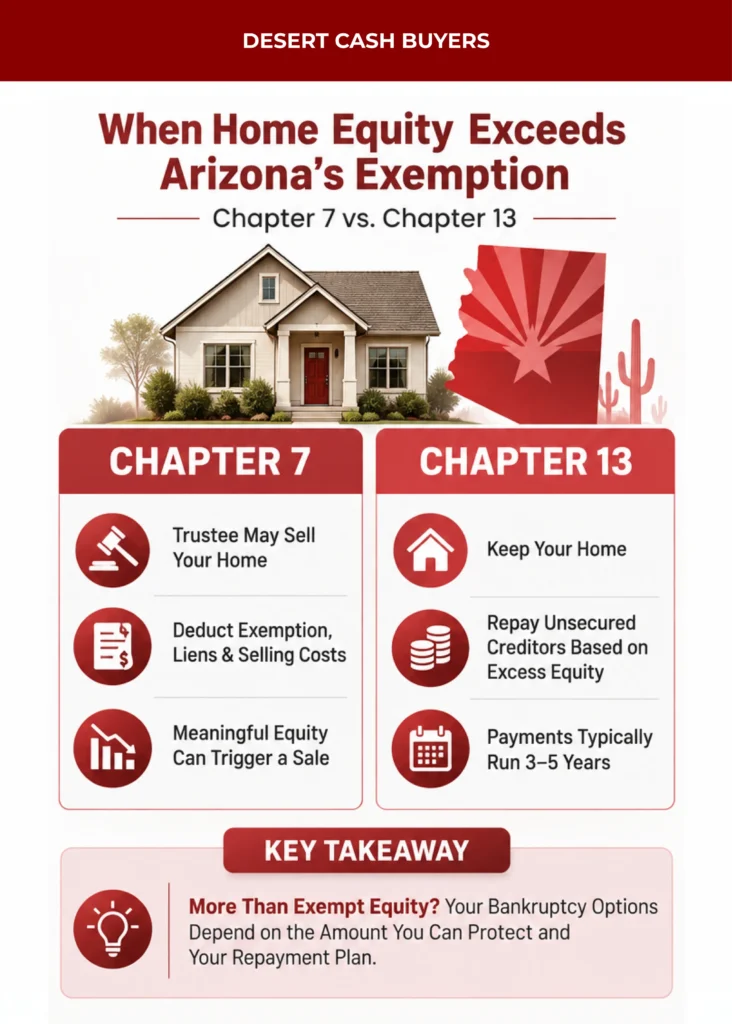
When your home equity is higher than Arizona’s exemption, a Chapter 7 trustee can sell the house and use the non-exempt portion to pay creditors, or a Chapter 13 plan has to repay unsecured creditors at least that same amount instead of losing the house.
Chapter 7: when a trustee decides there’s money to reach.
A trustee weighs your equity minus the exemption, minus the costs of selling (commission, closing costs, and holding costs while the case is open), minus any liens ahead of the exemption. If what’s left after those deductions is meaningful, the trustee may move to sell. If it’s thin or negative, many trustees abandon the house back to the debtor, because there’s nothing worth the effort of selling it. A licensed, independent title company and an escrow process still govern the actual closing either way.
Chapter 13: how excess equity affects your repayment plan.
Chapter 13 uses a liquidation test, described in the federal courts’ bankruptcy basics guide. Your repayment plan has to pay unsecured creditors at least what they’d receive in a hypothetical Chapter 7 sale. If your equity sits $50,000 above the exemption, your three-to-five-year plan generally has to deliver at least that amount to unsecured creditors, which raises your required monthly payment. This is general information, not a projection for your case. Confirm the actual math with your attorney or the trustee assigned to your filing.
| Chapter 7 | Chapter 13 | |
| Non-exempt equity | Trustee may sell the home to reach it, after selling costs and liens | You keep the home; the plan repays unsecured creditors at least that amount |
| Typical timeline | Case often closes within several months | Repayment plan runs three to five years |
| Best fit when | Equity is close to or under the exemption | You want to keep the home despite non-exempt equity |
This is exactly the moment many homeowners look at selling your house fast during bankruptcy in Arizona as a way to convert non-exempt equity into cash proceeds under the trustee’s or court’s supervision, rather than losing control of the timeline.
Worked Examples: Protected Equity vs. Non-Exempt Equity
These are example scenarios with round numbers, meant to show the math, not a valuation of your property or a promise about your case.
| Scenario | Home Value | Debt / Liens | Equity | Protected? |
| A: Comfortably under the limit | $480,000 | $340,000 mortgage | $140,000 | Fully protected |
| B: Above the exemption | $700,000 | $180,000 mortgage | $520,000 | $120,000 potentially non-exempt, before selling costs |
| C: Trimmed by a lien | $550,000 | $310,000 mortgage + $40,000 judgment lien | $200,000 | Fully protected once the lien is subtracted |
Scenario B is the one worth sitting with. $120,000 sounds like a clean number, but a trustee’s actual sale would still subtract commission, closing costs, and months of holding costs before anyone calculates net proceeds. That gap between the sticker number and the real number is exactly why an early, honest look at your equity, not the assessor’s estimate, matters before you file.
Common Arizona Homestead Exemption Mistakes That Cost Homeowners
The most common mistake is assuming your home’s tax-assessed value equals your equity, when the two numbers are rarely close. A few others show up just as often:
- Using the county’s assessed value instead of a real market estimate to gauge equity.
- Assuming the federal bankruptcy exemption applies in Arizona. It doesn’t. Arizona is an opt-out state, so state exemptions are the only ones available to residents domiciled here.
- Forgetting that a mortgage is a consensual lien. The exemption was never designed to touch it.
- Not accounting for recorded liens that lower the equity a trustee actually counts against the exemption.
- Waiting through a rising market without checking whether equity has quietly climbed past the exemption.
- Believing the exemption requires paperwork. It’s automatic by operation of law, though owning more than one qualifying property can trigger a creditor’s demand letter asking you to designate which one is protected.
If you’re reviewing your home’s equity before making a decision, read verified reviews from Arizona sellers to learn about other homeowners’ experiences with the selling process.

Frequently Asked Questions About the Arizona Homestead Exemption
Does the Exemption Apply to a Second Home or Rental Property?
No. The Arizona homestead exemption only protects the home you actually live in as your primary residence. A rental property, vacation home, or investment property doesn’t qualify, even if you own it outright.
Do I Need to File a Separate Homestead Declaration in Arizona?
No. The exemption attaches automatically by operation of law under A.R.S. § 33-1102, with no recording required. The one exception: if you have an interest in more than one qualifying property, a creditor can send a certified demand letter requiring you to designate which one carries the exemption.
What if My Equity Is Close to the Limit? Should I Sell Before or After Filing?
There’s no universal answer, and this is a genuinely case-specific question. Selling before you file converts home equity into cash proceeds, which carry the same homestead protection for up to 18 months. Selling during a case usually requires trustee or court involvement. Both paths are legitimate. Talk through the timing with a bankruptcy attorney who can see your full financial picture before you decide.
Does Arizona’s Homestead Exemption Stop Foreclosure?
No. A mortgage is a consensual lien, and the exemption specifically excludes it. What can pause a foreclosure is the bankruptcy process itself, particularly a Chapter 13 plan that lets you catch up missed payments over time. Desert Cash Buyers is not a substitute for that legal process, but once you understand where you stand, we can talk through what a sale would look like if that’s the direction you choose. To learn more about the company, you can meet our local team.
Is the Homestead Exemption Automatic in Arizona?
Yes. You don’t file a claim or pay a fee to get it. It attaches the moment you live in a qualifying home, and it’s one of the reasons Arizona’s exemption laws are considered generous compared to many other states.
Putting the Arizona Homestead Exemption to Work for Your Situation
The Arizona homestead exemption protects up to $400,000 of home equity today, adjusted every January upward for inflation, and it’s automatic the moment you live in a qualifying home. What it won’t do is erase your mortgage, override a handful of specific liens, or protect equity that genuinely exceeds the cap. If your number is close to that line, get a real market estimate of your home, not the assessor’s card, and talk to a bankruptcy attorney before you file.
If you’re weighing a sale as part of that decision, whether before filing or with your trustee’s involvement, we can walk through the comps, condition, and after-repair value behind a real number for your house. If your property is near downtown or central Phoenix, you can also explore our Phoenix cash home buyer page for more location-specific information.
Once you tell us about the property, we send a cash offer in about fifteen minutes, with the math explained, no obligation, and no fees. Get your free cash offer today.