
You are getting ready to sell a house in Arizona, and something happened inside those walls that you would rather not explain to a stranger. A death. A violent crime. A rumor your neighbors will not let go of. Before you fill out a single form, you want a straight answer to one question: do you have to disclose a death or crime when selling a house in Arizona?
No, in most cases. Arizona law specifically shields you from legal liability for staying silent about a death, a felony crime, or a nearby sex offender. That protection is real, and it has real limits too.
Here is what matters most before you touch a disclosure form.
- Arizona’s stigma-disclosure law, A.R.S. § 32-2156, protects your silence on deaths and crimes, but it never protects a direct lie.
- The protection covers three specific categories: deaths and felonies, a former occupant’s HIV or AIDS status, and a nearby registered sex offender.
- Physical defects, like a cracked foundation or a failing roof, still require disclosure through the Seller’s Property Disclosure Statement (SPDS), stigma or no stigma.
- Arizona’s rule is friendlier to sellers than California’s, which requires disclosure of any death within the past three years.
- A stigmatized history can still shrink your buyer pool, even when the law never forces your hand.
This article covers the legal side of a difficult property history. For the full picture on a fast Arizona sale, see our guide to selling a house fast for cash in Arizona, which walks through pricing, timelines, and closing details.
What Counts as a “Stigmatized Property” in Arizona
A stigmatized property is a home whose history, not its physical condition, makes some buyers uneasy. Real estate professionals use the term for any property linked to a death, a violent crime, a disease scare, a nearby offender, or even a reputation for being haunted. None of these facts change the foundation, the roof, or the plumbing. They change how a buyer feels walking through the front door.
This matters because Arizona disclosure law treats stigma very differently from a physical defect. A leaking roof affects the house itself, and state law requires you to disclose it. A death that happened in the primary bedroom ten years ago affects nothing about the structure, and Arizona law does not require you to bring it up. Most of the confusion sellers run into comes from blurring the two together.
A stigmatized history is really just one version of a difficult Arizona location, the kind of property that needs a buyer willing to look past the story instead of the walls. Arizona’s statute addresses three specific triggers, and only those three carry a legal exemption from disclosure.
What A.R.S. § 32-2156 Actually Protects You From
Arizona Revised Statutes § 32-2156 protects you from lawsuits for not volunteering three specific categories of information. The statute states that no criminal, civil, or administrative action can be brought against a seller, a lessor, or a licensee for failing to disclose these facts, and that silence on them is never grounds to cancel a sale.
Natural Death, Suicide, or Homicide: Arizona’s Disclosure Exemption
You do not have to disclose that a natural death, a suicide, or a homicide happened on the property. The statute reaches further than death alone. It covers any other crime classified as a felony, which means a burglary, an assault, or a drug conviction tied to the address also falls under the same protection. A buyer who later learns about any of these events cannot sue you, and cannot use it to unwind the deal, based on your silence alone.
HIV or AIDS Status of a Former Occupant
You do not have to disclose that a former occupant was living with HIV or had an AIDS diagnosis. Arizona added this protection to keep a health condition from becoming an excuse to stigmatize a property, and to keep sellers from being pressured into revealing private medical information about someone who no longer lives there.
A Registered Sex Offender Living Nearby
You do not have to disclose that a registered sex offender lives near the property. This one surprises people, because Arizona already runs a public sex offender registry that any buyer can search directly. The law simply confirms that finding and interpreting that public information is the buyer’s job, not something you owe them as part of the sale.
The Line Between Staying Silent and Lying
Staying silent about a stigma is legal in Arizona. Answering a direct question with a lie is not. A.R.S. § 32-2156 protects the choice not to volunteer information. It says nothing about protecting a seller who actively denies a fact once a buyer asks about it directly.
This distinction has already been tested in Arizona courts. A well-known Arizona Court of Appeals case, Lerner v. DMB Realty, involved a dispute over how a property’s history was described during a sale. The takeaway for sellers is not the outcome of that specific case, since every situation differs, but the underlying principle: silence is protected, misrepresentation is not.
Practically, this means you never need to write a blanket denial on a disclosure form if the underlying fact is not true. Leave the relevant section blank, or use the language your title company or attorney recommends. But if a buyer asks you directly during a walkthrough whether anyone died in the house, answer honestly. A false answer to a direct question can expose you to a misrepresentation claim that has nothing to do with the stigma statute at all.
What You Still Have to Disclose: Physical Defects and the Seller’s Property Disclosure Statement
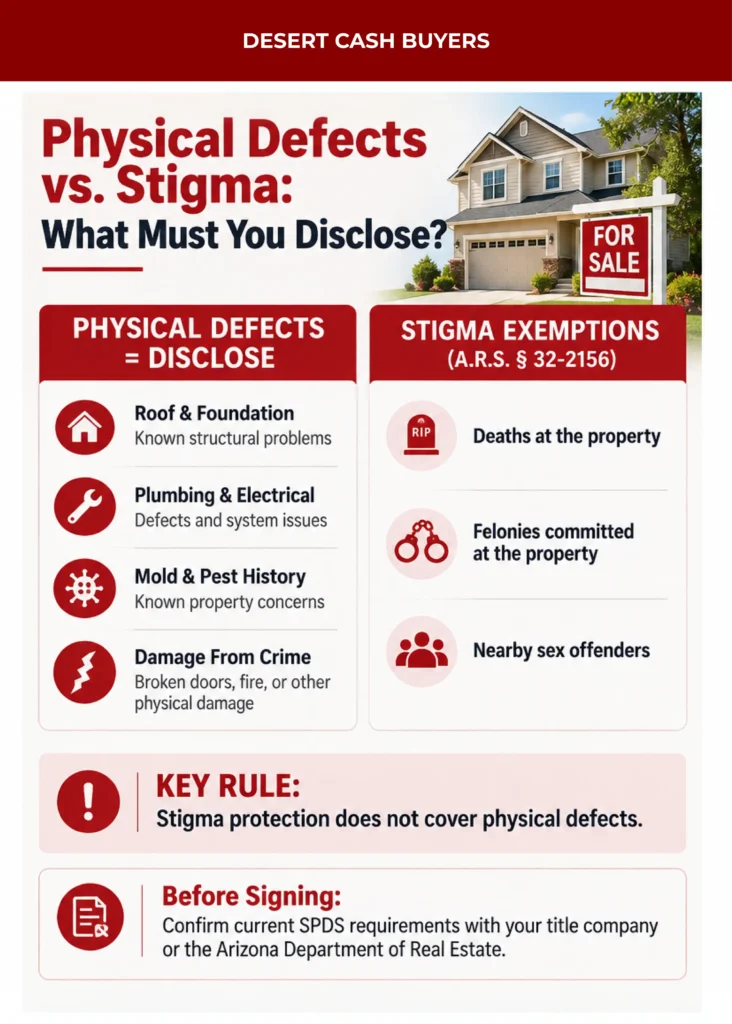
You still have to disclose known physical defects, regardless of any stigma protection. Arizona sellers complete a Seller’s Property Disclosure Statement (SPDS) that covers the condition of the roof, foundation, plumbing, electrical systems, pest history, environmental hazards, and other material facts about the physical property. Stigma protection under A.R.S. § 32-2156 never touches this obligation.
A useful way to separate the two: ask whether the fact describes the property or describes an event that happened at the property. A cracked slab, a failed septic system, or a known mold problem describes the property itself, and Arizona law requires disclosure. A death, a felony, or a nearby offender describes an event or a person, not the structure, so the statute exempts it. If a crime or a death caused physical damage, such as a fire or a forced entry that damaged a door frame, that physical damage still belongs on the SPDS even though the underlying event does not.
Sellers dealing with both a stigma issue and a real defect sometimes assume the stigma exemption covers everything connected to that history. It does not. Confirm current SPDS requirements with your title company, or with the Arizona Department of Real Estate, before you sign, since disclosure forms and statutory requirements can be updated.
Does the Stigma Exemption Cover Everything Connected to a Crime?
Not necessarily. Arizona’s stigma statute addresses the failure to disclose specific facts about a property, including a death, a felony, certain health information, or the vicinity of a registered sex offender. It does not automatically erase every other obligation connected to the property or the transaction.
For example, imagine a house where a violent incident caused damage to a bedroom door, flooring, or electrical wiring. The history of the incident and the condition of the damaged materials are two different issues. Even when the event itself falls within the statutory protection, known physical problems may still need to be addressed through the appropriate disclosure process.
The same distinction matters when a property has a history of drug activity, fire, or another serious incident. Sellers should separate what happened from what remains on the property today. A buyer may not need to be told about a protected event under A.R.S. § 32-2156, but known damage, contamination concerns, repair history, or other material property conditions should not be ignored.
If you are unsure whether a particular fact belongs on the SPDS or needs separate legal treatment, ask your Arizona real estate attorney or title company before making a representation to a buyer. The safest approach is to identify each issue separately instead of treating the entire history as one disclosure category.
How Arizona’s Rule Compares to Other States
Arizona’s disclosure rule is more seller-friendly than many states, and dramatically more seller-friendly than California’s. Roughly half of U.S. states have some form of death or stigma disclosure requirement, and the details vary widely from state to state.
| State | Death or Crime Disclosure Rule |
| Arizona | Not required for deaths, felonies, or nearby offenders (A.R.S. § 32-2156) |
| California | Required if a death occurred within the past 3 years (Civil Code § 1710.2) |
| Alaska | Required if a murder or suicide occurred within the past year and the agent knew |
| Most other states | No blanket disclosure law; buyers are expected to ask directly or investigate |
California’s rule illustrates the contrast well. Under California Civil Code § 1710.2, a seller does not have to volunteer a death that happened more than three years before an offer, but does have to disclose one that happened more recently, and must answer honestly if a buyer asks directly, regardless of timing. Arizona sets no time window at all. Once a fact fits one of the three protected categories, silence is permitted no matter how recent the event was.
Does Stigma Actually Lower Your Sale Price or Buyer Pool?
Sometimes, yes, though the effect is usually smaller and shorter-lived than sellers expect. Buyer reaction to a stigmatized property depends heavily on the nature of the event and the buyer’s own beliefs. A quiet natural death rarely moves the needle. A violent, well-publicized crime can shrink your buyer pool more noticeably, at least for a while.
One frequently cited academic analysis of stigmatized home sales found that these properties sold for roughly 3 percent less than comparable, non-stigmatized homes, and took about 45 percent longer to sell on average. Every market and every property is different, and a figure like that describes a general pattern, not a guarantee for your specific house.
The same logic applies to other properties with a hard story, like a fire-damaged property, that still has real value once a buyer looks past what happened. How publicized the event was, and how the property gets marketed afterward, tend to matter more than the stigma itself. A weeks-long public listing keeps a difficult history in circulation. A shorter, more private sale process gives the story less time to follow the house around.
Your Options If You’d Rather Not Have the Disclosure Conversation at All

You have three realistic paths if you would rather not repeat a difficult history to a parade of buyers: list traditionally and handle disclosure the standard way, sell to an iBuyer or a national franchise cash-buying operation, or sell directly to a local cash buyer who evaluates the property once.
A traditional listing still gives you the same legal protections under A.R.S. § 32-2156. It does not shorten the number of people who hear about the property’s history, and, over weeks of showings, an agent typically fields the same question from several buyers while neighbors mention it unprompted at an open house. If you take that route, see our How It Works page for how a faster, direct sale compares step by step.
An iBuyer prices with an algorithm and often will not touch a home with a documented stigma or unresolved repair needs, since these platforms are built to move standardized properties quickly. A national franchise cash buyer varies by local licensee, so the process and the questions you get asked depend entirely on who owns that territory.
We evaluate the property directly, and we buy with our own funds. We look at comparable sales, condition, and after-repair value (ARV) to build an offer, and we walk you through that math instead of asking you to trust a number. No open houses, no strangers touring your home week after week, and no waiting on a buyer’s financing or appraisal contingency to clear. We evaluate your property by phone or with a single private visit, and you are never asked to stage it for a parade of strangers. If your property is in the Phoenix area, see We Buy Houses in Phoenix for local specifics, or our cash home buyer overview for the Phoenix market for more background on how local direct buyers work.
Every closing runs through a licensed, independent Arizona title company, with your funds held in escrow until closing, the same as any other real estate sale. If your home is in good condition, you have no deadline, and getting the highest possible price matters more than speed or privacy, listing may still net you more once you account for the full asking price. This is simply a different tool for a different situation.

Frequently Asked Questions About Selling a House with a Death or Crime in Arizona
Do I Have to Tell a Buyer Someone Died in My House in Arizona?
No, you do not have to volunteer this information under A.R.S. § 32-2156. If a buyer asks you directly, answer honestly, since the statute protects silence, not a false answer to a direct question.
Can a Buyer Cancel the Deal After Learning About a Death or Crime Post-Closing?
Generally, no, if you disclosed truthfully or simply stayed silent as the statute allows. Subsection B of A.R.S. § 32-2156 states that failing to disclose these facts is not grounds to terminate or rescind a completed transaction.
Is There a Special Disclosure Form for Stigmatized Properties in Arizona?
No. Arizona does not require a separate stigma disclosure form. The standard Seller’s Property Disclosure Statement covers physical condition, and the stigma facts covered by A.R.S. § 32-2156 simply are not required on any form.
Does Arizona Require Me to Disclose a Nearby Registered Sex Offender?
No. A.R.S. § 32-2156 specifically exempts sellers from disclosing that a registered sex offender lives near the property, since that information is already available through Arizona’s public sex offender registry.
What Happens If a Buyer Directly Asks Me About a Death in the House?
Answer honestly. The stigma statute protects you for not bringing up a death on your own, but it does not protect a false statement once a buyer asks you the question directly. If you want more Arizona-specific selling guidance, browse our blog, visit our full FAQ page, or contact us with your specific situation.
Disclosing a Death or Crime in Arizona: What to Do Next
Arizona law does not require you to disclose a death, a felony, or a nearby sex offender when selling your house. A.R.S. § 32-2156 protects your silence on those three specific facts; physical defects still belong on your Seller’s Property Disclosure Statement, and a direct lie is never protected. Confirm anything property-specific with a real estate attorney or your title company before you sign.
We have worked with Arizona homeowners on difficult property histories for 10+ years, buying 1,000+ homes across the Phoenix metro since 2015, and we hold a 4.9/5 rating from more than a thousand verified sellers. You can read our verified seller reviews or learn more about our team before you decide anything. If you would rather not manage a long disclosure conversation with buyer after buyer, we can make you a cash offer in about 15 minutes, with no obligation and no fees of any kind. Get your free cash offer and see the math behind it before you decide.