

A letter from your homeowners association that mentions foreclosure can make you wonder whether you could actually lose your Arizona home. If you are asking whether an HOA can foreclose on your house in Arizona, the short answer is yes, but Arizona law places specific limits on when an association can use foreclosure.
As of September 30, 2026, a planned-community HOA or condominium association generally cannot foreclose its common expense lien until the owner has remained delinquent on an assessment or portion of an assessment for 18 months or owes $10,000 or more in unpaid assessments, whichever occurs first. For a special assessment initially valued at $10,000 or more, however, the law applies only the 18-month delinquency threshold. The association must also make reasonable efforts to communicate with the owner and offer a reasonable payment plan before filing a foreclosure action.
A few things surprise most homeowners who search this question:
- Late fees, interest, and collection costs never count toward the $10,000 figure. Only unpaid assessments do.
- Condo associations only reached this higher threshold on September 12, 2026. Before that date, condos sat under a much lower bar.
- Your association must offer you a reasonable payment plan before it can file suit.
- An HOA lien sits behind your mortgage and any tax lien, so an association rarely collects much by forcing a sale.
- Selling a home with a lien attached is legal in Arizona, and you do not have to pay it off first, since it is settled out of your proceeds at closing.
We walk Arizona sellers through situations like this one every week. For the bigger picture on your options, see our guide to selling your house fast for cash in Arizona.
Can an HOA Really Take Your House in Arizona? The Short Answer
Yes, but only after your delinquency reaches 18 months or $10,000 in assessments, whichever happens first. And only through a lawsuit filed in Arizona Superior Court. That last part matters. Unlike a mortgage lender, which typically forecloses through a non-judicial trustee sale, an HOA or condo association cannot sell your home on its own. It has to sue you and win a judgment first.
Two statutes govern this. A.R.S. § 33-1807 covers planned communities, the single-family HOA type most common across Scottsdale, Chandler, Gilbert, and the rest of the Phoenix metro. A.R.S. § 33-1256 covers condominiums. Both statutes now use the same threshold, a change that only took effect this month. We will walk through exactly what changed and when.
How an Association Lien Attaches to Your Home in the First Place
An association’s common expense lien attaches to the property when an assessment becomes due. The association does not have to record a separate lien document for the statutory lien to exist, because Arizona law provides that the declaration itself gives record notice and perfection of the common expense lien. An association may still record a separate Notice and Claim of Lien or other document during collection, which can make the delinquency visible in a title search.
The lien covers regular assessments, the recurring dues that fund landscaping, shared amenities, and reserve accounts. It also covers special assessments, the one-time charges associations levy for a major expense like a roof replacement or a road repaving project. Both count toward your balance. Only assessments count toward the foreclosure threshold, though, a distinction we unpack next.
Arizona’s Foreclosure Threshold: 18 Months or $10,000, for Both HOAs and Condos
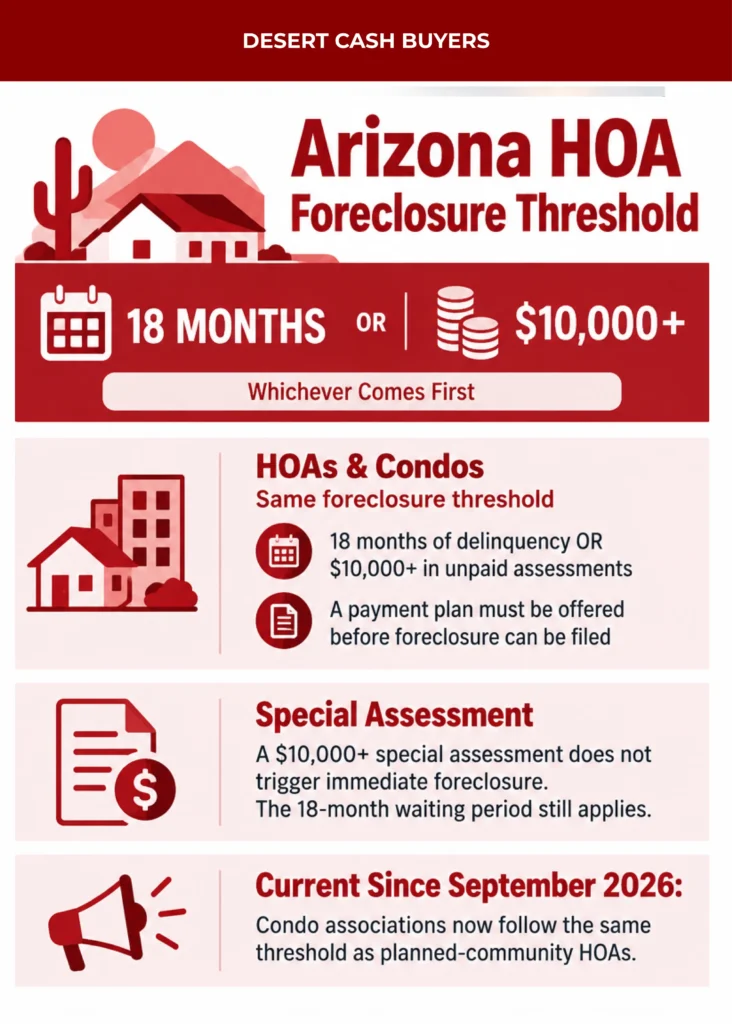
Arizona bars foreclosure until you are delinquent for 18 months or owe $10,000 or more in assessments, whichever comes first. That rule now covers condominiums as well as planned communities, and the two systems finally match.
This was not always true. Two different pieces of legislation got Arizona here, on two different timelines.
| Association Type | Threshold Before the Change | Threshold Now | Effective Date |
| Planned community (HOA) | 12 months or $1,200 | 18 months or $10,000 | September 26, 2025 |
| Condominium (COA) | 12 months or $1,200 | 18 months or $10,000 | September 12, 2026 |
SB 1494, signed in 2025, raised the planned-community threshold first. SB 1246 followed in 2026 and aligned condominiums with the same standard. Both bills also require the association to make a reasonable effort to communicate with you and offer a payment plan before it can file a foreclosure lawsuit.
What Changed on September 12, 2026
If you own a condominium, this is recent enough that a lot of published advice online still describes the old $1,200 and one-year rule. That rule no longer applies. As of September 12, 2026, your condo association faces the same 18-month or $10,000 bar a planned-community HOA does.
The change also added a special assessment rule that applies to both HOAs and condos. If a single special assessment starts out at $10,000 or more, the association cannot use the dollar threshold to foreclose right away. It has to wait for the 18-month delinquency clock instead. This closes a gap that let associations move faster against homeowners hit with one large, unexpected charge.
Whichever type of association you belong to, confirm your declaration with the Maricopa County Recorder and check the current statute language before assuming which threshold applies. Association bylaws and amendments can still vary, and this is general information, not legal advice for your specific account.
What Actually Counts Toward the Threshold
Only the unpaid assessment or portion of an assessment is used to determine whether the account has reached the $10,000 foreclosure threshold. Other amounts, such as authorized late-payment charges, reasonable collection costs, and qualifying attorney fees, can still be part of the association’s lien or overall balance, but they do not substitute for the unpaid assessment amount needed to trigger foreclosure under the statute.
Assessments vs. Late Fees, Interest, and Attorney Fees
Say your HOA statement shows a total balance of $10,400. That number alone might look like you have crossed the line. But if only $6,200 of that total is unpaid regular and special assessments, and the rest is late fees, interest, and legal costs the association added during collections, your account has not actually reached the threshold. This is an illustrative example with round numbers, not a real account.
Attorney fees and collection costs can still be added to the lien and secured against your property. An association can pursue you for the full balance. Those extra charges just cannot be counted toward the trigger that allows foreclosure in the first place.
Fines work differently than assessments, too. If your association fines you for a rules violation, like an unapproved paint color or a parking issue, that fine is not a common expense lien and does not fall under the foreclosure statute. An association can still sue you personally to collect a fine, but fines do not feed the $10,000 or 18-month threshold, and they cannot be the basis for a lien foreclosure under A.R.S. § 33-1807 or § 33-1256.
How Long Does an HOA Have to Act on a Lien?
An association’s common expense lien does not last forever. Under both statutes, the lien is extinguished if the association does not start proceedings to enforce it within six years after the full assessment amount became due. Miss that window, and the lien loses its legal force, even though the underlying debt may still be collectible in other ways.
This deadline does not erase what you owe. Your association can generally still sue you personally for the money. But once the six-year lien clock runs out, it loses its ability to force a sale over that specific assessment. This is one more reason a delinquency notice, however alarming, is not the same as an imminent forced sale. There is real time built into this process at almost every stage.
Where an HOA Lien Sits Behind Your Mortgage and Tax Liens
An HOA lien is subordinate to your recorded first mortgage or deed of trust and to property tax liens. The association gets paid after those senior claims, not before them.
At a closing or a forced sale, proceeds pay off liens in order of priority. Property taxes come first. Your first mortgage or deed of trust usually comes next, assuming it was recorded before the HOA lien attached. The HOA or condo lien sits behind both. See our breakdown of how all lien types get paid at closing for the full priority order across tax liens, HOA liens, contractor liens, and judgment liens.
An HOA or condo lien is only one type of lien that can attach to an Arizona home. Property tax liens, contractor and mechanic’s liens for unpaid work, judgment liens from a lawsuit, and IRS liens for unpaid federal taxes can all show up on the same title, each with its own priority rules. An HOA lien does not erase or outrank any of these. They can all exist on the same property at once, each waiting in line for its share of the proceeds at a sale.
This priority order matters for a practical reason. If a forced sale would not generate enough money to reach the HOA after the mortgage and taxes are paid, the association has little financial incentive to push all the way through foreclosure. That does not mean it will not file. It means the numbers often work against a full foreclosure, especially on a property with a typical amount of mortgage equity.
What Happens If Your HOA Actually Files for Foreclosure
If your account crosses the threshold and a payment plan offer has failed, the association can sue you in Arizona Superior Court. HOA and condo lien foreclosures are always judicial. There is no fast, non-judicial trustee sale the way there is for a typical mortgage default in Arizona.
The Judicial Foreclosure Process, Step by Step
| Step | What Happens |
| 1. Delinquency notice | The association sends the required written notice by certified mail, return receipt requested, at least 30 days before authorizing an attorney or qualifying collection agency to begin collection activity. |
| 2. Payment plan effort | The association must make reasonable efforts to communicate with the owner and offer a reasonable payment plan before filing a foreclosure action. |
| 3. Lawsuit filed | If the statutory foreclosure threshold is met and the matter is not resolved, the association can file a foreclosure action. |
| 4. Court judgment | The court determines the association’s rights and, if foreclosure is granted, enters the judgment needed to proceed with the sale. |
| 5. Sheriff’s sale | The property can then be sold through the judicial execution process, subject to the rights and priority of senior liens. |
A sheriff’s sale is not automatically the end of the story, either. Any money the sale generates above what is owed to the association, after senior liens like the mortgage and property taxes are paid, is generally owed back to you as the former owner, though the exact mechanics depend on your case. If the sale does not cover the full judgment, the association may be able to pursue you personally for the difference. A judgment itself can also affect your credit and appear in public records before any sale happens. None of this is guaranteed to unfold the same way in every case, which is exactly why a real delinquency notice is worth acting on early rather than waiting to see what happens.
This process routinely runs months, sometimes well over a year, once a case is filed, depending on the county court calendar and whether you contest it. Confirm current timelines with an Arizona attorney or the Maricopa County Superior Court before assuming a specific number of days or months applies to your case.
HOA Foreclosure vs. Mortgage Foreclosure in Arizona: What’s the Difference?
An HOA foreclosure and a mortgage foreclosure in Arizona are not the same process, and mixing them up causes a lot of unnecessary panic. Most Arizona mortgage foreclosures are non-judicial. The lender’s trustee records a notice of trustee’s sale and can sell the home at auction without ever filing a lawsuit or getting a judge’s signature. An HOA or condo lien foreclosure cannot use that shortcut. It always requires a lawsuit, a hearing, and a judge’s signed judgment before any sale can happen. That judicial requirement is one of the biggest practical protections built into Arizona’s HOA and condo lien law.
| Mortgage Foreclosure | HOA or Condo Lien Foreclosure | |
| Process | Non-judicial (trustee sale) | Judicial (lawsuit required) |
| Who authorizes the sale | Trustee, no court needed | A judge, after a lawsuit |
| Typical trigger | Missed mortgage payments | 18 months or $10,000 in unpaid assessments |
| Notice used | Notice of trustee’s sale | Certified-mail delinquency notice, then a lawsuit |
Your Options Before It Gets That Far
A notice of delinquency is a warning, not a done deal. You have real options, and selling is only one of them.
- Ask for the payment plan you are owed. The association must offer a reasonable one before it can sue, and many homeowners never ask what “reasonable” means for their specific balance.
- Dispute inaccurate charges. If you believe fees, fines, or the assessment total are wrong, the Arizona Department of Real Estate’s HOA dispute process gives you a hearing before an administrative law judge, outside civil court.
- Pay down the assessment portion. Since late fees and interest do not count toward the $10,000 trigger, paying down the underlying assessments can pull your account back under the threshold even if the total balance still looks high.
- Refinance or borrow against equity, if your mortgage situation allows it, to clear the balance in one payment.
- Sell the property. The lien comes out of your proceeds at closing rather than something you have to clear beforehand.
If an HOA lien is not your only challenge, our guide to selling a house fast in a difficult Arizona location covers other situations that complicate a sale.
Can You Sell a House With an HOA Lien in Arizona?
Yes, you can sell a home with an HOA lien attached in Arizona. The lien comes out of your proceeds at closing, not something you have to clear before you list or accept an offer.

Every closing we handle runs through a licensed, independent Arizona title company, with funds held in escrow until closing. The title company identifies every lien on the property, including an HOA or condo lien, and pays it directly from the proceeds in the correct priority order. You do not write a separate check to the association.
Here is an illustrative example, with round numbers, not a promise for your property. Say a home is worth $380,000 and carries a $220,000 mortgage balance and a $9,500 HOA lien. At closing, the mortgage and the HOA lien are both paid from the sale proceeds before you receive the remainder. The exact numbers on your home depend on your mortgage payoff, any tax liens, and the condition of the property, which is why we show you the actual comps and payoff figures behind any offer rather than asking you to take a number on faith.
If a traditional listing feels out of reach while a lien is attached, a direct sale skips the repeated public showings to strangers that a listing usually requires. We evaluate your property by phone or with a single private visit, and you are never asked to stage it or clear out for a stranger’s open house. See how our process works, from first call to closing day, and see our Phoenix-area service details if your home is inside the city itself.
We have served Arizona home sellers since 2015, more than 10 years now, and sellers rate us 4.9 out of 5 based on 1,245 verified reviews. Read seller stories on our site. Learn more about our team and how we evaluate a property.
Frequently Asked Questions About HOA Foreclosure in Arizona
If you are dealing with an HOA delinquency, lien, or foreclosure notice, the answers below cover the questions Arizona homeowners most often have about the process, payment plans, liens, and selling a property with HOA debt.
What’s the difference between an HOA lien and an HOA foreclosure?
A lien is a legal claim against your property for unpaid assessments. It attaches automatically and does not force a sale by itself. Foreclosure is the legal action an association can take to force a sale to collect on that lien, and it only becomes available once you cross the 18-month or $10,000 threshold.
How many months behind can I be on HOA dues before foreclosure in Arizona?
Up to 18 months, or until your unpaid assessments reach $10,000, whichever happens first. Both thresholds apply the same way to planned communities and, as of September 12, 2026, to condominiums.
Does an HOA lien show up on a title search?
Yes, in most cases. Even though the lien attaches automatically by law, associations commonly record a Notice and Claim of Lien with the county recorder, which a title search will surface during a sale or refinance.
Can I sell my house if I have an HOA lien in Arizona?
Yes. See the full explanation above under “Can You Sell a House With an HOA Lien in Arizona.” In short, the lien does not block a sale, since it is paid at closing in priority order behind your mortgage and any tax lien.
Is a condo association held to the same rules as an HOA in Arizona?
Now, yes. Condominium associations operated under a lower one-year or $1,200 threshold until September 12, 2026. Since then, both condo and planned-community associations follow the same 18-month or $10,000 standard.
Can my HOA restrict my access to community amenities before foreclosing?
Often, yes. Many governing documents let an association suspend privileges like pool, clubhouse, or gate access for a delinquent account. That is separate from foreclosure and usually happens much earlier. Check your specific community documents, since rules vary by association.
Does an HOA have to offer a payment plan before foreclosing?
Yes. Arizona law requires the association to make a reasonable effort to communicate with you and offer a payment plan before it can file a foreclosure lawsuit, for both planned communities and condominiums.
HOA Foreclosure in Arizona Comes With Real Guardrails
If an HOA lien is keeping you from moving forward with a sale, the important thing is to understand the actual balance, the assessment dates, the association’s collection activity, and the liens that may have priority over it. A foreclosure notice does not automatically mean your home will be sold, and Arizona law requires specific steps before an association can pursue a foreclosure sale.
If selling is one of the options you are considering, you can sell your house fast with an HOA lien in Arizona and review how lien payoffs can be handled through closing. If you want to explore a direct sale, get your free cash offer and see what the numbers look like for your property. This article is general information about Arizona law, not legal advice. Confirm how these rules apply to your specific account with a licensed Arizona attorney or the appropriate Arizona government office.
This article is general information about Arizona law, not legal advice. Confirm how these rules apply to your specific account with a licensed Arizona attorney, the Maricopa County Recorder, or your association’s governing documents.