
If you’re searching for a legitimate cash home buyer in Arizona, you’ve probably already seen the flood of “we buy houses” signs stapled to telephone poles in Phoenix, postcards promising an instant offer on your Mesa home, or texts from numbers you don’t recognize. With so many companies advertising cash offers, it’s important to know how to separate legitimate buyers from wholesalers and scams. Some cash buyers are genuine, well-funded companies that close in days using their own money. Others are wholesalers with no funds of their own, or scammers looking for upfront fees or contracts that unfairly lock sellers into an agreement. Before you hand over your address, your signature, or your trust, it helps to know exactly what separates a real Arizona buyer from a risk, starting with how our own process for sellers who want to sell your house fast for cash in Arizona works.
A legitimate cash home buyer in Arizona proves it with real proof of funds, a licensed Arizona title company at closing, no upfront fees, and a written offer you’re free to walk away from. Scammers push you to sign fast or ask for money before closing. If a buyer can’t answer those points plainly, that’s your answer.
- Ask for proof of funds in writing before you sign anything.
- A real buyer closes through a licensed Arizona title company, never a private “escrow.”
- No legitimate cash buyer charges a fee to make or close an offer.
- Wholesalers assign your contract to someone else; direct buyers close with their own money.
- Check a buyer’s BBB profile and recent Google reviews before you commit to anything.
How to Spot a Legitimate Cash Home Buyer in Arizona
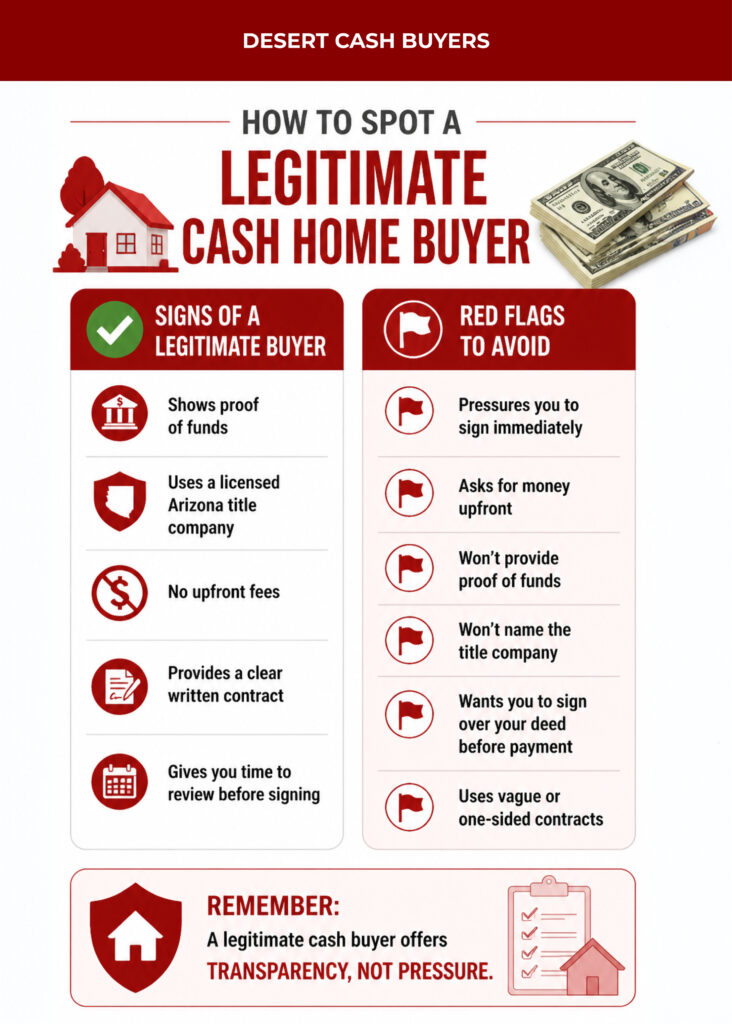
A legitimate cash home buyer in Arizona will show you proof of funds, name the title company handling your closing, and put every term in a contract you can read in full before you sign, with no pressure to decide on the spot.
We’ve purchased more than 1,000 Arizona homes this way, direct buyer to seller, with private funds and no assignment games. Our reviews average 4.9 out of 5, and you can often get a cash offer within 15 minutes of telling us about the property, all without paying us a dollar in fees. That combination- proof up front, a named title company, and speed without pressure- is what a legitimate buyer looks like in practice, not just on a website. You can see the full picture of how we buy houses in Arizona before you compare us to anyone else, or see the exact steps we follow after you accept on our how it works page.
Quick checklist for any buyer you’re considering:
- A proof of funds document, shown on request
- A named, licensed Arizona title company
- A real business address and a phone number that’s actually answered
- Zero fees requested at any point in the process
- A contract you can read in full, with time to think before you sign
Red Flags of a Cash Home Buyer Scam
As Arizona homes spend more time on the market, with a statewide median of 65 days on the market as of June 2026 according to Redfin, more homeowners are exploring cash sales for speed and certainty. Unfortunately, that increased demand also creates opportunities for dishonest buyers and scams, making it even more important to recognize the warning signs before signing any agreement.
The clearest sign of a cash home buyer scam is pressure: to sign today, to skip reading the contract, or to send money before anyone sends you any.
- Pressure to decide today, or “the offer disappears.” A real cash offer can wait a day or two for you to read it closely.
- Any request for money upfront. If a buyer asks you to pay an application fee, a processing fee, or an “unlock” fee before closing, that’s a scam, full stop.
- No proof of funds when you ask. A cash buyer with real money will show it. Hesitation is your answer.
- A vague or unnamed title company. Every legitimate Arizona closing runs through a licensed title company you can call and confirm.
- A contract with no expiration date, or one that locks you in for months with no way out.
- Any request to sign your deed over before you’re paid. Ownership should move at closing, once funds are in your hands, never before.
The Federal Trade Commission’s guidance on avoiding scams flags this same pattern across industries: high-pressure tactics and any request for money in advance are the two most reliable warning signs of fraud.
Watch for the same pressure in smaller forms, too. A buyer who won’t put an offer in writing, who calls repeatedly instead of answering a single email with real answers, or who name-drops a closing date before ever seeing the property, is leaning on urgency instead of substance. A legitimate cash offer holds up whether you look at it today or after you’ve slept on it.
Green Flags: Signs of a Trustworthy Buyer
A trustworthy cash buyer answers the hard questions plainly and puts the answers in writing before you ever sign.
- Offers proof of funds without you having to ask twice
- Names the Arizona title company handling your closing, by name
- Has a real local address and a phone number that connects to an actual person
- Explains how the offer was calculated instead of just stating a number
- Never asks for a fee, at any stage, for any reason
- Gives you a clear timeline and an honest way to back out before closing
None of these signs are hard to spot once you know to look for them, and a company with nothing to hide will never make you dig for them.
This matters most for sellers in a harder situation, someone weighing a fire-damaged house or trying to sell a house fast in Mesa with a tenant who won’t leave, because that’s exactly when pressure tactics show up hardest. A legitimate buyer treats a hard situation as a reason to slow down and explain, not to rush.
Direct Buyers vs. Wholesalers (Why It Matters)
The difference between a direct buyer and a wholesaler is whose money is actually behind your offer, and that difference decides whether your sale actually closes.
A direct buyer, like Desert Cash Buyers, uses its own private funds to purchase your home and close through a licensed Arizona title company. A wholesaler puts your house under a purchase contract, then tries to resell, or “assign,” that contract to a different investor for a fee. If no one buys the assignment, the deal can fall apart weeks after you thought it was done, and you’re back where you started, often having already turned down other offers.
| Factor | Direct Cash Buyer | Wholesaler |
| Who provides the funds | The company’s own private funds | No funds; the contract is resold to another investor |
| Offer reliability | The offer is the offer, backed by cash on hand | Depends on finding a buyer for the contract |
| Closing certainty | No financing contingency; closes on the agreed date | Can fall apart if no assignee is found |
| Who closes the sale | Same company from offer to closing | Often a stranger you never vetted |
How a direct buyer uses private funds
A direct buyer doesn’t need a lender’s approval or another investor’s cash, so there’s no financing contingency that can kill the deal at the last minute. That’s also why sellers often compare selling a Phoenix home without a realtor to selling directly to a cash buyer: both skip financing risk, but only a direct buyer skips the wholesaler’s middle step, too. The offer you sign is the offer that closes, because the same company holds the funds the entire time.
How wholesaling contracts work, and where sellers get stuck
A wholesaler’s contract often includes broad exit clauses that let the wholesaler walk away for almost any reason, while the seller has no matching way out. Some contracts run for months with no expiration date, which means you can’t legally accept another offer even after the wholesaler has gone quiet. None of that makes wholesaling illegal in Arizona, but it does mean the person signing your paperwork may not be the one who ends up buying your house. Arizona doesn’t require wholesalers to register or hold a license the way a handful of other states now do, so the burden of vetting the buyer falls more on you as the seller than it would elsewhere. That’s one more reason to ask who is actually funding your offer before you sign, not after.
Questions to Ask Before You Sign
Ask these six questions before you sign anything, and a legitimate buyer will answer every one without hesitation.
- Can you show me proof of funds for this specific offer?
- Which licensed Arizona title company will handle my closing?
- Will your company actually buy my house, or will the contract be assigned to someone else?
- Are there any fees, at any point, for any reason?
- What happens if I need to back out before closing?
- How did you calculate this offer?
Once you’ve asked those six questions, compare the answers against other ways to sell a house for cash in Arizona, and ask us for a transparent, no-obligation cash offer. We’ll walk you through the same numbers before you sign anything, and you’ll never owe us a fee to hear them.
How to Verify a Cash Buyer in Arizona
Verify a cash buyer in Arizona with five checks you can finish in under twenty minutes, before you ever agree to a showing.
- Search the company name plus “scam,” “complaint,” or “review” and read what comes up, good and bad.
- Look up the company’s Better Business Bureau profile for accreditation status and complaint history.
- Read recent Google reviews, not just the star average, and look for details that match a real transaction.
- Ask for proof of funds and the name of the Arizona title company, then confirm both are real.
- Confirm a physical Arizona address and a working phone number, and call it before you sign anything.
None of these checks require special tools or a professional’s help. A search engine, a phone, and twenty minutes are enough to separate a buyer worth talking to from one worth ignoring.
Checking proof of funds and title company details
Proof of funds is usually a bank statement or a signed letter showing the money is available right now, not a promise it will be. A title company can be confirmed with a quick search of the Arizona Department of Insurance and Financial Institutions, which licenses title insurers and agents in the state, or with a direct call to the office named in your contract. If a buyer hesitates on either, treat that as the same red flag it would be anywhere else. A licensed title company also matters because it, not the buyer, is the one who runs the title search, clears any liens, and holds the closing funds until everything checks out, so a buyer who avoids naming one is avoiding the one neutral party in the deal. You can see how these pieces fit together across Arizona cash home buying options before you decide who to work with.
| We’ll hand over our proof-of-funds letter, the licensed Arizona title company we close through, and real seller references before you sign a single page, no exceptions. Desert Cash Buyers is also a BBB Accredited Business with an A+ rating, which you’re welcome to verify independently before you ever pick up the phone. |

Frequently Asked Questions about Vetting Cash Home Buyers in Arizona
These are the questions Arizona sellers ask us most before working with a cash buyer; for more, see our Arizona home selling blog or read verified reviews from Arizona sellers.
What is proof of funds and why ask for it?
Proof of funds is a bank statement or signed letter showing a buyer already has the money to close, without a loan or another investor. Asking for it protects your time, because a buyer who can’t produce it may not be able to close at all, no matter how confident the offer sounds. A legitimate buyer treats the request as routine, not as an insult, and can usually provide it the same day you ask.
Is “we buy houses” a scam?
Not on its own. Plenty of “we buy houses” companies, including direct buyers like us, are legitimate and close on time with private funds. The label alone tells you nothing, though, since anyone can print a sign or run an ad, so verify each specific company with the same checks you’d use for any large transaction: proof of funds, a named title company, and a real address you can confirm.
Should a legit buyer charge me any fees?
No. A legitimate direct buyer covers standard closing costs and never charges the seller a fee to make an offer, process paperwork, or close. If a fee comes up at any stage, before, during, or after the offer, that’s a scam signal, not a normal cost of doing business, and it’s reason enough to walk away.
How do I check a buyer’s reputation?
Check the buyer’s Better Business Bureau profile, read recent Google reviews for specific transaction details rather than just the star average, confirm proof of funds, and verify a real Arizona address and phone number. Together, those four checks cover almost every scam pattern Arizona sellers report, and take less time than a single showing.
Is Desert Cash Buyers BBB accredited?
Yes. Desert Cash Buyers holds BBB Accreditation with an A+ rating. You can verify this directly on the BBB’s website, and we’d encourage you to check any buyer’s BBB status the same way before signing anything.
Do cash home buyers put down earnest money?
Some direct cash buyers put down earnest money as a show of good faith, though because these sales close so quickly, many skip it since a deposit period doesn’t have much time to matter. What protects you either way is proof of funds and a named title company handling the closing. If a buyer asks you, the seller, to pay a deposit of any kind, that’s not earnest money; that’s a red flag.
Can I have an attorney review the contract before I sign?
Yes, and a legitimate buyer will never discourage it. Arizona doesn’t require an attorney for a residential closing; a licensed title company handles that, but you’re always free to have a real estate attorney review your contract first. If a buyer pressures you to skip that step, treat it the same as any other red flag.
Choosing a Legitimate Cash Home Buyer in Arizona
Choosing a legitimate cash home buyer in Arizona comes down to the same handful of checks every time: proof of funds, a named title company, zero fees, and a contract you have time to actually read. Be candid with yourself, too, that any cash offer will land below full retail; a legitimate buyer explains that honestly, basing the number on the home’s After Repair Value and covering your closing costs, rather than dressing it up as something it isn’t. Run through the checklist once, and the difference between a company you can trust and one you should walk away from usually becomes obvious within a single phone call.
If you’d like to compare a transparent offer against everything above, get a no-obligation cash offer from our team. We’ll give you a fair cash offer fast, close in as few as 3 days, with most sales closing in 7 to 14 days, and never charge a fee, and you’ll pick the closing date either way. Ask us the six questions above first; we’d rather earn the sale than rush it.